
The Nagano Family Robbery-Murders
Three members of a business group chairman's family were killed in Nagano on 24 March 2010, and about ¥4.16 million was taken. Four defendants received sharply different sentences: two death sentences, one life sentence and an 18-year prison term, reflecting their individual roles.
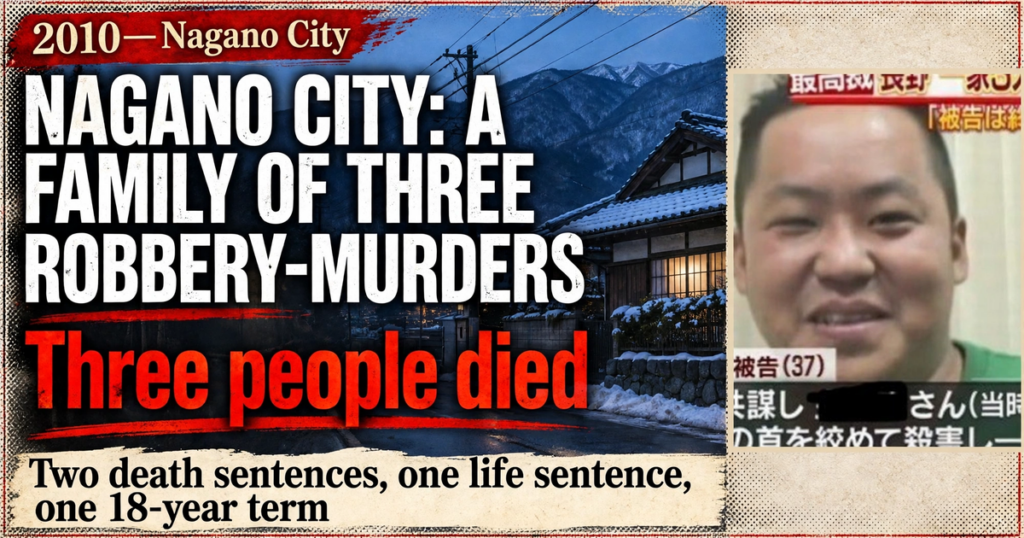
Three family members were killed and about ¥4.16 million was taken
On 24 March 2010, three members of a business group chairman's family were killed at the chairman's home in Nagano City. The victims were the chairman, aged 62, his 30-year-old eldest son, and the son's 26-year-old wife. Approximately ¥4.16 million in cash was taken. The bodies were transported to a materials yard in Aichi Prefecture and buried. Four men were prosecuted in connection with the crimes, but their sentences differed substantially. Kazushi Ito and Tomohiro Matsubara received death sentences, Kaoru Ikeda received life imprisonment, and Hideki Saita received a term of 18 years. The differences arose from the courts' assessments of each man's participation, planning and purpose.
The plan initially focused on the chairman and his eldest son
According to the Supreme Court findings described in the Japanese source, Ito and others planned to kill the chairman and his eldest son, who was an executive in the business group, and take cash. On the day of the offence, the son was given food containing a sleeping medication and became unconscious. The plan changed when the son's wife became suspicious. She was strangled with a rope. The unconscious son and the chairman, who was asleep, were then killed. The wife was not part of the original plan as described by the court; her killing followed her discovery of the suspicious situation. The three deaths were therefore not simply the execution of an unchanged plan.
The bodies were moved and buried in Aichi Prefecture
After the killings, the defendants removed the three bodies from the Nagano home and transported them to a materials storage site in Aichi Prefecture, where they were buried. The post-offence handling of the bodies formed part of the prosecution case and the courts' assessment of the participants' roles. The cash taken from the home was approximately ¥4.16 million. The courts examined how the plan was developed, how additional participants were brought in, who carried out the killings, and who helped conceal the crime. These distinctions later became central to the different sentences imposed on the four defendants.
Ito was found to have led the plan from beginning to end
The Supreme Court's review of Ito's case described him as the person who proposed killing the chairman and his son and taking the money. He brought other participants into the plan in stages and arranged practical preparations. When the son's wife became suspicious on the day of the killings, Ito decided that she too should be killed, summoned another participant and took part in the killing. He also participated in disposing of the bodies. The Supreme Court described Ito as having led the offence throughout. The court considered background evidence that he had worked while living at the chairman's home and had been subjected to harsh treatment, threats and long hours. It nevertheless found that those circumstances did not justify the murders.
Matsubara was treated as a central participant from the planning stage
Matsubara was involved from an early stage and served as Ito's adviser during the preparation. The Supreme Court found that he also personally took part in killing two of the victims and played an important, indispensable role in carrying out the plan. His first-instance death sentence was maintained by the Tokyo High Court. On 2 September 2014, the Supreme Court dismissed his appeal and upheld the death sentence. The defence argued that Matsubara had lived under pressure and financial control by the victims and had been in a subordinate position. The Supreme Court considered those circumstances but concluded that his early participation, practical role and direct involvement in the killings made his responsibility extremely serious.
Ikeda joined on the day and his sentence was reduced to life imprisonment
Ikeda was called to the scene on the day of the killings. He was found to have participated in the killing of the eldest son's wife and the son. Unlike Ito and Matsubara, however, he had not been involved in developing the plan from the beginning. The Tokyo High Court treated that difference as important. Although his participation in the deaths was serious, the court found that his level of planning and his intention to obtain the stolen money were materially different from those of Ito and Matsubara. It set aside the first-instance death sentence and imposed life imprisonment. The Supreme Court dismissed Ikeda's appeal on 9 February 2015, making the life sentence final.
Saita was convicted as an aider, not a principal in the robberies and murders
Saita's role centred on transporting and handling the bodies after the killings. The first-instance court had sentenced him to 28 years in prison. The Tokyo High Court, however, concluded that he had not jointly carried out the three robbery-murders as a principal offender. It treated him as an aider whose conduct assisted the crimes, rather than as a joint principal in the killings. The sentence was reduced to 18 years. The Supreme Court dismissed his appeal in September 2013, and the 18-year term became final. Assistance after the killings may still attract serious criminal liability, but it is not automatically equivalent to jointly committing the murders.
The four sentences show why accomplice liability must be examined individually
Ito and Matsubara were involved from the planning stage and played major roles in the killings. Ikeda joined later and had a different degree of planning and financial purpose. Saita's participation was evaluated as assistance in the disposal of the bodies rather than joint execution of the murders. The resulting sentences—death for two defendants, life imprisonment for one and 18 years for another—were not based merely on whether each man was part of the same group. They reflected findings about what each person knew, planned, intended and did. The cases proceeded separately, so each sentence became final on a different date.
The proceedings also tested the review of jury-trial death sentences
The Matsubara case was among the early important examples in which the Supreme Court reviewed a death sentence imposed by a lay-judge trial. The Supreme Court rejected constitutional challenges to the lay-judge system and the death penalty, then examined the concrete conduct and role of the defendant. It upheld the death sentence because of Matsubara's early involvement and direct participation. Ikeda's case went in the opposite direction at the appellate level: the Tokyo High Court set aside the lay-judge court's death sentence and substituted life imprisonment. The contrast shows that Japanese appellate courts can review whether a death sentence is justified by the individual defendant's role.
The final outcomes must not be collapsed into a single group sentence
The final legal outcomes were two death sentences for Ito and Matsubara, life imprisonment for Ikeda, and 18 years for Saita. Ito's death sentence was upheld by the Supreme Court on 26 April 2016. Matsubara's death sentence was upheld on 2 September 2014. Ikeda's life sentence became final after the Supreme Court dismissed his appeal on 9 February 2015. Saita's 18-year term became final in September 2013. The source article does not establish that the death sentences have been carried out; this translation records the final sentences without describing either man as executed.
Original Japanese record: 長野市一家3人強盗殺人事件|死刑2人・無期1人・懲役18年に分かれた共犯4人の裁判
Last updated:
Related articles
Case record
The Kanie Family Three-Person Attack
Case record
The Hekinan Pachinko-Manager Couple Murders: Preserved DNA Evidence and Three Different Outcomes
Case record
The Sakai Serial Robbery-Murders: Two Planned Killings and a Death Sentence Confirmed

Case record