
The Hekinan Pachinko-Manager Couple Murders: Preserved DNA Evidence and Three Different Outcomes
Mr. Ma and his wife Mrs. Ma were killed in their Hekinan home between June 28 and 29, 1998. Their two young sons were present but survived. Three men were arrested in 2012 after preserved scene material, including saliva DNA, was re-examined. Hori received a final death sentence, while Sato and Hayama received life imprisonment. Hori's separate 2006 attempted robbery-murder was also considered in his sentencing.
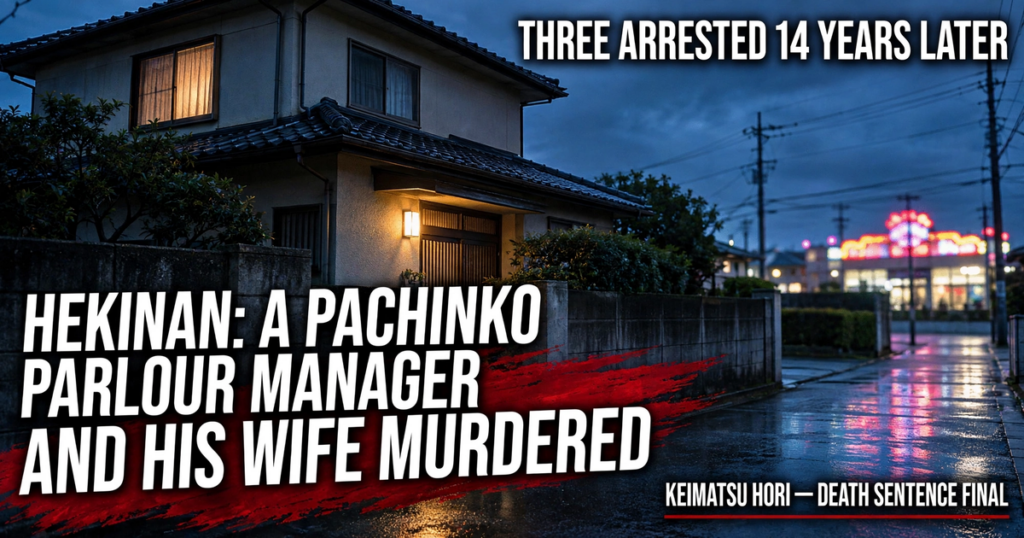
A couple were killed in their Hekinan home
Between June 28 and 29, 1998, Mr. Ma, aged 45, and his wife Mrs. Ma, aged 36, were killed at their home in Hekinan, Aichi Prefecture. The husband worked for a company operating pachinko parlours. The couple's two young sons were also in the house, but they were not killed. The case therefore involved two adult deaths and two surviving children. It is important not to describe the incident as a murder of all four members of the household. The victims' home was targeted because the offenders believed that the husband's employment might provide access to the keys and cash at the pachinko business.
The intended target was the business's cash and keys
According to the Supreme Court judgment as summarized in the archive, Hori planned to take the key to the pachinko parlour where Mahyō worked and steal the money kept there. He recruited two associates and made inquiries about Mahyō's family circumstances before the group went to the home. The plan was directed at obtaining access to the business's money; the evidence did not establish that the murder of the couple had itself been planned in advance. That distinction later mattered to the sentencing analysis. It does not reduce the seriousness of the deaths, but it is necessary to explain how the courts characterized the original purpose and the use of lethal violence.
The offenders entered by giving a false explanation
On the evening of June 28, 1998, the three men went to the house and used a false story, including a claim that they were being pursued by gangsters, to gain entry. Mrs. Ma and the two children were at home. The Supreme Court found that the intruders knew that members of the household were present. Mrs. Ma was strangled with a cord-like object and died of suffocation. The offenders searched the house. When Mr. Ma returned, he was attacked from behind and strangled as well. The children survived, but they lost both parents in the same incident.
Money was taken and the bodies were found in Takahama
After killing the couple, the offenders took approximately 60,000 yen and other property. Their bodies were discovered several days later in neighbouring Takahama City. The initial purpose had been to obtain the key to the pachinko parlour and access its cash, but the plan ended with the deaths of both adults in the household. The Supreme Court did not find that the killings had been planned from the outset. It did, however, find that the defendants used lethal force with strong intent to kill in order to carry out the robbery. This distinction between a planned robbery and killings committed in its execution should be maintained in the English account.
Preserved material allowed the investigation to move forward fourteen years later
The case remained unsolved for many years. Material collected from the home in 1998 had been preserved. Later DNA testing of saliva traces provided an important lead, connecting the evidence to Hori and helping investigators identify the other participants. The passage of fourteen years did not mean that the evidence had been newly created; it was the later examination of material retained from the original scene that advanced the case. DNA evidence was a key investigative development, but it was not the entire prosecution case. Investigators also examined relationships, statements and other evidence before bringing charges.
Three men were arrested and charged in August 2012
On August 3, 2012, Aichi Prefectural Police arrested Hori, Sato and Hayama on suspicion of robbery-murder. The three were later indicted. At the time, Hori had recently received a final life sentence in the separate 2007 Nagoya Internet-dating-site murder case. That prior case was not the Hekinan murders; it was a separate conviction that became relevant to his background. The distinction matters because the Hekinan prosecution concerned conduct in 1998, and the three men were tried for their respective roles in that incident.
The courts assessed each defendant's responsibility separately
The three defendants did not receive identical sentences. Sato was sentenced to life imprisonment by the Nagoya District Court on February 5, 2016, and he did not appeal, so that sentence became final. Hayama received life imprisonment from the same court on March 25, 2016; the sentence was upheld on appeal and his final appeal was dismissed by the Supreme Court. Hori's case also included a separate July 2006 attempted robbery-murder. He and an associate had disguised themselves as workers conducting a routine inspection, entered a woman's home and attempted to strangle her. The woman survived with injuries. This additional offence was considered in Hori's sentencing, not treated as another death.
Hori's death sentence became final in July 2019
The Nagoya District Court sentenced Hori to death on December 15, 2015. The Nagoya High Court dismissed his appeal on November 8, 2016. On July 19, 2019, the Supreme Court's Second Petty Bench dismissed his final appeal and upheld the death sentence. The Supreme Court emphasized Hori's leading role in planning the robbery, his active participation in the killings and his involvement in the separate 2006 attempted robbery-murder. It also considered factors favourable to him, including that the murders had not been planned in advance and his age at the time, but concluded that the consequences were sufficiently grave to justify death. This was the finalization of a sentence, not an announcement of an execution.
The significance of the case lies in evidence preservation and individual liability
The Hekinan case demonstrates why physical evidence must be preserved even when an investigation has stalled. Material collected in 1998 could still be examined with later DNA methods and used to reopen investigative avenues. It also shows why the criminal responsibility of co-defendants must be assessed individually. Hori's leadership and the additional 2006 attempted murder affected his sentence, while Sato and Hayama received life imprisonment. The two children who survived the 1998 attack remain part of the factual context, but their later private lives are not needed to explain the public legal record. The case's final outcomes are two deaths, two surviving children and three different defendants whose sentences became final through separate procedural paths.
Original Japanese record: 碧南市パチンコ店長夫婦殺害事件|14年後に3人逮捕、堀慶末の死刑確定まで
Last updated:
Related articles
Case record
The Nagoya Nishi Ward Housewife Murder: A 26-Year DNA Breakthrough and a Case Still Awaiting Trial
Case record
The Wanted Suspect in the 1999 Nagoya Pachinko Shop Robbery-Murder
Case record
The Nagoya Pregnant Woman Murder: A Surviving Newborn, Unanswered Clues and a 2003 Limitation Deadline
Case record