
The Kansai Cyanide Serial Murders
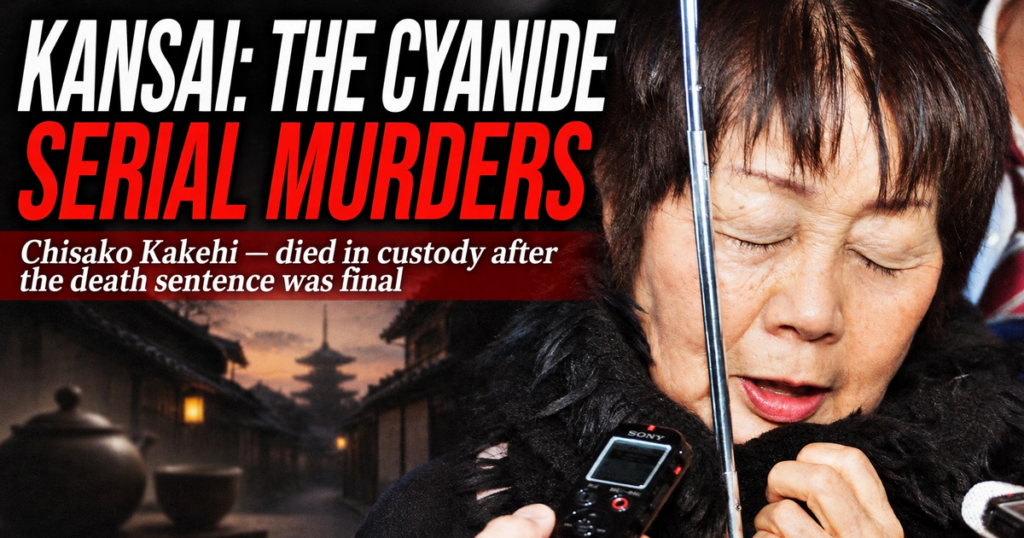
The criminal case against Chisako Kakehi covered four incidents between 2007 and 2013: three murders and one attempted robbery-murder. Her death sentence became final in July 2021. Kakehi died in Osaka Detention House on 26 December 2024 without the sentence having been carried out.
A husband's death led investigators back to earlier cases
On 28 December 2013, Yūo Kakehi, aged 75, collapsed at his home in Muko City, Kyoto Prefecture, and later died at hospital. A forensic examination detected a cyanide compound in his body. That finding prompted investigators to re-examine the deaths of men who had been connected with his wife, Chisako Kakehi, through marriage, relationships or financial dealings. The investigation expanded across Hyogo, Osaka and Kyoto Prefectures and ultimately produced a criminal case covering four incidents.
The indictment covered four incidents, not every suspicious death
The four incidents that formed the final criminal case occurred over approximately six years. They involved three men who died and one man who survived with serious neurological consequences. The charges were three counts of murder and one count of attempted robbery-murder. Reports and investigations discussed other deaths among men who had known Kakehi, but those matters must not be added to the convictions. The scope of the judgment is narrower and must remain distinct from the wider public discussion of suspicious deaths.
Suehiro survived the 2007 incident but suffered lasting impairment
The earliest incident in the case occurred in Kobe on 18 December 2007. Kakehi met Toshiaki Suehiro, a man who had lent her a substantial sum, and he later collapsed. The court found that she gave him a capsule containing a cyanide compound in order to avoid repaying a debt of approximately 40 million yen. Suehiro survived the poisoning but suffered severe after-effects, including hypoxic brain injury and higher brain dysfunction. He died in 2009 from another illness, so the charge in this incident was attempted robbery-murder rather than murder.
Honda's death in 2012 was initially treated as a sudden collapse
On 9 March 2012, Masanori Honda, aged 71, died after collapsing while travelling by minibike in Osaka Prefecture following a meeting with Kakehi. His death was initially regarded as possibly resulting from an acute medical event. Material from his body had been preserved, however, and investigators later arranged further testing after the cyanide finding in Yūo Kakehi's case. Cyanide was detected in the preserved specimen. The prosecution treated Honda's death as one of the murders committed by administering poison.
Hioki died in Hyogo in September 2013
Minoru Hioki, a man with whom Kakehi had a personal and financial relationship, died in Hyogo Prefecture in September 2013. His death became another part of the prosecution case after investigators identified cyanide poisoning as the common mechanism. The Japanese article notes that Kakehi later sought a retrial in relation to the Hioki incident. That later procedural challenge must not be confused with the original trial's findings or treated as an acquittal. The conviction for the murder remained part of the final judgment.
Her husband Yūo was the fourth incident in the indictment
The last incident occurred in December 2013, when Yūo Kakehi collapsed at home and died after being taken to hospital. The cyanide detected in his body was the trigger for the wider investigation. The court found that Kakehi had administered the poison to men who trusted her through intimate relationships or financial dealings. The incidents were not one continuous attack at a single place. They occurred at different times and locations, and the prosecution had to prove each count separately.
The prosecution case concerned poison and relationships of trust
The four victims had different relationships with Kakehi, but each had reason to trust her: one was a lender, others were partners or husbands. The prosecution argued that she exploited those relationships to get the men to ingest cyanide compounds. The Supreme Court later treated the abuse of trust as an important aggravating feature. The fact that the incidents involved a similar poison did not remove the need to prove the defendant's responsibility for each individual death or attempted killing.
Toxicological findings linked the incidents, but each count still required proof
The investigation did not rely on the fact that the men had known Kakehi. In Yūo's case, the forensic examination detected cyanide; the preserved specimen from Honda also tested positive. In the Suehiro incident, the court relied on evidence that he had been given a cyanide-containing capsule and on his neurological condition after the poisoning. The Hioki and Yūo incidents were assessed separately in the trial record. The common substance helped investigators identify a pattern, but the court still had to determine whether Kakehi had administered it in each case and whether the relevant offence was completed murder or attempted robbery-murder. The evidence supporting each individual conviction remained separately examinable. The courts assessed the four counts individually.
Dementia and the ability to stand trial were disputed
Kakehi's cognitive condition became a major issue during the proceedings. The defence argued that dementia affected her criminal responsibility at the time of the offences and her ability to understand and participate in the trial. These are separate legal questions. Criminal responsibility concerns whether a defendant could understand the nature and wrongfulness of conduct and control it at the time of the offence. Litigation capacity concerns whether the defendant can understand the proceedings and exercise the rights needed to defend herself.
The courts found criminal responsibility and upheld the death sentence
On 7 November 2017, the Kyoto District Court found Kakehi guilty of all four charged incidents and sentenced her to death. The court emphasised the financial purpose, the use of trust and the administration of a highly toxic substance. Kakehi appealed on the day of judgment. The Osaka High Court dismissed the appeal on 24 May 2019, and the Supreme Court dismissed her further appeal on 29 June 2021. The death sentence became final in July 2021.
Kakehi died in detention without execution
Kakehi died at Osaka Detention House on 26 December 2024, after her death sentence had become final but before it was carried out. A separate retrial request had been filed in 2022 concerning Hioki's death, with the defence arguing that he may have died from an underlying illness rather than cyanide poisoning. The Kyoto District Court rejected that request on 11 March 2024, and the defence filed an immediate appeal to the Osaka High Court. That appeal was still pending when Kakehi died. A death sentence, a final judgment and an execution are distinct events; the first two occurred, while the third did not. The application must be described as a challenge to the final conviction, not as a judicial finding that the conviction had been overturned.
Original Japanese record: 関西青酸連続殺人事件|4人への青酸投与、死刑確定から筧千佐子の拘置所内死亡まで
Last updated:
Related articles
Case record
The Suicide-Website Serial Murders
Case record
The Takashi Yamashita Sexual Assault Case: Online Recruitment, Coordinated Attacks and a 22-Year Custodial Sentence
Case record
The Greater Tokyo Suspicious Deaths: How Circumstantial Evidence Established Three Murders
Case record