
The Kabutoyama Case: A Nursery Teacher's 21-Year Trial and Three Acquittals
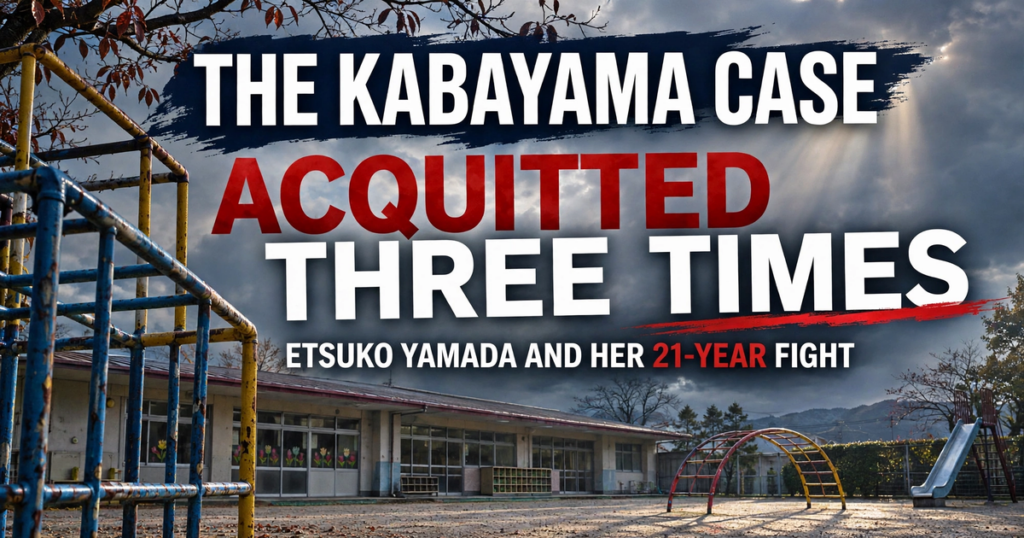
Two 12-year-old children disappeared at Kabutoyama Gakuen in Nishinomiya, Hyogo Prefecture, in March 1974 and were found dead in a purification tank. Nursery teacher Etsuko Yamada was suspected of killing the boy, initially released without prosecution, then re-arrested and tried after a prosecution review. After a first acquittal was overturned and the case remanded, a second acquittal was upheld by the Osaka High Court on September 29, 1999. The prosecution did not appeal, and her acquittal became final.
Two children disappeared at Kabutoyama Gakuen
In March 1974, two 12-year-old children at Kabutoyama Gakuen, a residential facility for children with intellectual disabilities in Nishinomiya, Hyogo Prefecture, disappeared within a short period. A girl went missing on March 17, and a boy disappeared on March 19. Late that night, both children were found dead in a purification tank on the grounds. The girl's death was treated as an accident, while the boy's death was investigated as a possible homicide. The difference in how the two deaths were treated shaped the investigation that followed.
A nursery teacher on duty became the principal suspect
Etsuko Yamada, then 22, was working at the facility as a nursery teacher and was on duty around the time of the boy's death. Police focused on her work schedule and statements attributed to children at the institution. She was arrested on April 7, 1974, on suspicion of murdering the boy. During questioning, she made statements that were interpreted as admitting involvement, but she later withdrew them and maintained that she was innocent. The investigation did not produce decisive physical evidence linking her to the killing.
The first investigation ended without an indictment
Yamada was released after the initial arrest and the Kobe District Public Prosecutors Office ultimately decided not to prosecute her because the evidence was insufficient. That decision brought the first criminal investigation to an end, but the case did not disappear. The boy's family challenged the decision, and the prosecution review process became part of the story. The question was whether the available evidence justified bringing Yamada before a criminal court, even though the first investigation had not produced a case that prosecutors considered sufficient for indictment.
A prosecution review led to a second arrest and indictment
Following an application by the boy's family, the Prosecution Review Commission issued a decision that the non-prosecution was inappropriate. The Kobe District Public Prosecutors Office reopened its investigation. In February 1978, Yamada was arrested again, and she was indicted the following month. The second prosecution transformed the case into a long-running trial. A separate perjury case involving a person who had provided an alibi also became entangled with the proceedings, making the evidentiary history more complicated.
The first trial ended in acquittal in 1985
On October 17, 1985, the Kobe District Court acquitted Yamada. The court examined the reliability of statements attributed to children at the institution, the circumstances in which those statements had been obtained and the reliability of Yamada's earlier statements during interrogation. It found that the evidence did not establish beyond reasonable doubt that she had killed the boy. The prosecution appealed. The acquittal was therefore not yet final, and the case continued through another stage of the ordinary criminal process.
The Osaka High Court overturned the first acquittal and remanded the case
In 1990, the Osaka High Court set aside the first acquittal and sent the case back for further proceedings. This did not mean that the High Court had found Yamada guilty. A reversal and remand means that the earlier judgment is set aside and the case must be heard again in accordance with the higher court's ruling. The remand prolonged the proceedings and returned Yamada to the position of a defendant in a case that had already lasted many years. The defence challenged the appellate decision, but the remand process went ahead.
The remand trial again found Yamada not guilty
After years of further proceedings, the Kobe District Court again acquitted Yamada on March 24, 1998. The court reassessed the children's statements, the earlier confession and the other evidence. It concluded that the prosecution had still not proved beyond reasonable doubt that Yamada had killed the boy. The prosecution appealed once more. By then, the case had continued for more than two decades from the original deaths, and the evidentiary issues were inseparable from the length and complexity of the proceedings.
The Osaka High Court upheld the acquittal in 1999
On September 29, 1999, the Osaka High Court dismissed the prosecution's appeal and upheld the remand trial's acquittal. The prosecution decided not to appeal further, and Yamada's acquittal became final. She had first been arrested in 1974 and was re-arrested and indicted in 1978; the final acquittal came more than 21 years after the indictment. The outcome was not a conviction later overturned through a retrial. It was an acquittal in the ordinary trial process after the first acquittal had been reversed and the case remanded.
The case turned on the reliability and formation of evidence
The proceedings examined how statements from children with intellectual disabilities had been obtained and whether repeated or suggestive questioning might have affected their content. The issue was not that every statement by a child should be dismissed. It was whether the particular statements in this case were sufficiently reliable, consistent and independent to support a conviction. Yamada's earlier statements were also considered in light of their context and whether they were corroborated by objective evidence. The final acquittal reflected the conclusion that the evidence did not meet the criminal standard of proof.
The case was not a retrial after a final conviction
The Kabutoyama Case is sometimes described as involving three acquittals, but the procedural stages must be kept distinct. The first acquittal in 1985 was set aside in 1990. The remand trial produced another acquittal in 1998, and the Osaka High Court upheld it in 1999. Yamada had never had a conviction become final, and no retrial was required to overturn one. The case remains a major example of how witness statements, interrogation practices and lengthy criminal proceedings can affect a person's life even when the final outcome is acquittal.
Original Japanese record: 甲山事件|山田悦子さんを21年間被告人にした園児供述と、3度の無罪判決
Last updated:
Related articles

Case record
The Shibushi Case: A Failed Vote-Buying Allegation, Twelve Acquittals and an Unlawful Investigation

Case record
The Yokkaichi Jusco Wrongful Arrest Death: A False Theft Suspicion, Police Restraint and a Civil Judgment

Case record
The Saga Seven Women's Murders: Seven Unresolved Deaths and Three Charges Ending in Acquittal
Case record