
The Haneda Airport Runway Collision: Five Coast Guard Crew Killed and 379 Evacuated
On January 2, 2024, Japan Airlines Flight 516 collided with a Japan Coast Guard aircraft on Haneda Airport's C runway. Five of the Coast Guard aircraft's six crew members died; its captain was seriously injured. All 379 people aboard the JAL aircraft evacuated. The Japan Transport Safety Board's second interim report, issued on December 25, 2025, confirmed that the investigation and analysis were still continuing.
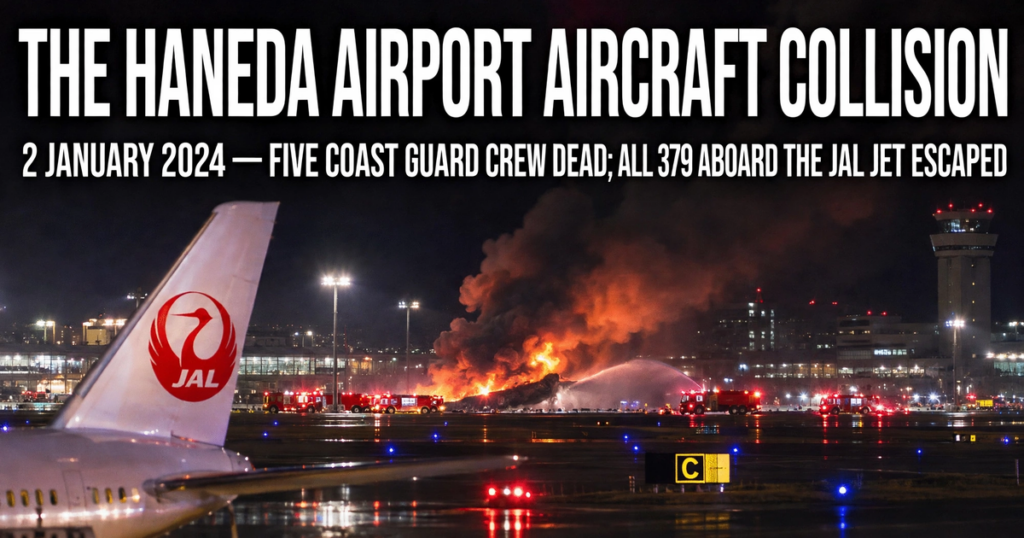
Two aircraft collided on Haneda's C runway
At about 5:47 p.m. on January 2, 2024, Japan Airlines Flight 516 collided with a Japan Coast Guard aircraft on Runway 34R, also known as C runway, at Tokyo International Airport. The JAL aircraft was an Airbus A350-941 arriving from New Chitose Airport. The Coast Guard aircraft was a Bombardier DHC-8-315, registration JA722A. Both aircraft caught fire and were severely damaged. The collision occurred on the runway, where one aircraft was preparing to depart and the other had just landed.
The Coast Guard aircraft was preparing to carry relief supplies
The Coast Guard aircraft, identified in the investigation as Aircraft A, was scheduled to depart for Niigata Airport to transport relief supplies for people affected by the Noto Peninsula earthquake of January 1. It had left the Coast Guard's Haneda base and was directed by air traffic control to hold short of the runway. The aircraft nevertheless entered Runway 34R and stopped there. Its mission was urgent, but the purpose of the flight is separate from the question of whether it had permission to enter the runway. The investigation examined how the crew understood the instructions and what information was available to the controllers.
JAL Flight 516 landed while the Coast Guard aircraft was on the runway
Flight 516 was carrying passengers and crew from New Chitose to Haneda. As it landed on C runway, it struck the Coast Guard aircraft that was stopped on the runway. The impact caused a fire beneath the JAL aircraft's fuselage as well as extensive damage to both aircraft. The JAL plane continued along the runway before leaving it and coming to a stop on the grass near the far end. The Coast Guard aircraft was destroyed by the collision and fire.
Five Coast Guard crew members died
Six people were aboard the Coast Guard aircraft. The captain suffered serious injuries, while the other five crew members died. The loss occurred during a mission intended to support earthquake-affected communities. The distinction between the six people aboard the Coast Guard aircraft and the 379 people aboard the JAL aircraft is essential to an accurate casualty account. The JTSB's second interim report records the same basic outcome: the Coast Guard captain was seriously injured and the other five occupants died.
All 379 people aboard the JAL aircraft evacuated
The JAL aircraft carried 367 passengers and 12 crew members, for a total of 379 people. Every passenger and crew member escaped from the aircraft after it came to a stop. The Japanese article cites the Fire and Disaster Management Agency's white paper as listing 15 injuries on the JAL aircraft. The JTSB's second interim report uses more detailed categories: one passenger with serious injuries, four with minor injuries, and 12 passengers who received medical attention for physical complaints. Because the reports use different categories, the figures should not be added together or presented as interchangeable. The successful evacuation occurred despite the fire and severe damage to the aircraft.
The first interim report described several gaps in awareness
The JTSB's first interim report, published on December 25, 2024, described information gathered about the movements of the aircraft and the communications among the Coast Guard crew, the control tower and the JAL pilots. The Coast Guard crew believed that it had received permission to enter the runway. The control tower did not recognize that the Coast Guard aircraft had entered and stopped on C runway. The JAL pilots also did not see the Coast Guard aircraft before the collision. These were reported circumstances under investigation, not a final allocation of blame to one person.
The second interim report expanded the investigation
On December 25, 2025, the JTSB issued a second interim report. It continued to examine the Coast Guard captain's fatigue and work management, the absence of a sterile-cockpit rule at the Haneda base, the checklist completed by the first officer and the way runway occupancy was monitored by air traffic control. It also examined the visibility of the Coast Guard aircraft from the approach path, the use of the JAL pilots' head-up displays, the operation of the cabin announcement system and the spread of smoke inside the JAL aircraft. These matters were still being analysed.
The investigation is intended to prevent another accident
An accident investigation is designed to establish causes and identify measures that can prevent recurrence and reduce harm. It is not the same as a criminal proceeding or a process that assigns legal responsibility. The second interim report stated that further fact-finding, analysis, hearings and consultations with relevant parties and other countries were still needed. It would therefore be inaccurate to describe the report as a final determination of the cause. The runway-entry instructions, controller monitoring, cockpit decisions and evacuation conditions all remain part of the broader safety review.
The confirmed facts and the unresolved questions must be kept separate
The confirmed outline is that the collision occurred on January 2, 2024, on Haneda's C runway; five Coast Guard crew members died and the captain was seriously injured; and all 379 people aboard the JAL aircraft evacuated. The JTSB's second interim report was published on December 25, 2025, and continued the investigation rather than closing it. The report identifies multiple areas for analysis, including communication, runway monitoring, aircraft visibility and evacuation. Until a final report is issued, those areas should not be presented as completed findings or used to assign blame.
Original Japanese record: 羽田空港航空機衝突事故|海保機の5人死亡、日航516便379人脱出と滑走路の安全
Last updated:
Related articles
Case record
The 1999 Tomei Expressway Drunk-Driving Crash: Two Young Sisters Killed and a Four-Year Sentence
Case record
The Ikebukuro Runaway-Car Crash: Two Deaths, a Five-Year Sentence and the Driver's Death in Custody
Case record
The Schindler Elevator Death: An Open-Door Movement, a Teenager's Death and Acquittals on Appeal
Case record