The Hotel Nihonkaku Murders: Two Missing Owners, a Separate Poisoning and Two Executions
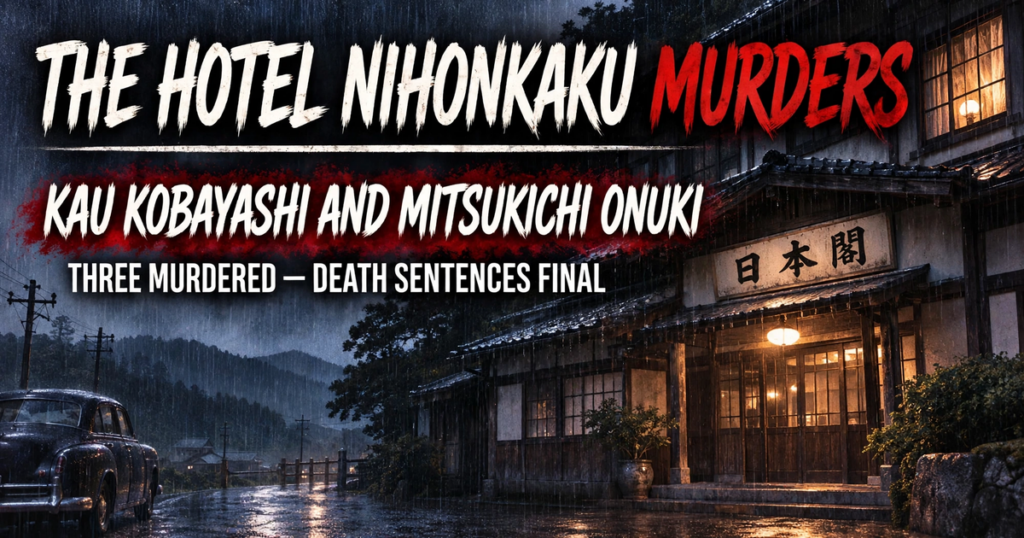
The Hotel Nihonkaku case centred on the disappearance and killing of innkeeper couple Ume and Kamasuke Ubukata in Shiobara, Tochigi Prefecture. Ume disappeared in February 1960; Kamasuke disappeared on December 31 that year. Investigators later connected their deaths to Kau Kobayashi and Mitsuyoshi Onuki. A separate 1952 death in Kumagaya, that of Kau's husband Hidenosuke Kobayashi, was also prosecuted as part of the same series, with former police officer Mataichiro Nakamura implicated. The final convictions were not identical: Kau and Onuki received death sentences, while Nakamura received ten years. The Supreme Court made the sentences final on July 14, 1966; Kau and Onuki were executed on June 11, 1970.
The case involved more than one disappearance and more than one location
Hotel Nihonkaku stood in the Fukuwatari area of Shiobara, then in Tochigi Prefecture. The central victims in the hotel-related crimes were Ume Ubukata, aged 48, and her husband Kamasuke, aged 53. But the criminal proceedings eventually covered a third victim: Hidenosuke Kobayashi, the husband of Kau Kobayashi, who had died in Kumagaya, Saitama Prefecture, in 1952. That earlier death was not a third killing inside the hotel. Keeping the locations and victims separate is essential to understanding why the case involved three homicide convictions while only two victims were directly connected to the hotel.
Ume Ubukata disappeared in February 1960
The first disappearance was that of Ume, the wife of Hotel Nihonkaku's owner, Kamasuke. She vanished in February 1960. Kau had become involved with Kamasuke and wanted to enter the inn business. Contemporary reporting later reconstructed how Kau developed a relationship with Kamasuke and became increasingly involved in the hotel's management. The court proceedings treated Kau, Kamasuke and Onuki as participants in Ume's killing. This created a complicated legal position for Kamasuke: he was later a murder victim himself, but in the case involving his wife he was treated as one of the people involved in the crime.
The hotel's financial problems and management rights formed part of the background
Hotel Nihonkaku faced financial difficulties and problems associated with expansion and renovation. Kau wanted to obtain a position in the inn business and, ultimately, control of the hotel's management and property. While Kamasuke remained alive, however, she could not freely dispose of the hotel's rights and assets. The prosecution and courts considered the relationship between Kau and Kamasuke, and the question of who would control the property, as part of the motive for the crimes. These circumstances explain the financial context, but they do not change the need to distinguish the court's findings from the rumours and sensational descriptions that later surrounded Kau.
Kamasuke disappeared on the final day of 1960
On December 31, 1960, Kamasuke also disappeared. The later investigation concluded that Kau and Onuki had killed him and concealed his body. For a period, both members of the hotel-owning couple were missing. In February 1961, the police investigation intensified. According to local newspaper reports reproduced in later coverage, Onuki was first arrested for theft in the early hours of February 20. After his statements, Kau was arrested that evening on suspicion of murder. On February 21, investigators began excavating places where the two bodies were believed to have been buried.
Onuki's statements led police to search the hotel grounds
Investigators received information that Kamasuke's body had been buried in woodland in front of Hotel Nihonkaku and that Ume's body had been concealed beneath the foundation of the hotel's new building. Excavations followed. The case had developed from two disappearances into an investigation of killings connected with the hotel's ownership and property. The location of each body was significant because it tied the missing persons to the hotel and helped the prosecution reconstruct the sequence of events. The early statements and investigative theories, however, were not the same as final judicial findings; the defendants' respective roles were determined in the subsequent trials.
The investigation also reopened the 1952 death of Kau's husband
During the Nihonkaku investigation, police received information about the death of Kau's husband, Hidenosuke Kobayashi, in Kumagaya in 1952. That death had not originally been prosecuted as murder. In March 1961, Tochigi and Saitama police re-examined the circumstances. The later proceedings alleged that Kau and former police officer Mataichiro Nakamura had poisoned Hidenosuke. This was a separate incident, nine years earlier and in another prefecture. It became part of the criminal case against Kau, but it should not be described as a third killing at Hotel Nihonkaku.
The first trial produced different outcomes for the three defendants
On March 18, 1963, the Utsunomiya District Court sentenced Kau to death, finding her responsible for the murders of Ume, Kamasuke and Hidenosuke. The court found Onuki involved in the murders of the Ubukata couple and sentenced him to life imprisonment. Nakamura was acquitted of the murder of Hidenosuke at first instance because the court considered the evidence insufficient to establish his conspiracy. The first-instance outcomes therefore differed substantially: death for Kau, life imprisonment for Onuki and an acquittal for Nakamura on the murder charge.
The Tokyo High Court changed two of the first-instance outcomes
Both the defence and the prosecution appealed. On September 15, 1965, the Tokyo High Court maintained Kau's death sentence but increased Onuki's punishment from life imprisonment to death. It also overturned Nakamura's murder acquittal and found him guilty of conspiring in Hidenosuke's killing, sentencing him to ten years in prison. The appellate decision changed the final legal picture. It is inaccurate to report only the district-court results or to say that Nakamura was acquitted in the final outcome.
The Supreme Court made the sentences final in July 1966
All three defendants appealed to the Supreme Court. On July 14, 1966, the Supreme Court First Petty Bench dismissed the appeals. Kau's and Onuki's death sentences and Nakamura's ten-year prison term became final. The legal record thus covered three victims across two locations and different periods: Ume and Kamasuke in the hotel-related crimes, and Hidenosuke in the separate 1952 Kumagaya poisoning case.
Kau and Onuki were executed on June 11, 1970
On June 11, 1970, the death sentences of Kau and Onuki were carried out on the same day at the Tokyo detention facility in Kosuge. Kau was 61 and Onuki was 46. Kau was the first woman executed in postwar Japan, although she was not the first woman whose death sentence had become final. This distinction matters: “first woman sentenced to death” and “first woman executed” are different historical claims. The case's final procedural sequence was the 1963 district-court judgment, the 1965 High Court decision, the 1966 Supreme Court dismissal and the 1970 executions.
Original Japanese record: ホテル日本閣殺人事件|経営者夫妻と夫の3人殺害、小林カウ・大貫光吉の死刑執行
Last updated: