
The Honjo Insurance-Murder Case
Between 1995 and 1999, two men died and a woman survived a poisoning attempt in a series of insurance-related crimes in and around Honjo, Saitama Prefecture. Shigeru Yagi was convicted as the central planner alongside three women. His death sentence became final in 2008. A later expert opinion proposing drowning as one victim's cause of death did not lead to the first retrial request being granted.
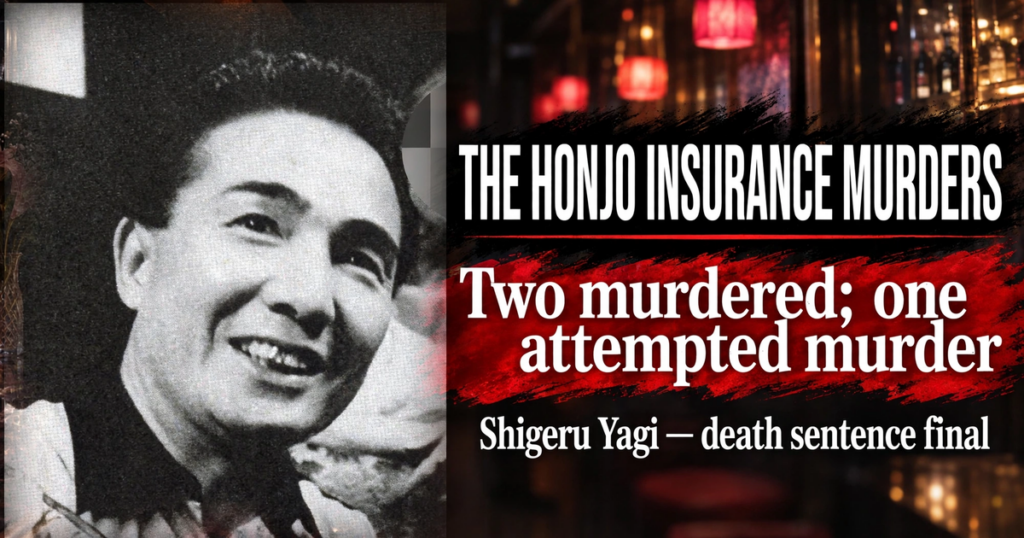
Paid press conferences drew attention to the insurance suspicions
In the summer of 1999, Shigeru Yagi began holding paid press conferences in Honjo, Saitama Prefecture, denying suspicions that had gathered around him. The meetings attracted attention because the person at the centre of the allegations was charging journalists to hear his explanations. That public performance became part of the case's reputation, but it was not the central evidence on which the convictions rested. The trial concerned two murders and one attempted murder committed between 1995 and 1999. The court examined insurance arrangements, witness testimony, substances given to victims and the relationship between those acts and the resulting deaths.
The case involved three victims but only two deaths
The offences covered a period from June 1995 to May 1999. The victims identified in the Japanese article were Shuichi Sato, aged 45; Akira Morita, aged 61; and Fujimi Kawamura, who survived. Two men died, while Kawamura suffered serious injury. The legal findings were two counts of murder and one count of attempted murder, along with fraud and related offences. It is inaccurate to describe the case as three completed murders. The distinction between the two deaths and the surviving victim is central to the convictions and later arguments about the evidence.
The first murder involved aconite poisoning
The first death addressed in the judgment was that of Sato. The court found that Yagi and his co-defendants arranged substantial life-insurance coverage and that Sato was given aconite, a toxic plant-derived substance. The case was not simply about the existence of an insurance policy. The prosecution had to establish that the defendants acted together and that the substance was administered as part of a plan to cause death and obtain insurance proceeds. The later retrial dispute focused particularly on the medical explanation for Sato's death, but that dispute did not automatically determine the other two victim-related offences.
Morita was given cold medicine and alcohol over an extended period
The second murder involved Akira Morita. The court found that, from the summer of 1998, he was repeatedly given cold medicine and alcohol, and that the prolonged administration contributed to his death in May 1999. The defence disputed the causal relationship, arguing that long-term use of cold medicine could not account for the death. The first-instance court did not assess a single dose in isolation. It considered the repeated conduct over time and the combined effect of substances administered to Morita. The judgment treated the conduct as part of a continuing plan.
Kawamura survived and was the victim of attempted murder
Fujimi Kawamura was also given cold medicine and alcohol over a prolonged period, according to the court's findings. The prosecution alleged that the same general method was used in an attempt to kill her. She did not die, although she suffered serious injury. The final legal classification was attempted murder, not murder. This distinction matters because the case is sometimes described broadly as a three-victim insurance-murder scheme. The court's findings were more specific: two victims died, while the third survived an attempt to kill her.
The court examined the evidence against Yagi and the three women
Yagi denied involvement from the investigation through the trial and challenged the credibility of the three women treated as accomplices. The Saitama District Court found the testimony of Mayumi Take persuasive because it was detailed and consistent with the accounts of the other two women. The court regarded Yagi as the central planner, even though he was not found to have personally carried out every physical act. It considered whether the women acted pursuant to a shared plan, how insurance contracts supported their accounts and whether other evidence corroborated the testimony.
The district court imposed the death penalty in 2002
On 1 October 2002, the Saitama District Court sentenced Yagi to death, as requested by the prosecution. The judgment found him guilty of two murders and one attempted murder, together with fraud and related offences. The court imposed different sentences on the three women: one received life imprisonment, another 15 years and the third 12 years. The different outcomes reflected their individual roles and responsibility. Yagi appealed, and the Tokyo High Court dismissed his appeal on 13 January 2005.
The Supreme Court made the death sentence final in 2008
On 17 July 2008, the Supreme Court's First Petty Bench dismissed Yagi's final appeal. The death sentence became final after the relevant procedure. The Supreme Court accepted the lower courts' findings that Yagi had conspired with the women in the two murders and the attempted murder. It considered the insurance motive, planning and seriousness of the results. The final sentence was not merely a district-court death judgment awaiting review: it had been maintained by the High Court and Supreme Court.
A later expert opinion did not automatically reopen the trial
After the death sentence became final, Yagi sought a retrial. An important issue was a new examination of preserved organs from Sato. An expert concluded that the presence of plankton was consistent with drowning, which differed from the cause of death accepted in the original judgment. The Tokyo High Court considered whether the sample could have been contaminated during autopsy or preservation. On 31 July 2015, it rejected the immediate appeal against the refusal to begin a retrial, finding that the opinion did not meet the standard for a clear new fact requiring the case to be reopened.
The final conviction and the retrial request are separate legal matters
A retrial request does not automatically suspend or cancel a final criminal judgment. Japanese retrial procedure requires new evidence of sufficient weight to cast reasonable doubt on established findings. The first retrial effort in Yagi's case did not meet that threshold. The source article cites reporting from March 2025 that Yagi continued to deny guilt and seek a retrial while held under the final death sentence. The two murders and one attempted murder therefore remain the convictions in force in the account reviewed here; the expert opinion is an argument in a retrial process, not a judgment overturning the case.
Original Japanese record: 本庄保険金殺人事件|2人死亡・1人殺人未遂、八木茂の死刑確定と再審
Last updated:
Related articles
Case record
The Attacks on Former Health Ministry Officials' Residences
Case record
The Hotel Nihonkaku Murders: Two Missing Owners, a Separate Poisoning and Two Executions

Case record
The Yokohama–Fukaya Serial Murders
Case record