
The Attacks on Former Health Ministry Officials' Residences
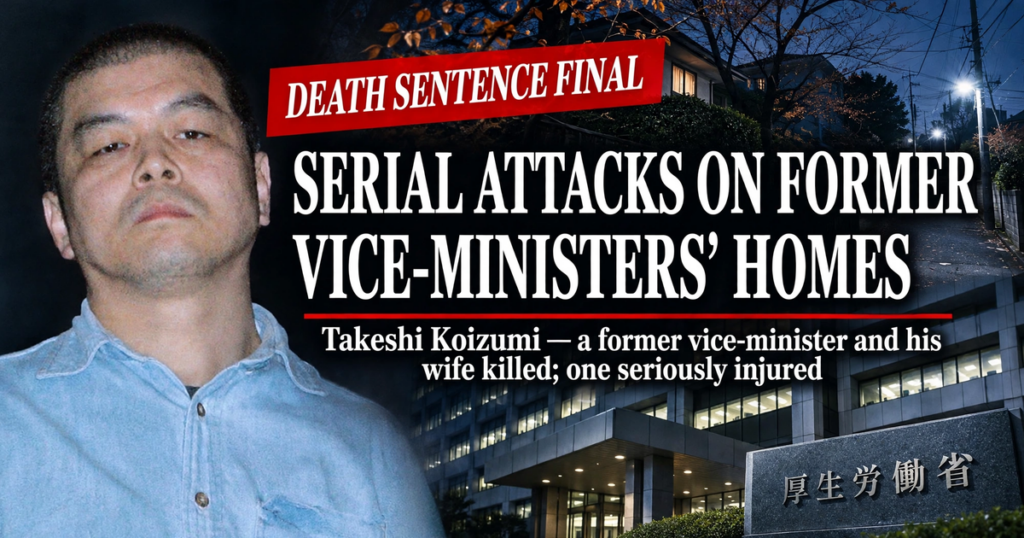
In November 2008, Koizumi Takeshi attacked households connected to former senior officials of Japan's Ministry of Health and Welfare. A former vice-minister, Tsuyohiko Yamaguchi, and his wife Michiko were killed in Saitama; the wife of another former vice-minister, Yasuko Yoshihara, was seriously injured in Tokyo. Koizumi also prepared to attack another former official. The Supreme Court upheld his death sentence in June 2014.
Two households were attacked on consecutive days
On 17 and 18 November 2008, attacks were carried out against homes connected to former senior officials of Japan's Ministry of Health and Welfare. In Saitama City, former vice-minister Tsuyohiko Yamaguchi, aged 66, and his wife Michiko, aged 61, were killed. On the following day in Nakano, Tokyo, Yasuko Yoshihara, aged 72, the wife of another former vice-minister, was stabbed and seriously injured. The attacks were linked by their targets' former government positions and by the defendant's plan.
The first attack killed Yamaguchi and his wife
On 17 November, Koizumi Takeshi went to the home of Tsuyohiko Yamaguchi. The Supreme Court findings state that Koizumi stabbed Yamaguchi and his wife repeatedly in the chest and other areas with a kitchen knife, causing both to die from blood loss. The couple had no personal dispute with Koizumi. He selected them because Yamaguchi had once served as a senior official in the former Ministry of Health and Welfare. The fact that Michiko Yamaguchi was also killed demonstrated that the attack extended beyond the former official himself.
The next day, Yoshihara's wife was seriously injured
On 18 November, Koizumi went to the home of Kenji Yoshihara, another former vice-minister. Yoshihara was not at home. His wife, Yasuko, answered the door and was stabbed repeatedly in the chest and other areas. She managed to escape, and the attack did not result in her death. The injuries were serious and posed a substantial threat to her life. The legal charge was attempted murder, not murder, because she survived.
A third target was included in the plan
The Supreme Court's findings covered more than the two household attacks. Koizumi also travelled by car to the vicinity of the residence of another former senior official, a former head of the Social Insurance Agency who had later served as a Supreme Court justice. He carried knives, including kitchen knives, in the vehicle. The court found that this conduct constituted preparation for murder. It was not an additional completed attack or an attempted murder charge, but it showed that the plan extended to another target.
Koizumi described the motive as revenge for a dog
Koizumi said that when he was a child, a dog he had kept was put down by a public health centre. He described his attacks as retaliation for that experience and expressed anger toward the health administration. The Supreme Court considered this explanation but found that the victims had no personal responsibility for the dog's treatment. The defendant had transferred resentment toward an administrative system onto former officials and their family members. The court found no mitigating justification for attacking people who were not personally involved in the event he described.
The attacks were prepared over a period of time
The Supreme Court found that Koizumi spent a substantial period selecting targets and considering the timing, order, weapons and methods of attack. He used a delivery-person disguise or similar approach to gain access to a home. He had prepared multiple knives and travelled to more than one target's residence. The court treated the attacks as a planned series, rather than spontaneous acts arising from a confrontation. The preparation and the inclusion of family members were significant aggravating factors in the sentencing analysis.
Koizumi surrendered to police on 22 November
On the night of 22 November, Koizumi went to the Tokyo Metropolitan Police Department in a rental car and surrendered. Investigators examined the vehicle and items inside it, including knives and gloves bearing bloodstains. The Japanese article also records that DNA testing connected blood evidence to the victims. Koizumi had sent a statement to media organizations before surrendering, explaining his grievance about the dog. His surrender was a key investigative development, but it did not itself determine guilt; the charges were tested in court.
The prosecution included murder, attempted murder and preparation for murder
Koizumi was prosecuted for the murders of Tsuyohiko and Michiko Yamaguchi, the attempted murder of Yasuko Yoshihara, preparation for murder in relation to the third former official, and violations of the Firearms and Swords Control Act. These legal categories describe different stages of conduct. Two people died, one person survived a serious attack, and a further attack was prepared but did not proceed to an assault. Combining all of these into a single count of completed murder would misstate the court's findings.
The defence challenged criminal responsibility
The defence argued that Koizumi's unusual beliefs and fixation on the dog incident were connected to a mental disorder and should affect criminal responsibility and sentence. The lower courts considered his mental condition but found that he could understand the wrongfulness of his conduct and control his actions. They emphasized his selection of targets, the order and timing of the attacks, the preparation of weapons and efforts to avoid detection. The Supreme Court maintained the finding of full criminal responsibility.
The Saitama District Court imposed death in March 2010
On 30 March 2010, the Saitama District Court sentenced Koizumi to death. It considered the two deaths, the serious injuries to Yoshihara, the preparation for another attack, the absence of any fault by the victims and the planning involved. Koizumi appealed. The Tokyo High Court dismissed the appeal on 26 December 2011, maintaining the death sentence and the lower court's assessment of his responsibility.
The Supreme Court dismissed the final appeal in June 2014
On 13 June 2014, the Supreme Court's Second Petty Bench dismissed Koizumi's appeal. It upheld the death sentence. The Court considered the prolonged preparation, the two-day sequence of attacks, two deaths, one attempted murder and the preparation directed at another former official. It also considered that Koizumi had no significant prior criminal record apart from a fine, but found that this did not justify avoiding the death penalty. The death sentence became final after the Supreme Court decision.
The victims' families were not responsible for the grievance Koizumi described
The case was widely described through Koizumi's claim that he was avenging a dog. That account should not obscure who was attacked: two people were killed, a third person was seriously injured, and another household was targeted in preparation. None of these people was shown to have been personally responsible for the event Koizumi cited. The Supreme Court's judgment focused on the arbitrary selection of targets, the attack on family members and the careful preparation of the offences. The current Japanese article records the death sentence as final, without reporting an execution.
Original Japanese record: 元厚生事務次官宅連続襲撃事件|山口剛彦さん夫妻殺害と小泉毅の死刑確定
Last updated:
Related articles

Case record
The Gunma Pachinko-Parlor Robbery-Murders: Two Employees Killed for Store Keys and Cash
Case record
The Ikebukuro Street Attack: Two Women Killed, Six Injured and the Death Sentence for Hiroshi Zoda

Case record
The Four-Prefecture Four-Murder Case: Twelve Years for the First Killing and Death for Three Later Murders
Case record