
The Hitachi Junior-High-School Girl Abduction-Murder: A Family Acquaintance, a Ransom Demand and Death in Custody
On October 16, 1978, a 14-year-old junior-high-school girl disappeared in Hitachi, Ibaraki Prefecture. The offender, Makoto Watahiki, aged 39, was known to her family and had a relationship with them described as being almost like that of a relative. He used a drug prepared in advance to render the girl unconscious, killed her and then demanded ransom from her family. The courts found that he had planned the crime to obtain money for debts and entertainment. His death sentence became final in 1988, but he died of a subarachnoid haemorrhage in Tokyo Detention House in 2013 without being executed.
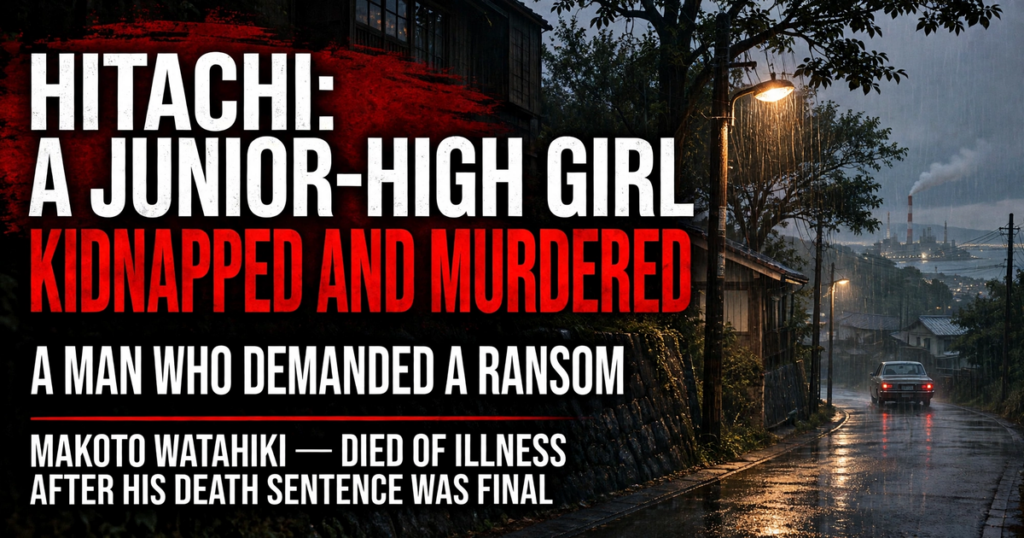
A 14-year-old girl disappeared in Hitachi
On October 16, 1978, a 14-year-old junior-high-school student disappeared in Hitachi, Ibaraki Prefecture. The person who took her was not a stranger who happened to encounter her on the street. Makoto Watahiki, then 39, had known the girl's family for some time, and the relationship was described in the final judgment as being similar to that of relatives. The use of an existing family connection was central to the way the offender was able to approach the girl without immediately raising the same level of suspicion that an unknown adult might have caused.
The offender had prepared a drug and used the family relationship
Watahiki operated an ironworks business but had accumulated substantial debts through business and entertainment expenses. The Supreme Court found that he planned to abduct the girl to obtain money to repay debts and fund his leisure activities. He used a drug that he had prepared in advance to render her unconscious. The source does not identify the drug by name, so the English translation does not speculate about its chemical type or dose. The court treated the preparation and use of the drug as evidence that the abduction was planned.
The girl was killed and the offender then demanded ransom
After taking the girl and rendering her unconscious, Watahiki killed her and disposed of her body. He then contacted the family and demanded ransom, presenting the situation as though she could still be returned. Reports cited in the Japanese article give the demand as 30 million yen. The money was not successfully collected. The timing was a central aggravating feature: the family was asked to produce money after the girl had already been killed, so the demand did not represent a genuine attempt to secure her release.
The investigation moved from a missing-person case to murder and body disposal
When the girl did not return home and the family received ransom communications, police investigated a kidnapping for ransom. They examined her movements, her connections and the circumstances known to people close to the family. Watahiki emerged as a suspect and was arrested three days after the disappearance. The discovery and examination of the girl's body confirmed that the incident involved murder and disposal of a body, not simply a kidnapping that had gone wrong. The fact that the family had known Watahiki became an important part of the investigative history.
The charges included offences beyond kidnapping and murder
The criminal case included kidnapping for ransom, murder, abandonment of a body, a demand for ransom by an abductor and attempted quasi-rape. The source's summary lists these offences separately because the conduct involved several stages. The girl was taken from her ordinary life, rendered unconscious with a prepared drug, killed and abandoned; the offender then continued to seek money from her family. The case was therefore not treated as a single act of homicide detached from the abduction and ransom scheme.
The Mito District Court imposed death in 1980
On February 8, 1980, the Mito District Court sentenced Watahiki to death. The fact that there was only one homicide victim and that Watahiki had no serious prior criminal record were considered, but the court found the responsibility extremely grave. The judgment placed particular weight on the financial motive, the victim's age, the use of a family relationship to approach her, the drug prepared in advance and the ransom demand made after the murder. The court found that the stages of the offence had been carried out in accordance with the financial plan.
The Tokyo High Court and Supreme Court maintained the sentence
Watahiki appealed, but the Tokyo High Court dismissed the appeal on March 15, 1983. He then appealed to the Supreme Court. The Supreme Court's First Petty Bench dismissed the final appeal on April 28, 1988. It accepted the finding that the abduction had been planned for ransom and that the murder and later demand were part of the same course of conduct. The death sentence became final on April 28, 1988. The case did not result in an acquittal or a reduced sentence.
Watahiki remained a death-row prisoner and sought retrial
After the death sentence became final, Watahiki was held at Tokyo Detention House. The Japanese article records that he continued to seek a retrial, but the conviction was not overturned. The fact that a retrial request is made does not by itself cancel a final judgment or automatically suspend the sentence. No successful retrial or acquittal is recorded in the source. His legal status remained that of a person with a final death sentence until his death in custody.
He died in detention in 2013 without execution
On June 5, 2013, Watahiki was found collapsed inside Tokyo Detention House and was diagnosed with a subarachnoid haemorrhage. He received medical treatment but died on the night of June 23, aged 74. The Ministry of Justice announced his death early the following morning. He was not executed. The correct final chronology is a death sentence imposed in 1980, upheld in 1983 and finalized in 1988, followed by death from illness in detention in 2013. His death did not convert the case into an execution.
Original Japanese record: 日立女子中学生誘拐殺人事件|14歳少女を誘拐・殺害し身代金要求、綿引誠の死刑確定と病死
Last updated:
Related articles
Case record
The Hikari Mother-and-Child Murders: A Death Sentence and the Third Retrial Request's Move to the Supreme Court
Case record
The Ibaraki University Student Murder: DNA Evidence, Two Life Sentences and a Third Suspect Still Sought
Case record
The Utsunomiya Confinement Murders: Two Deaths, Three Survivors and a Final Death Sentence
Case record