
The Ichihara Parents Murder: A Contested Confession and the Evidence Behind a Final Death Sentence
On October 30, 1974, Mr. Sasaki, 59, and his wife Akiko, 48, were killed at their home and tyre-repair business in Ichihara, Chiba Prefecture. Their son Sasaki, then 22, was convicted of both murders and the disposal of the bodies. He initially admitted the killings during the investigation but denied them at trial, arguing that his mother had killed his father and that another person had killed her. The Supreme Court dismissed his appeal on January 30, 1992.
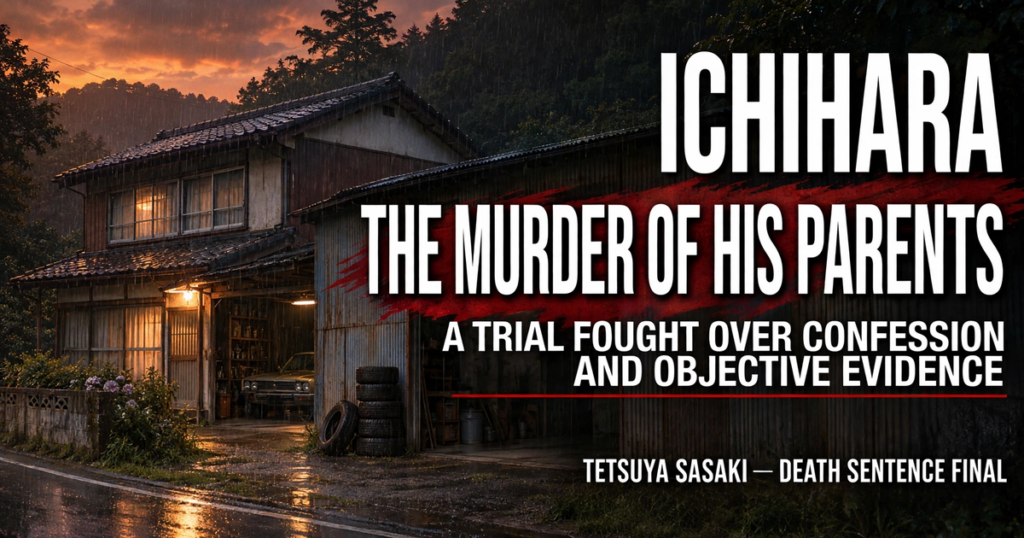
A couple were killed at their home and tyre business
On October 30, 1974, Mr. Sasaki, aged 59, and his wife Akiko, aged 48, were killed at the family home, which was also used for an automobile tyre sales and repair business in Ichihara, Chiba Prefecture. Their eldest son, Sasaki, was 22 at the time. The bodies were removed from the property and later disposed of at sea. The case resulted in a death sentence for the son for two murders and abandonment of the bodies. The case became notable not simply because of the family relationship, but because the trial turned on how confession evidence should be assessed alongside physical and circumstantial evidence.
A dispute about a relationship preceded the killings
According to the Supreme Court judgment summarized in the archive, Sasaki was closely involved with a woman who worked in the sex industry. His parents repeatedly urged him to end the relationship, expressing concern about his future. On October 30, his father criticized the relationship and referred to the woman's occupation. The court found that Sasaki became enraged during this argument. The killings were not found to have been planned in advance as a pre-arranged double murder. The prosecution case was that the confrontation escalated into violence against his father, followed by the killing of his mother when she arrived at the scene.
The court found that both parents were stabbed with a climbing knife
The final judgment found that Sasaki used a climbing knife he owned to stab his father repeatedly, causing his death. His mother came to the scene and was also stabbed repeatedly with the same knife. The number and distribution of the wounds were considered alongside the blood traces in the house. The Tokyo High Court described the attacks as persistent, and the Supreme Court accepted the seriousness of the conduct. The fact that the first killing followed an argument did not make the second death an unrelated event; the prosecution and courts treated both as part of the same sequence.
The bodies were taken to the Goi coast and weighted
At approximately 5:30 a.m. on November 1, 1974, Sasaki transported the bodies from the residence to a public landing area near Goi Minami Coast in Ichihara and disposed of them in the sea. The bodies were not discovered immediately. The father's body was recovered on November 9, and the mother's on November 10. A vehicle wheel weighing approximately 21.5 kilograms had been attached to the mother's body as a weight. The disposal was considered part of the effort to conceal the killings. It was charged separately from the murders and formed part of the overall criminal case.
The son's report of his parents' disappearance did not resolve the case
Sasaki reported that his parents had disappeared. Investigators, however, found substantial blood traces in the home. He had also sustained a wound to his left little finger that required eleven stitches soon after the incident, and his explanations for the injury changed. He had little money before the incident but was found with more than 600,000 yen on the evening afterward. The parents' safe showed signs of having been opened with a key carried by Akiko. These facts were not treated as isolated proof; they were considered together as circumstantial evidence that required explanation.
Physical traces and post-crime conduct became central evidence
The Tokyo High Court examined bloodstains in the kitchen, hallway, sink, washroom and bathroom, as well as signs that blood had been wiped from the floor. It also considered that Sasaki discarded his climbing knife and bloodstained clothing. Items from the home bearing blood, including towels and floor coverings, were placed in a plastic container and loaded into his car, but were not handed to police when he filed the missing-person report. The court regarded this conduct as inconsistent with the behaviour expected of someone genuinely searching for missing parents. The judgment did not rely on the confession alone; it assessed the physical traces and his actions after the deaths.
The defence challenged the confession and proposed another sequence
During the investigation, Sasaki made statements admitting that he had killed his parents. At trial he denied the offences and argued that his mother had killed his father and that an unidentified person had later killed his mother. The defence relied on a witness who said she had seen Akiko after the time the prosecution placed the killings, as well as arguments about blood type, the condition of the bodies and whether the confession had been voluntary. This made the case a dispute about the reliability of the investigation and the consistency of the evidence, not merely a question of whether the defendant had once confessed.
The alleged sighting of Akiko was examined against other records
A particularly important defence argument concerned a food-shop employee who recalled Akiko buying cooked rice between approximately 7:00 and 7:30 p.m. on October 30. If the sighting had occurred on the day of the killings, it would have conflicted with the prosecution's timeline. The Tokyo High Court compared the employee's recollection with other details, including a television programme, the shopkeeper's visit to a barber and the timing of payday. It concluded that the visit was more likely to have occurred on October 29, the previous day. The court therefore did not find that the testimony displaced the prosecution's account of the deaths.
The three court stages ended with a final death sentence
The Chiba District Court sentenced Sasaki to death on March 15, 1984. The Tokyo High Court dismissed his appeal on August 29, 1986, and the Supreme Court dismissed his final appeal on January 30, 1992. The sentence therefore became final after the ordinary three-stage process. The Supreme Court's decision followed examination of the evidence and legal arguments; it was not merely the result of a withdrawn appeal. The case illustrates the distinction between an investigative confession and a judicial finding of guilt, because the conviction was upheld after the courts considered the defence's alternative account and the objective evidence.
Original Japanese record: 市原両親殺人事件|客観証拠と自白をめぐる争い、22歳の長男に死刑確定
Last updated:
Related articles
Case record
The Ichihara Family-Restaurant Shooting: Two Gang Leaders Killed in Front of 22 Bystanders

Case record
The Osaka Electrolysis Murders: Two Executives Killed in a Staged Embezzlement Disappearance
Case record
The Hitachi Junior-High-School Girl Abduction-Murder: A Family Acquaintance, a Ransom Demand and Death in Custody
Case record