
The Hino Town Robbery-Murder: A Posthumous Retrial, Disputed Police Reconstruction and Newly Disclosed Alibi Evidence
A 69-year-old woman who ran a small liquor shop in Hino Town, Shiga Prefecture, disappeared on the night of December 28, 1984, and her handbag-sized safe was also missing. Her body was found on January 18, 1985, and the safe on April 28. Hiromu Sakahara, a regular customer, was arrested in March 1988 and convicted of robbery-murder, receiving a life sentence that became final in 2000. He died in prison in 2011 while maintaining his innocence. His family's second retrial request was finally granted in 2026. Prosecutors announced that they would not seek a guilty verdict, while new evidence concerning his alibi continued to be disclosed in November 2026.
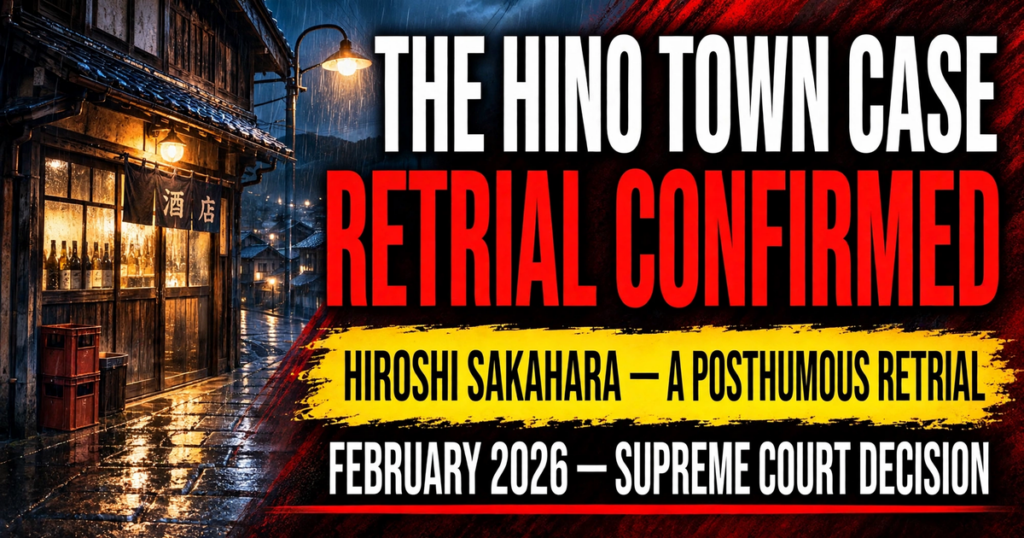
A shopkeeper and her small safe disappeared on the same night
On the night of December 28, 1984, a 69-year-old woman who operated a liquor shop in Hino Town, Shiga Prefecture, disappeared. A small safe belonging to her was also missing from the shop. Police began investigating the possibility that she had been taken and robbed. Her body was discovered on January 18, 1985, in a residential development area in the town. On April 28, a handbag-sized safe that had been removed from the shop was found in a separate wooded area. The separate locations of the body and safe became important parts of the investigation.
Sakahara was a regular customer, but was not arrested until 1988
Hiromu Sakahara was a regular customer at the victim’s shop. Police considered him during the investigation, but he was not arrested until March 1988, more than three years after the woman disappeared. After being taken for questioning, he underwent repeated interviews and a confession statement was prepared in which he admitted killing the woman and taking the safe. At his first trial hearing, he withdrew the confession and maintained that he had not committed the robbery-murder. The case did not rest on a direct physical trace that independently linked him to the killing; the confession and the investigative reconstruction based on it became central.
The police said Sakahara had guided them to the locations
Investigators prepared records of a procedure known as an investigative reconstruction or “lead-in investigation.” They said Sakahara had guided officers to the place where the safe was found and to the place where the body had been discovered. If a suspect independently identifies locations known only to the offender, that can be treated as information supporting the reliability of a confession. The original courts relied on this reconstruction as an important link between Sakahara and the crime. The later retrial proceedings examined whether the photographs and records truly showed him independently leading police to information that only the offender could know.
The first-instance court imposed life imprisonment in 1995
On June 30, 1995, the Otsu District Court sentenced Sakahara to life imprisonment for robbery-murder. The Osaka High Court dismissed his appeal on May 30, 1997, and the Supreme Court dismissed his final appeal on September 27, 2000. The life sentence thereby became final. The evidentiary reasoning differed between the courts: the district court gave relatively little weight to the confession and relied more heavily on circumstantial evidence, while the high court considered the central parts of the confession reliable. The retrial order did not itself overturn the conviction.
Sakahara died before his first retrial request could be resolved
Sakahara filed a first retrial request in 2001. The Otsu District Court rejected it in 2006, and an immediate appeal was being considered when he died in prison on March 18, 2011, aged 75. His death ended his own first retrial procedure. It did not mean that a court had rejected every later challenge to the conviction, and it did not overturn the life sentence. On March 30, 2012, his family filed a second retrial request at the Otsu District Court, seeking to clear his name after his death.
Photographs and negatives undermined the claimed route to the safe
During the second retrial proceedings, previously undisclosed photographs, negatives and investigative records were examined. Some photographs that had been presented as showing Sakahara travelling toward the safe’s discovery site were found, when compared with the negatives, to include images taken on the return journey. The sequence therefore did not necessarily show that he had independently guided officers to the location without assistance. The defence argued that officers may have supplied fragments of information before the reconstruction. The issue was not simply whether Sakahara had been at the location, but whether the procedure proved that he possessed offender-only knowledge.
The body-site reconstruction had also been rehearsed in advance
Materials disclosed during the second retrial request showed that the reconstruction at the body-discovery location was not necessarily a spontaneous demonstration by Sakahara. Investigators had conducted a rehearsal with him before the formal reconstruction. That fact affected the evidentiary value of the procedure. If a suspect had been coached or had been given information before leading officers to a location, the resulting record could not automatically be treated as independent confirmation of a confession. The defence also submitted forensic opinions about whether the manner of killing described in the confession was consistent with the condition of the body.
The second retrial was ordered in 2018 and upheld in 2023
On July 11, 2018, the Otsu District Court granted the family’s second retrial request, finding that the new and old evidence, considered together, created reasonable doubt about the final conviction. Prosecutors appealed. On February 27, 2023, the Osaka High Court dismissed the immediate appeal and maintained the retrial order. Prosecutors then filed a special appeal to the Supreme Court. The retrial itself could not begin while that challenge remained unresolved. The case therefore spent several more years in proceedings about whether the original judgment should be reopened.
The Supreme Court made the retrial order final on 24 February 2026
On February 24, 2026, the Supreme Court’s Second Petty Bench dismissed the prosecutors’ special appeal. It found no error in the lower courts’ conclusion that the new evidence met the legal requirements for a retrial. The 2018 order to reopen the case therefore became final. This was a posthumous retrial sought by the family of a person who had received a final life sentence and died in custody. It was not itself an acquittal. The retrial court still had to conduct proceedings and issue a judgment.
Prosecutors said they would not seek a guilty verdict
On June 19, 2026, the Otsu District Public Prosecutors Office announced that, after reviewing the record, it would not argue for a guilty verdict and would not present new evidence to prove guilt in the retrial. At the fifth three-party conference on September 7, prosecutors said they would not ask the retrial court to examine the evidence supporting the original conviction. They explained that this reflected their decision not to argue for guilt, rather than an admission that the evidence was unlawful. That announcement was a major change in the prosecution’s position, but it was not a court judgment. The legal status remained that Sakahara’s original life sentence had been reopened for a retrial and that the retrial court had yet to issue an acquittal. The family continued to seek a formal judicial decision clearing his name.
New evidence about Sakahara’s alibi emerged in October and November 2026
The pretrial process continued after the prosecutors’ June announcement. At the sixth three-party conference on October 15, 2026, the Otsu District Public Prosecutors Office indicated that it would disclose 57 additional items, including investigative records that police had not forwarded to prosecutors. Prosecutors described the voluntary disclosure as a way to conclude discussions promptly, despite their view that additional disclosure was of limited necessity for preparing the defence. They said that nail and skin fragments sought by the defence could not be located even after checking with police. The defence said that a comprehensive inventory of evidence, including items not forwarded to prosecutors, had not been provided.
At the seventh three-party conference on November 5, the defence said that about half of the 57 items disclosed in October concerned Sakahara’s alibi. According to the defence, prosecutors had answered in 2016 that no additional evidence supporting the alibi existed beyond material already disclosed. The defence said it would seek to establish Sakahara’s alibi at the retrial and asked whether the 57 items represented all evidence to be disclosed. Prosecutors said they had voluntarily disclosed a broad range of material, including items not forwarded by police, but considered further disclosure unnecessary for the retrial’s purpose. The defence continued to seek disclosure. These are the parties’ positions, not findings by the retrial court. The eighth three-party conference is scheduled for December 4, 2026. As of November 24, 2026, no retrial verdict had been delivered.
Original Japanese record: 日野町事件|自白と「引当捜査」が揺らぎ、阪原弘さんの死後再審開始が確定
Last updated:
Related articles
Case record
The Koto Memorial Hospital Case: A Twelve-Year Sentence Overturned by Retrial, and a Death Not Proven to Be Homicide
Case record
The Katsuta Kiyotaka Serial Murders: The Reported 22-Victim Confession, Eight Judicially Established Deaths and the Nationwide No. 113 Investigation
Case record
The Otsu Probation Officer Murder: A Trusted Meeting, a Life Sentence and a Pending Appeal

Case record