
The Hamamatsu Mahjong Parlour Arson-Murder
A fire at the Kin-chan mahjong parlour in Hamamatsu on 17 November 2009 killed four male customers and injured three others. The fire service initially recorded the cause as under investigation, while Shizuoka Prefectural Police now classify the case as murder and arson. No perpetrator has been apprehended.
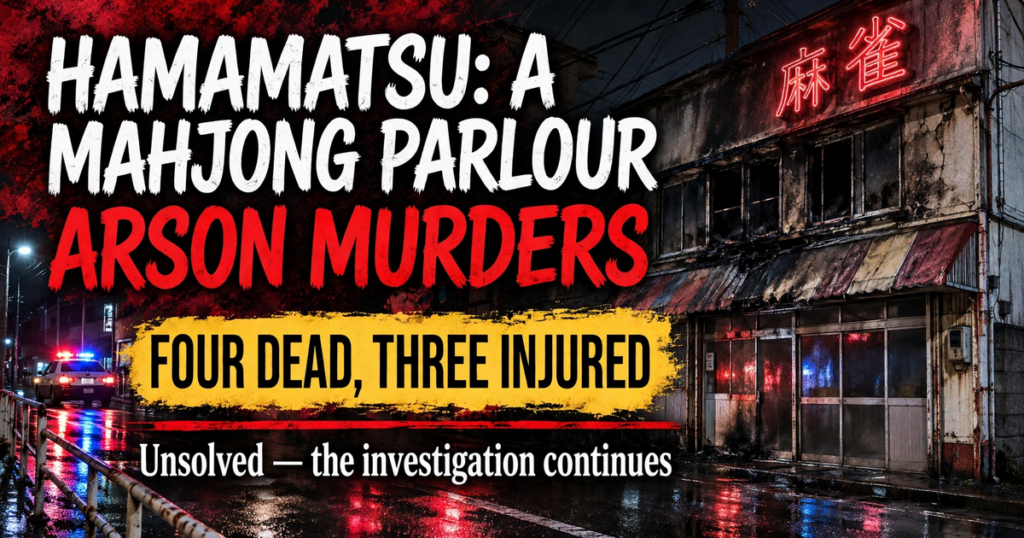
A fire was reported at 3:33 a.m. and four customers died
At 3:33 a.m. on 17 November 2009, a fire was reported at the Reach Mahjong Kin-chan parlour in Takaoka Higashi, Hamamatsu. The two-storey steel-frame building, with a total floor area of 211.05 square metres, was completely destroyed. Four male customers died. Two male employees and one male customer were injured, making seven people dead or injured. The distinction between the time the fire was detected and the time it began is important: the Fire and Disaster Management Agency's report gives 3:33 a.m. as the time the fire was recognised, not as a conclusively established ignition time.
Fire crews contained the blaze within an hour and a half
The Fire and Disaster Management Agency's fourth report recorded that the fire was brought under control at 4:16 a.m. and extinguished at 4:59 a.m. The fire department dispatched twelve vehicles and forty-two personnel, while the volunteer fire corps sent two vehicles and forty-nine personnel. Despite the rapid response, the building was recorded as completely burned out. The three injured people were classified in the report as two moderately injured and one lightly injured. The four people who died were all male customers; later information released by Shizuoka Prefectural Police gave their ages at the time as 65, 45, 58 and 64.
The fire service initially recorded the cause as under investigation
The Fire and Disaster Management Agency's fourth report, dated 20 November 2009, listed the cause of the fire as “under investigation.” That administrative entry describes what was known when the report was prepared. It should not be treated as the final position of the criminal investigation many years later. Contemporary newspaper coverage reported that police were already investigating possible arson and had established an investigative headquarters. A suspicion pursued by investigators and a cause formally determined in a fire-service report are different kinds of findings, made for different purposes and at different stages.
Police later classified the incident as murder and arson
The official position had developed by 2026. On 22 May 2026, Shizuoka Prefectural Police included the Takaoka Higashi mahjong-parlour fire among fourteen unsolved cases with investigative headquarters still in place. The police classified it as a “murder and arson” case. This later classification is the appropriate description of the current police investigation, while the older fire-service report remains relevant as a record of the immediate response. The two statements are not necessarily contradictory: one records the cause as undetermined in November 2009, while the other reflects the police assessment after years of criminal investigation.
The four people who died were customers, not employees
The fire-service report described all four deceased as male customers. Shizuoka Prefectural Police later released their ages at the time of the incident: 65, 45, 58 and 64. Contemporary reports said that three people died inside the parlour and another died after being injured while trying to escape. The victims did not all die in the same circumstances. The current police classification nevertheless treats the four deaths as part of the same murder-and-arson investigation. Their names were not included in the prefectural police announcement described in the Japanese article.
Witness accounts and movements near the parlour were examined
Newspaper reports from the time described witnesses hearing a sound like a door closing on the first floor shortly before the fire. Investigators also examined customers who had left shortly before the blaze and people reportedly seen in the surrounding area. These details were investigative leads, not proof that any particular person started the fire. No individual was identified publicly as the perpetrator, and no one was charged. In an unsolved case, a person mentioned in a witness account can easily become labelled a suspect in later retellings. The available record does not justify that conclusion.
Electrical failure was considered, but arson remained the police view
A December 2009 report by the Mainichi Shimbun said that police had strengthened their arson theory after an examination reportedly found no electrical fault. A later Yomiuri report in May 2010 nevertheless described the investigation as difficult because there was no decisive evidence proving arson or identifying the person responsible. The two reports illustrate the gap between eliminating one possible accidental cause and proving a criminal act beyond a reasonable doubt. The police assessment eventually became an official murder-and-arson classification, but the perpetrator and the exact method of ignition remain undisclosed.
A 2003 inspection had identified fire-safety deficiencies
The Fire and Disaster Management Agency report also recorded that the most recent fire-safety inspection before the incident had taken place on 6 November 2003. Inspectors had identified deficiencies involving partially missing fire extinguishers, partially missing emergency exit lights and the absence of an appointed fire-safety manager. These administrative findings should not be presented as proof that the deficiencies caused the fire or directly caused any particular death. Establishing how the fire spread and why people could not escape would require evidence about the ignition point, smoke movement, evacuation timing and the operation of safety equipment.
The national fire authority issued a safety notice on the day of the fire
On 17 November 2009, the Fire and Disaster Management Agency sent prefectures a notice titled “Thorough Implementation of Fire Safety Measures in Mahjong Parlours.” The notice sought stronger fire-safety guidance for similar facilities. The administrative response could proceed even while the criminal investigation remained unresolved. Authorities could check evacuation routes, fire extinguishers, emergency lighting and management arrangements without waiting for a final determination of who had started the fire. The parlour's earlier inspection deficiencies were therefore relevant to prevention and building safety, but they were separate from the question of criminal responsibility for the deaths.
A long-term investigative team continues to seek the perpetrator
Shizuoka Prefectural Police established an Unsolved Major Cases Investigation Unit in April 2011 within its First Investigation Division. The prefectural police explanation in 2026 said that the unit works with the local police stations that maintain investigative headquarters, continuing neighbourhood inquiries and DNA examinations. The mahjong-parlour case remains among the fourteen cases in that system. In the published breakdown, eleven were classified as murders, two as robbery-murders and one as an arson-murder. The Kin-chan fire was the single case in the last category. As of the latest supplied update, no perpetrator had been apprehended and the motive remained unknown.
Original Japanese record: 浜松市麻雀店放火殺人事件|4人死亡・3人負傷、「原因調査中」から殺人・放火事件として続く捜査
Last updated:
Related articles
Case record
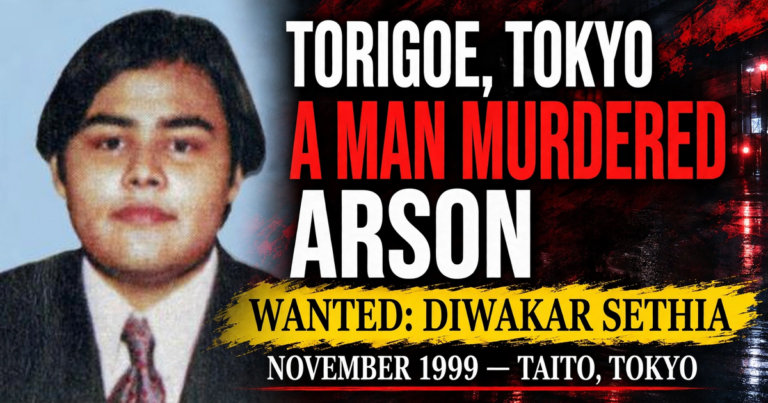
The Torigoe 2-Chome Murder and Arson: The Killing of an Indian Jewelry Worker and the Search for Diwakar Sethia
Case record
The Matsudo Female University Student Murder-Arson: A Death Sentence Replaced by Life Imprisonment
Case record
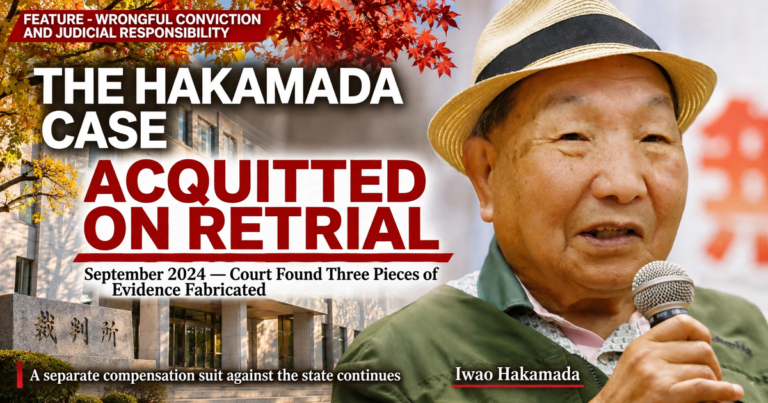
The Iwao Hakamada Case: From Death Row to a Final Acquittal

Case record