The Torigoe 2-Chome Murder and Arson: The Killing of an Indian Jewelry Worker and the Search for Diwakar Sethia
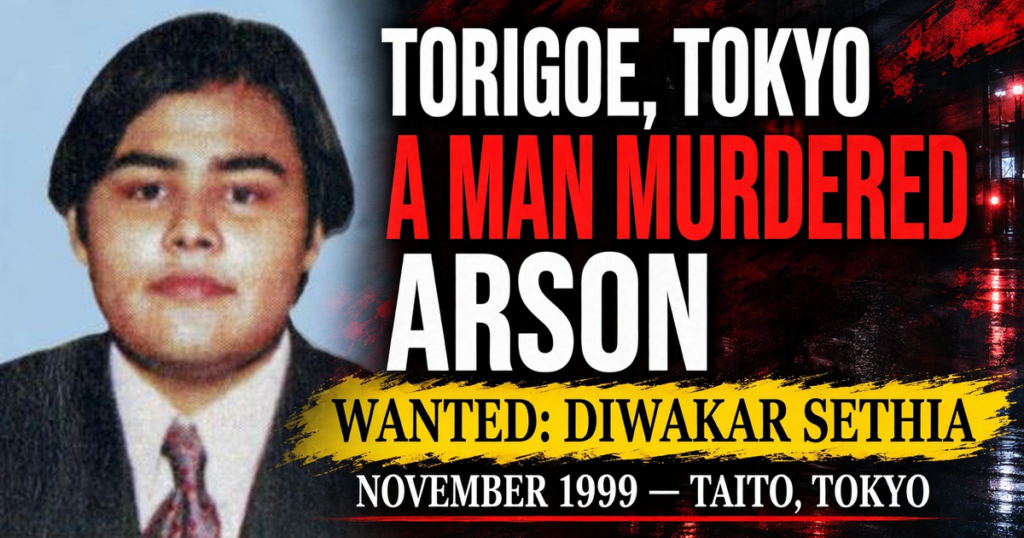
Around 29 November 1999, an Indian man aged 42 who worked in the jewelry trade was killed inside a building in Torigoe 2-chome, Taito Ward, Tokyo. Tokyo police say the suspect, Diwakar Sethia, stabbed the victim, set fire to the building and used the victim's cash card to withdraw approximately 12 million yen before leaving Japan for India. Sethia remains wanted. These are police allegations; no conviction has been entered in the case.
A jewelry worker was killed in a building in Taito Ward
Around 29 November 1999, an Indian man aged 42 who worked for a jewelry-related business was killed inside a building in Torigoe 2-chome, Taito Ward, Tokyo. The Tokyo Metropolitan Police Department describes the victim as an employee in the jewelry trade. The case involved more than a homicide: the building was set on fire, and money was later withdrawn using the victim's cash card. Police continue to list the case as a murder and arson investigation and seek information about the man they identify as the suspect.
Police say the victim was stabbed and the building was set on fire
According to the police account, the victim was stabbed repeatedly with a knife and died. The building was then set alight and damaged by the fire. The official public description does not provide a full reconstruction of the fire's spread, the exact ignition method or the precise condition of every room. It is therefore appropriate to state the actions that police have publicly described without adding a detailed sequence that is not in the official record. The homicide and the fire are treated as connected parts of the same case.
Approximately 12 million yen was withdrawn using the victim's card
Police say the person they seek used the victim's cash card, among other means, to withdraw approximately 12 million yen. The withdrawal is a central part of the investigation because it links the killing to the victim's financial assets and to activity after the death. The public police notice does not set out every transaction or identify a confirmed recipient of the cash. The amount should therefore be described as the approximate sum police say was withdrawn, rather than as a court-established finding against a convicted person.
The suspect named by police is Diwakar Sethia
Tokyo police identify the wanted suspect as Diwakar Sethia. He was born on 30 November 1976 and was 22 at the time of the incident. He is an Indian national, born in Kolkata, formerly known as Calcutta. At the time, he was responsible for a jewelry wholesale and precious-metal processing company, Suashish Diamonds Japan Ltd. Police list his height as approximately 182 centimetres and his weight as more than 100 kilograms, describing him as strongly built. These are details in an official wanted notice, not a finding made after a criminal trial.
Police say Sethia left Japan after the incident
The Tokyo Metropolitan Police Department states that Sethia left Japan soon after the killing and returned to India. The official notice also warns that he may have re-entered Japan and could be living somewhere in the country. That warning matters because the police do not assume that his last known departure establishes his present location. The public request for information is directed not only to people who may have seen him abroad but also to anyone who may know of a later return or a current whereabouts.
The wanted notice preserves photographs and identifying information
The police have published a photograph taken around 1997, when Sethia was about 21, as well as an age-progressed image representing how he might look at about 40. The notice also gives his physical characteristics, nationality, birthplace and previous place of residence in Mumbai. Such details are intended to help people recognise a person after a long period of time. They do not establish where he is now, and an age-progressed image is an investigative aid rather than a current photograph.
The case remains an active wanted-person investigation
As of the latest police information reviewed for this translation, the Torigoe case remains on the Tokyo Metropolitan Police Department's public lists for overseas fugitives, murder and arson. Kuramae Police Station and the First Criminal Investigation Division continue to request information. The police ask people to report even small details, including sightings of someone who resembles the wanted man, knowledge of his current location or information about his movements. The case has not been publicly resolved by an arrest or a criminal judgment.
The allegations must not be described as a conviction
The distinction between a wanted suspect and a convicted offender is especially important in a case where the person sought has not appeared before a court. Police publicly identify Sethia as the suspect and attribute the stabbing, arson, card use and departure from Japan to him. Those are the investigative allegations underlying the wanted notice. The materials reviewed do not show an arrest, indictment or trial judgment in Japan. This translation therefore attributes the alleged actions to the police account and does not state that Sethia has been found guilty.
A quarter-century later, the unresolved questions concern both the crime and the suspect's location
The established public record identifies the approximate date, the location, the victim's occupation and age, the police-named suspect and the alleged withdrawal of approximately 12 million yen. It does not publicly establish the suspect's current whereabouts, the full motive, the complete sequence of the fire or a court-tested account of the allegations. The passage of time does not itself resolve those questions. The case remains a public investigation, and the most accurate description is a murder-and-arson case in which a named suspect is still being sought.
Original Japanese record: 鳥越二丁目ビル内外国人男性殺人・放火事件|男性殺害・約1200万円引き出し後に国外逃亡
Last updated: