
The Chiba Chuo Medical Center Abandonment and Death Case
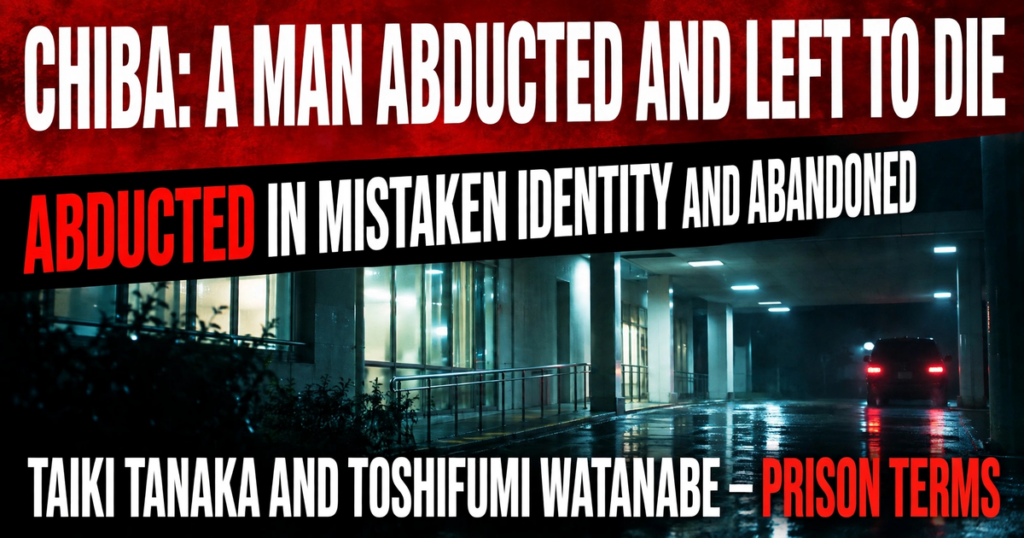
Tomohiro Shimamura was mistakenly abducted in Yashio, Saitama Prefecture, and beaten in a moving vehicle. Two men brought him to a hospital in Chiba before leaving without explaining what had happened. They were ultimately sentenced for assault resulting in death and corpse abandonment, not murder.
Two men brought an injured stranger to a hospital before leaving
At about 4:45 a.m. on 3 September 2020, two men brought a severely injured man to Chiba Chuo Medical Center in Wakaba Ward, Chiba City. They handed him to a security guard, saying only, “Please take care of this person,” and drove away without explaining where he had come from or what had happened. Hospital staff found that he was already dead and notified police. The man was identified as Tomohiro Shimamura, aged 32. The decision to leave without giving the hospital or police the circumstances of the case later became an issue in the corpse-abandonment proceedings.
The abduction began with a mistaken identity in Yashio
The violence had begun hours earlier in a restaurant car park in Yashio, Saitama Prefecture. Toshifumi Watanabe was looking for a different man with whom he had a financial dispute. He believed that the person he wanted was at the car park and went there with Daiki Tanaka. Shimamura was there by coincidence. He had no connection to the dispute and had never met the two men. Watanabe mistook him for the person he was seeking and decided to punish him. The distinction matters: Shimamura was not the target of the original grievance and had no known reason to expect an attack.
Shimamura gave his name, but the men did not accept his explanation
When the men approached him, Shimamura reportedly told them his name and tried to explain that he was not the person they were looking for. His explanation did not stop the confrontation. The men covered his mouth, forced him into a vehicle and drove away. During the journey they struck his head repeatedly. The Japanese account identifies an iron pipe and a metal implement worn over a fist among the weapons used. Shimamura lost consciousness in the vehicle. The attack was not a brief argument that ended when the mistake became apparent; the assailants continued the assault after he had been taken away.
About three and a half hours passed between the abduction and the hospital
The abduction occurred at approximately 1:20 a.m. on 3 September. Shimamura was taken from the Yashio restaurant car park and transported across prefectural boundaries to Chiba City. The two men reached Chiba Chuo Medical Center at about 4:45 a.m., roughly three and a half hours after the abduction. By then, Shimamura was said to have died from serious head injuries, including brain damage caused by strong impacts. The hospital transfer therefore did not amount to a successful rescue. It did, however, leave a trail that connected the two men, the vehicle and the hospital to the earlier assault.
Tanaka appeared at the police station and Watanabe was secured
Chiba Prefectural Police began investigating after the hospital reported the unexplained arrival of a dead man. Tanaka appeared at a police station on the same day, while Watanabe was also located and taken into custody. Both were first arrested on suspicion of corpse abandonment and injury resulting from unlawful confinement. Investigators then examined their statements, the route taken by the vehicle and the evidence of the assault. On 16 October 2020, police re-arrested both men on suspicion of murder. That re-arrest reflected the direction of the investigation; it did not determine the final charge or establish that a court would later find murderous intent.
The prosecution proceeded on assault resulting in death, not murder
The prosecutors ultimately charged Tanaka and Watanabe with assault resulting in death and corpse abandonment. They did not proceed with murder charges. Whether the men had intended to kill Shimamura, or had recognised and accepted that death might result, became a central issue in the proceedings. Prosecutors argued that the severity and manner of the blows supported an inference of murderous intent. The defence denied that either man had intended Shimamura to die. The eventual legal classification must therefore be kept separate from the earlier murder re-arrests: the convictions were for assault resulting in death, together with corpse abandonment and related offences.
Tanaka received eleven years after the court considered the hospital handover
Tanaka's trial included an argument about whether bringing Shimamura to a hospital could still constitute corpse abandonment. The defence said that taking an injured person to a medical facility was inconsistent with abandoning a body. The Chiba District Court rejected that position in the circumstances of this case. The men had handed Shimamura to a guard, withheld the circumstances and left without notifying the authorities or explaining the violence. On 24 August 2021, the court sentenced Tanaka to eleven years in prison. He did not appeal, and his sentence became final.
Watanabe was treated as the person who planned the punishment
Watanabe's role was assessed as more serious because he had been looking for the person involved in his financial dispute and had organised the punitive confrontation. The prosecution argued that he planned the retaliation and drew Tanaka into it. The court found that Watanabe had taken the leading role. The man they encountered was not the person they sought, but Watanabe continued with the attack after the mistaken identification. On 30 March 2022, the Chiba District Court sentenced him to fourteen years, against a prosecution request for fifteen years. Watanabe appealed, and the Tokyo High Court dismissed the appeal, leaving the fourteen-year sentence in place.
The case ended with two substantial sentences, but no murder convictions
The two sentences reflected different assessments of the defendants' roles: eleven years for Tanaka and fourteen for Watanabe. By March 2022, both outcomes had become final. The courts treated the mistaken abduction, the prolonged assault and the decision to leave the dying or deceased victim at the hospital without an explanation as serious criminal conduct. At the same time, the final convictions were not murder convictions. The distinction is important when describing the case: police initially pursued murder allegations, but the prosecution and courts ultimately dealt with assault resulting in death and corpse abandonment. Shimamura had been an uninvolved person caught in a dispute that was never his.
Original Japanese record: 千葉中央メディカルセンター男性置き去り死亡事件|島村智広さんを人違いで連れ去り、田中大樹と渡部俊文に実刑
Last updated:
Related articles
Case record
The Asaka Girl Confinement Case: Two Years of Psychological Control and a Twelve-Year Sentence
Case record
The Niigata Girl Confinement Case: 3,364 Days of Captivity and a Supreme Court Ruling on Sentencing
Case record
The Fujimino Hostage Shooting: A Home-Care Doctor Killed and a Life Sentence Finalized
Case record