
The Niigata Girl Confinement Case: 3,364 Days of Captivity and a Supreme Court Ruling on Sentencing
A nine-year-old girl disappeared in Sanjo, Niigata Prefecture, on November 13, 1990. She was found alive in a Kashiwazaki home on January 28, 2000, aged 19, after 3,364 days in captivity. The Supreme Court restored the original 14-year sentence for her abductor, Sato Nobuyuki.
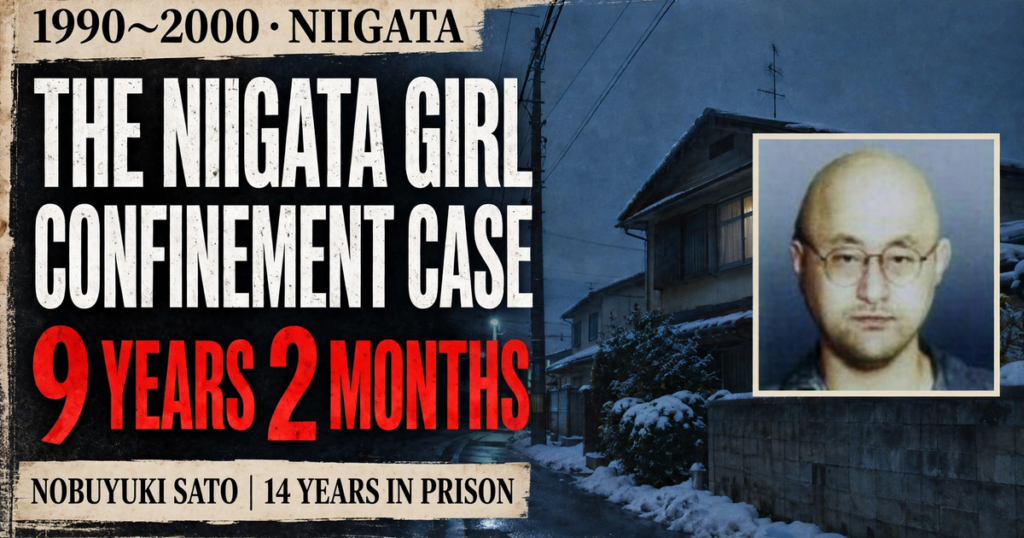
A nine-year-old girl disappeared while walking in Niigata
On November 13, 1990, a nine-year-old fourth-grade pupil disappeared in Sanjo City, Niigata Prefecture. Her disappearance began a search that would last for more than nine years. She had been abducted and held inside a house in nearby Kashiwazaki, where she was kept away from ordinary life and contact with the outside world. On January 28, 2000, police found her alive in the residence. She was then 19 years old. The period of confinement is commonly described as nine years and two months, or 3,364 days. The case was not a short episode of unlawful restraint: it deprived a child of almost her entire adolescence.
The rescue revealed the scale of the confinement
The girl had spent the years between childhood and young adulthood in a single residence. She had been separated from school, friends and ordinary social development. The Japanese source describes the period in terms of the length of time and the lasting physical effects, rather than treating the case as a sensational story. Legal research cited in the source notes reduced muscle strength in both legs and loss of bone mass after the prolonged confinement. Those injuries were relevant to the charge of kidnapping and confinement causing injury. The victim's current identity and private life are not needed to understand the crime and are not included here.
The offender had previously come to the attention of health services
During the period of confinement, Sato Nobuyuki's mother visited the Kashiwazaki public health centre in January 1996 to consult about her son's domestic violence and social withdrawal. Government records state that health-centre staff proposed home visits or telephone counselling, but the mother did not consent to those steps. She was advised to consult a psychiatrist and later visited a hospital approximately once or twice a month. The consultation did not lead to the discovery of the girl. The government's review distinguished the health centre's counselling response from the police investigation. The fact that a family had sought help did not mean that the authorities had been told that a child was being held in the home.
Sato was arrested and indicted after the girl was found
Sato was arrested on February 11, 2000, on suspicion of kidnapping a minor and unlawful confinement causing injury. He was indicted on March 3. Prosecutors also charged him with shoplifting four items of women's underwear, worth approximately 2,464 yen, which had been taken for the purpose of dressing the girl during the confinement. The theft was a relatively small amount in monetary terms, but it later became important to the legal question of how multiple offences should be combined when calculating the maximum sentence. The criminal case therefore concerned both the long-term deprivation of liberty and the statutory method for determining punishment when the offences were treated as a single group.
The District Court imposed a 14-year prison term
On January 22, 2002, the Niigata District Court sentenced Sato to 14 years in prison. At the time, the statutory maximum for the confinement-causing-injury offence, when combined with the theft under the applicable rules, produced a maximum sentence of 15 years. The District Court imposed a term close to that limit, taking account of the extraordinary length of the confinement and the injuries suffered by the victim. The sentence was not simply a calculation that the underwear theft had added several years. The court assessed the offences together, and the legal framework for doing so became the central issue in the appeal.
The High Court reduced the sentence to 11 years
On December 10, 2002, the Tokyo High Court set aside the District Court judgment and reduced the sentence to 11 years. It reasoned that the offences making up the combined crime should be assessed separately when determining their individual statutory limits, rather than treating the whole course of conduct as one unified sentencing range. The prosecution appealed, arguing that the High Court's method did not correctly apply Article 47 of the Penal Code, which governs the sentencing of multiple offences. The case therefore reached the Supreme Court not because the identity of the offender was in doubt, but because the courts disagreed about how to calculate the sentence for the combined offences.
The Supreme Court restored the 14-year sentence in July 2003
On July 10, 2003, the Supreme Court's First Petty Bench set aside the High Court judgment and rejected Sato's appeal, restoring the original 14-year sentence. The Court explained that Article 47 forms a unified sentencing range for the combined offences and does not contemplate calculating a separate sentence for each offence and then adding the results together. The confinement and the theft committed during it could therefore be assessed together within the statutory framework. The judgment became an important precedent on the sentencing of multiple offences, in addition to resolving Sato's sentence. The final term was 14 years, not the 11 years imposed by the High Court.
The investigation was later examined by the Diet and the government
After the rescue, questions were raised about why the girl had not been found earlier. Government answers acknowledged that the police had not identified Sato as a person of interest and that information about his methods had not been sufficiently digitised for searching. The police had established a task force of 107 people, but the number of officers assigned did not guarantee that relevant information would be connected. The mother's consultation with the public health centre was also examined, but the government described that response separately from the police investigation. Sato was reported to have been released in 2015 and to have died in Chiba Prefecture around 2017. The available reporting does not establish a detailed account of his later life or the circumstances of his death.
Original Japanese record: 新潟少女監禁事件|佐藤宣行の判決と出所後、9年2か月の監禁
Last updated:
Related articles

Case record
The Tochigi Lynching Murder: Two Months of Captivity, a Failed Rescue and the Police Negligence Ruling

Case record
The Pepper Lunch Case: A Customer Abducted from a Restaurant and the Twelve-Year Sentence for Its Manager
Case record
The Murder of Second-Grader Tamao Omomo

Case record