
The Fujimino Hostage Shooting: A Home-Care Doctor Killed and a Life Sentence Finalized
On January 27, 2022, a man in Fujimino, Saitama Prefecture, summoned seven home-care professionals to his house after his 92-year-old mother had died. When her physician explained that resuscitation was no longer possible, the man opened fire with a shotgun. The doctor was killed, a physical therapist was seriously wounded, and other medical workers were attacked. The defendant received life imprisonment; the Supreme Court dismissed his final appeal on July 14, 2026.
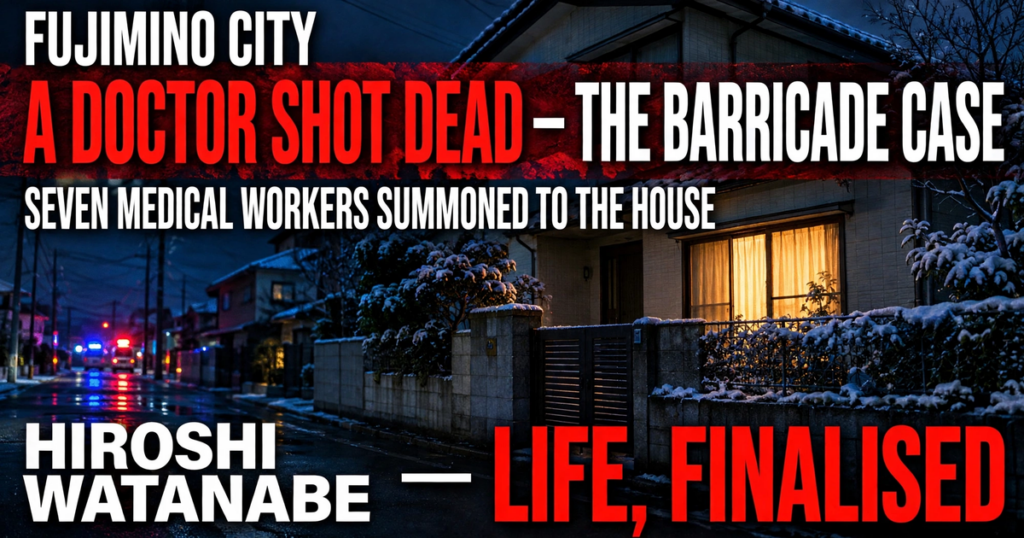
Seven medical professionals were called to a private home
The incident began on the evening of January 27, 2022, at a residence in Oi-Musashino, Fujimino, Saitama Prefecture. The resident, Watanabe, had been living with his 92-year-old mother, who received home medical care from a local clinic. She died on January 26. The following evening, Watanabe asked seven people connected with her care, including her physician, Dr. Suzuki, to come to the house and pay their respects. They arrived in response to what appeared to be a family request following a death.
A demand for resuscitation became the immediate point of confrontation
According to the prosecution account reported in court, Watanabe demanded that the visitors perform cardiopulmonary resuscitation on his mother. By then, approximately 30 hours had passed since her death. Suzuki explained that resuscitation was medically impossible. The disagreement was not a clinical decision about whether a living patient could be treated; the mother had already died. Watanabe nevertheless rejected the explanation and became hostile toward the medical personnel. The court later examined this exchange as part of the sequence leading to the shooting, rather than treating the mother's death itself as an excuse for violence.
The defendant had prepared firearms before the visitors arrived
The trial focused heavily on whether the shootings were deliberate or accidental. The Saitama District Court considered evidence that Watanabe had contacted a firearms dealer before the incident to ask whether a shotgun could fire more powerful ammunition. He had two shotguns and ammunition available. He had also written a note criticizing medical personnel. These circumstances mattered because they suggested preparation before the confrontation. The court assessed them together with the distance of the shots, the body areas targeted and the number of times the weapons were fired.
Suzuki was killed and other members of the visiting team were attacked
Watanabe fired a shotgun at Suzuki's chest. The shot caused a fatal rupture of the heart. He then shot a physical therapist in the right side of the abdomen, causing serious injuries including liver damage. A male medical social worker was sprayed in the face with a chemical irritant and was injured. Another medical social worker who had escaped outside was fired at with a second shotgun. The indictment therefore involved more than the murder of one physician: it also included attempted murder and injury allegations arising from attacks on other members of the visiting team.
A voice recording preserved part of the encounter
A voice recorder carried by members of the medical team captured conversations about the mother's condition and sounds from around the time of the shooting. The recording was played in court during the 2023 lay-judge trial. It gave the judges and lay judges material that could be compared with witness testimony and the physical evidence. The court did not treat the recording as a complete explanation of every moment. Instead, it considered the audio alongside the defendant's preparations, the firearms, the distances involved and the direction of the shots when deciding whether he had intended to kill.
The hostage situation continued for about eleven hours
After the shooting, Watanabe remained inside the residence with Suzuki, who had been gravely wounded. Police officers negotiated with him while emergency responders were unable to reach the physician. The stand-off continued overnight. On the morning of January 28, Saitama Prefectural Police entered the house and took Watanabe into custody. Suzuki was rescued but was confirmed dead. The roughly eleven-hour stand-off prolonged the danger to the people inside and delayed medical access to the injured doctor. The incident ended with Watanabe's arrest, not with a negotiated release.
The prosecution and first-instance trial
Watanabe underwent court-ordered psychiatric observation for approximately three months beginning on March 3, 2022. The Saitama District Public Prosecutors Office indicted him on July 1, 2022, for murder, attempted murder and related offences. At trial, the defence disputed intent, arguing in substance that the fatal shot was not fired with an intention to kill and that some later shots were accidental or intended only as warnings. The prosecution sought life imprisonment, relying on the advance preparation of the weapons and the manner in which they were used at close range.
The district court imposed life imprisonment on December 12, 2023
On December 12, 2023, the Saitama District Court found that Watanabe had acted with intent to kill in the attacks covered by the indictment and imposed life imprisonment, as requested by the prosecution. The court placed weight on the inquiries about ammunition, the preparation of two shotguns, the close-range shot directed at Suzuki's chest and the continuing use of the weapons. The loss of Watanabe's mother was considered as background, but it did not remove his criminal responsibility. Members of Suzuki's family also used Japan's victim-participation system to address the court about the loss and its effects on their lives.
The appeals ended with a final life sentence
Watanabe appealed, disputing the finding of intent and the sentence. On March 11, 2025, the Tokyo High Court dismissed the appeal and upheld the district court's judgment. The appellate court agreed that the use of a highly lethal shotgun at close range, the targeting of the chest and the repeated firing supported the finding of intent. On July 14, 2026, the Supreme Court's Third Petty Bench dismissed his final appeal. The life sentence therefore became final. The Supreme Court decision ended the criminal proceedings; it was not a new trial of the underlying facts.
The case prompted renewed attention to the safety of home-care workers
After the incident, the Ministry of Health, Labour and Welfare highlighted the safety of professionals who provide medical care in patients' homes. Its materials refer to the Fujimino shooting and call for stronger cooperation among prefectural medical associations, health-care providers and police. The materials also discuss safety training, consultation routes and the use of multiple workers when a risk is identified. Home visits place professionals in a private environment that they do not control. The policy response was not to abandon home care, but to improve risk assessment, information sharing and practical arrangements for protecting staff.
Original Japanese record: ふじみ野市散弾銃男立てこもり事件|医療関係者7人を呼び出した銃撃と無期懲役確定
Last updated:
Related articles
Case record
The Chiba Chuo Medical Center Abandonment and Death Case
Case record
The Urawa Game-Center Murder: The Unsolved Killing of a 73-Year-Old Employee Near Kita-Urawa Station
Case record
The Wako City Honcho Nurse Murder
Case record