
The Sagamihara Care-Facility Attack: The Former Employee Who Killed Nineteen — From a Warning Letter to a Death Sentence and the Following Decade
On 26 July 2016, former employee Satoshi Uematsu attacked residents at Tsukui Yamayuri En in Sagamihara, killing 19 and injuring 26. Five months earlier, he had delivered a letter to the Speaker of the House of Representatives' residence warning of a mass killing of disabled people. Police and the facility knew of his dangerous statements, and sixteen security cameras were installed, but the attack still occurred. The Yokohama District Court found full criminal responsibility and imposed a death sentence in 2020. Uematsu's second retrial request was rejected by the Supreme Court on 29 September 2026.
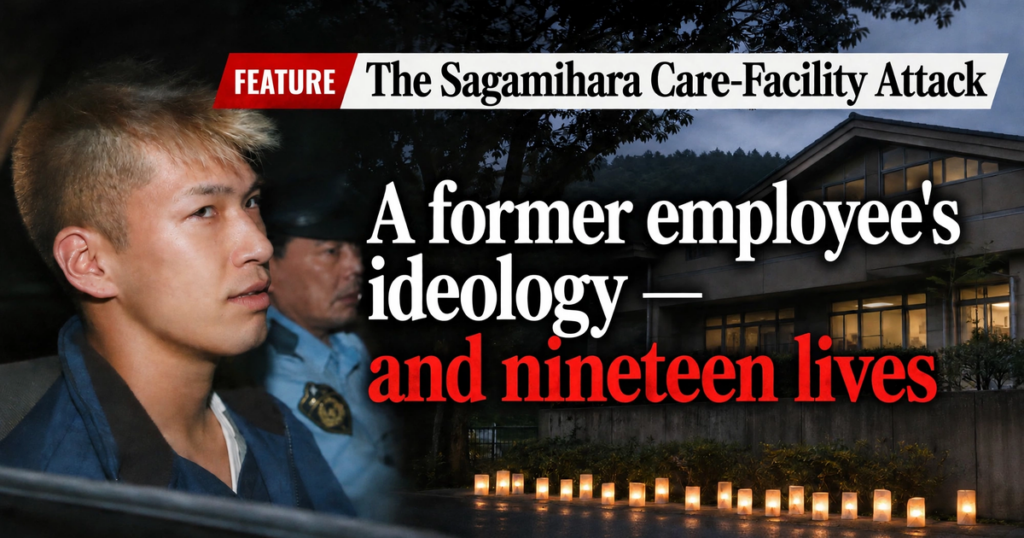
Introduction: A warning had been made five months before the attack
In the early hours of 26 July 2016, nineteen residents at Tsukui Yamayuri En, a residential facility for people with disabilities in Sagamihara, were killed while they slept. A further 26 people were injured. The offender, Satoshi Uematsu, had worked at the facility until only a few months earlier. About five months before the attack, he had delivered a letter to the residence of the Speaker of the House of Representatives warning of a mass killing of disabled people. Police and facility staff had also become aware of his dangerous statements. Yet the attack still occurred.
Why did the warnings fail to prevent the crime? How did the court assess the offender's attempt to exclude people with disabilities? And ten years after the attack, how have the lives of people who lived at the facility continued? This feature examines the line the offender drew around whose lives he considered valuable through the judgment and the experiences of survivors.
Nineteen deaths in one night: 157 people had lives at the facility
Tsukui Yamayuri En was a prefectural residential facility in Chigira, Midori Ward, Sagamihara City, Kanagawa Prefecture. It was established by Kanagawa Prefecture and operated by the social welfare corporation Kanagawa Kyodo-kai under a designated-management arrangement. On the night of the attack, 157 service users were at the facility: 149 residents and eight people using short-term accommodation. Eight staff members were on night duty. These figures were recorded in material compiled by the prefecture immediately after the incident.
The number 157 does not simply describe the capacity of a facility. It represents people sleeping in their usual rooms and waiting for breakfast or activities the next morning. Some communicated their wishes through words; others used facial expressions and movements. Staff supported them, and family members elsewhere waited for visits or for them to return home.
At about 1:43 a.m. on 26 July 2016, according to the final judgment of the Yokohama District Court, Uematsu entered the facility grounds. He restrained staff members and moved through the residential buildings, attacking 43 residents with knives. Nineteen residents died, 24 residents were injured and two staff members were also hurt, making 26 injured people in total. The attacks were found to have continued until about 2:48 a.m. Uematsu then went to a police station and surrendered.
The attack was not an accidental crime by a stranger who entered from outside. Uematsu was a former employee who could know where residents lived and how staff moved at night. The court found that he selected victims according to his own criteria and changed his actions in response to the situation. This was important to its assessment of planning and responsibility.
The offender's claim that some residents could not communicate must not be accepted as an objective description of those people. It was a classification invented by Uematsu. Difficulty speaking does not mean a person has no feelings or wishes.
The warning letter and the limits of involuntary hospitalisation
On 15 February 2016, Uematsu brought a letter to the residence of the Speaker of the House of Representatives. It described a plan to kill large numbers of people with severe disabilities. The letter contained discriminatory claims and a request for political action. The danger was not hidden: the content was serious enough for officials and police to take notice.
Uematsu left the facility on 19 February. He was then admitted to hospital under the system of involuntary hospitalisation, and was discharged on 2 March. The existence of a psychiatric condition and the legal requirements for continuing involuntary admission are separate questions. A person cannot be kept in hospital indefinitely solely because others fear that they may commit a crime in the future if the statutory conditions for admission are no longer met.
The prefectural verification report and the court judgment did not conclude that continuing hospitalisation would certainly have prevented the attack. The support provided after discharge, including medical and welfare services, and the response to a concrete threat of violence at the facility had different purposes and were governed by different systems. They could be coordinated, but one did not replace the other.
This is also not a claim that people with mental disorders generally are violent. The court examined Uematsu's own mental state and discriminatory ideology in the context of his individual conduct. Explaining a dangerous ideology away with the general label of mental illness would obscure the discrimination itself.
Sixteen security cameras did not prevent a night-time intrusion
The facility had not stopped being concerned about its former employee. The prefectural verification materials record that staff consulted police on 5 March, decided to install security cameras on 7 March and installed sixteen cameras on 26 April. Staff members were also warned to remain alert.
During the attack on 26 July, Uematsu broke a window and entered the building. Night staff were restrained, and residents in several rooms were attacked. Installing cameras was one measure, but it did not create a system that could prevent entry by itself. The prefectural investigation committee identified further issues, including strengthening building openings, installing intrusion-detection devices, improving communication between staff and conducting emergency drills.
Looking back, it is easy to list measures that might have been taken. But the staff were responsible for supporting 157 residents at night, while also facing the difficult task of protecting their lives without turning the facility into an excessively closed environment. If the only question is why the building was not made more secure, the answer may become that a facility should be turned into a fortress. Security is necessary, but residents must also retain opportunities to live freely and remain connected with their communities. Safety and quality of life should not be treated as mutually exclusive.
The Yokohama District Court asked whether Uematsu could make decisions
The lay-judge trial began at the Yokohama District Court on 8 January 2020. It involved seventeen hearings, and judgment was delivered on 16 March. Uematsu largely admitted the acts charged. The central dispute was his criminal responsibility at the time of the attack.
The defence argued that symptoms associated with cannabis use and mental illness had affected his ability to judge his actions, and claimed that he was legally insane or had diminished responsibility. The prosecution argued that he had full criminal responsibility. The court focused on how he organised his conduct: he prepared knives and restraints in advance, entered the facility, restrained staff, selected residents according to his own belief that they could not communicate and adjusted his actions to the circumstances. He then went to the police himself. The court found that he understood the situation and adjusted his actions to achieve his purpose.
The fact that Uematsu held discriminatory beliefs and the question of whether those beliefs were formed through a mental disorder that detached them from reality were not the same issue. The court considered that his ideology had developed through his own interpretation of experiences while working at the facility and did not find that a pathological thought process had controlled the crimes.
This legal assessment did not endorse his discriminatory beliefs. It meant that even an irrational belief does not remove criminal responsibility if the person chooses it, turns it into a plan and carries it out. The court regarded the nineteen deaths and injuries to many others, together with the planned and malicious nature of the attack, as extremely serious and imposed a death sentence.
Uematsu himself withdrew the appeal
After the judgment, defence counsel filed an appeal. Uematsu himself then withdrew it, and the death sentence became final on 30 March 2020. The case therefore became final without a full appeal hearing in the High Court. This is an important feature of its procedural history.
Finality did not mean that discussion of the judgment was impossible. Uematsu later sought a retrial. His first retrial request was made in 2022; the refusal to reopen the case became final at the Supreme Court in October 2025. In January 2026, he filed a second retrial request. The Yokohama District Court rejected it, and the Tokyo High Court maintained that decision in August 2026.
On 29 September 2026, the Supreme Court rejected the special appeal concerning the second retrial request. Reports on 30 September said the decision refusing a retrial had become final. As of November 2026, it is therefore incorrect to say that the second retrial request remains pending at the Supreme Court. The refusal to reopen the case did not impose a new death sentence; it meant that the procedure for seeking to reopen the final 2020 judgment had not been accepted.
The offender selected whose lives he considered valuable
It is difficult to decide how much of Uematsu's discriminatory statements should be repeated. Publishing his words at length does not necessarily help readers understand the crime and may instead spread language that denies the existence and dignity of people with disabilities. What matters is the core of the ideology and how it was connected to actual conduct.
Uematsu expressed the belief that people with severe disabilities whom he personally judged unable to communicate with others could be excluded from society. He did not seek to understand their words or feelings. He did not ask about their wishes. He decided by himself whether other people deserved to live.
The selection recognised by the Yokohama District Court was a concrete expression of that ideology. He attacked residents who were not resisting, using his own prejudice rather than their abilities or wishes as the criterion. It is not enough to describe the ideology as a simple misunderstanding that people with disabilities are unhappy. It involved a dangerous idea that human dignity could be measured by social usefulness or by how a person communicated. Uematsu turned that idea into a plan to kill.
The trial did not establish every factor that decisively shaped the ideology. His work experience, personality, the reactions of people around him and discriminatory language in society may all be relevant, but the evidence does not justify naming one of them as the sole cause. Explaining an offender's ideology is not the same as simplifying the reasons in a way that excuses it.
The nineteen victims' names and the time taken to remember them
Immediately after the attack, Kanagawa Prefectural Police announced the names of the nineteen victims anonymously, taking account of the wishes of bereaved families. In major criminal cases, victims' names are often reported, but for a long period this case was widely remembered through the number nineteen alone.
Some families wanted their relatives' names made public; others did not. Some wished to protect their loved ones from prejudice against disability, while others wanted their names to remain as evidence that they had lived. Neither position can simply be declared the correct one for every family.
Names have gradually been added to a memorial at the facility with the consent of bereaved relatives. Reports said that an eleventh name was added in July 2026 and a twelfth in September. Even when a family consents to having a name engraved at the memorial, that does not necessarily mean it wants the name widely publicised in the media. This feature does not seek out and list the names of people whose families have not wished them to be made public.
The fact that nineteen people lived individual lives must remain at the centre of the account. Their days at the facility, favourite foods and music and relationships with family cannot be seen from a list of deaths. Those were the things that Uematsu took away.
Kazuya Ono rebuilt a life in the community after surviving
The case cannot end with “nineteen dead and twenty-six injured.” The people who survived have had their own decade since the attack. In a July 2026 interview with TBS, Kazuya Ono, one of the residents who suffered serious injuries, spoke about his life after the incident. He had once been close to death. For a time afterward, he did not want to eat even a favourite rice ball offered by his mother, and felt strong anxiety when travelling in the direction of the facility.
In 2020, Ono left the facility where he had lived for many years and began living in an apartment near his family home. He uses the system of intensive home-visit care and receives support from care workers. He can go shopping, choose what he wants to eat and decide when to bathe. These may look like small everyday actions, but they are part of living one's own life.
His caregiver, Yasuki Otsubo, said that life in the community may have helped Ono regain confidence. Reports also said that seven years after the attack, Ono was able to visit the facility for the first time to lay flowers. Uematsu decided, according to his own arbitrary standard, whose life had value. But Ono's preferred way of living was never for Uematsu to decide. Needing support or communicating without the same words as other people does not make a person's life less meaningful.
The facility was rebuilt, but restoration meant more than returning to the past
After the attack, Kanagawa Prefecture considered how the facility should be rebuilt. In 2016, it initially announced a policy of rebuilding the entire facility. In 2017, that policy was revised and a basic plan was drawn up that placed greater emphasis on smaller living arrangements and transition into the community rather than simply reproducing a large, segregated institution.
The new Tsukui Yamayuri En building was completed in July 2021 and began accepting residents again in August. The new Serigaya Yamayuri En building was completed in November 2021 and began receiving residents in December. The facilities again became places where people lived, but the aim was not merely to restore the previous physical arrangement.
The prefecture placed support for each person's decision-making at the centre of the recovery plan. Even where someone cannot easily express a choice in words, supporters can consider past preferences, everyday reactions and changes through experience when thinking about where and with whom the person wants to live. The aim is to prevent decisions from being made for the convenience of others.
The plan has not removed every difficulty. Moving away from a familiar place can be stressful; community support must be secured; and there may be shortages of staff and housing options. The prefectural review also noted that some housing choices had to be made under time pressure and that the COVID-19 pandemic limited opportunities for residents to visit and experience new places. In fiscal year 2026, the “Tomoi-ki Friend” programme began using interaction between facility residents and local people to support decision-making. Ten years after the attack, some initiatives were only just beginning.
The 2026 memorial and unresolved social questions
On 25 July 2026, a memorial ceremony was held in Sagamihara to mark ten years since the attack. The following day, flowers were placed at the monument at Tsukui Yamayuri En. The facility's director spoke about how every person has feelings and wishes, regardless of the severity of a disability. The governor of Kanagawa also acknowledged that it could not be said that society had changed sufficiently over the ten years.
The prefecture's Charter for a Society of Coexistence, support for decision-making by people with disabilities and legislation placing the person at the centre of support were responses to the issues exposed by the attack. But saying “never again” does not by itself change society. Are there homes where people with disabilities can live in the community? Can people who need support continue the lives they want? Are their choices respected inside institutions? Can discriminatory language be challenged when it spreads in ordinary conversation and online?
Investigating where the offender's ideology came from and preventing similar prejudice from remaining in society are both necessary. The death sentence against Uematsu did not resolve the latter issue. Ten years after the attack, the criminal judgment remains final and the second retrial request has also been rejected. But the questions about disability, autonomy, community living and the preservation of dignity continue.
At a glance
Date: early hours of 26 July 2016. Location: Tsukui Yamayuri En, Midori Ward, Sagamihara, Kanagawa Prefecture. Victims: 19 residents killed; 24 residents and two staff members injured, for 26 injured in total. Offender: Satoshi Uematsu, aged 26 at the time, a former employee of the facility from December 2012 to February 2016. Before the attack: on 15 February 2016, he delivered a letter warning of a mass killing to the Speaker of the House of Representatives' residence; he left the facility on 19 February, was admitted involuntarily and discharged on 2 March. Security: sixteen cameras installed on 26 April 2016. Judgment: on 16 March 2020, Yokohama District Court found full criminal responsibility and imposed death; Uematsu withdrew his appeal and the sentence became final on 30 March 2020. Retrial: first request finally rejected in October 2025; second request finally rejected after Supreme Court dismissal on 29 September 2026. Ten-year memorial events were held in July 2026.
Original Japanese feature: 相模原障害者施設殺傷事件【特集】|19人の命を奪った元職員――予告の手紙から死刑判決、その後の10年
Last updated:
Related articles
Same case · Case record
Sagamihara Care Home Attack: Third Retrial Petition Accepted
Case record
The Kyoto Animation Arson Attack: 36 Deaths, Criminal Responsibility and the Disputed Appeal Withdrawal
Case record
The Maebashi Snack Bar Shooting: Four Killed, Including Three Uninvolved Customers
Case record