The Neyagawa Junior-High-School Double Murder: Two Victims and the Procedural Dispute That Made a Death Sentence Final
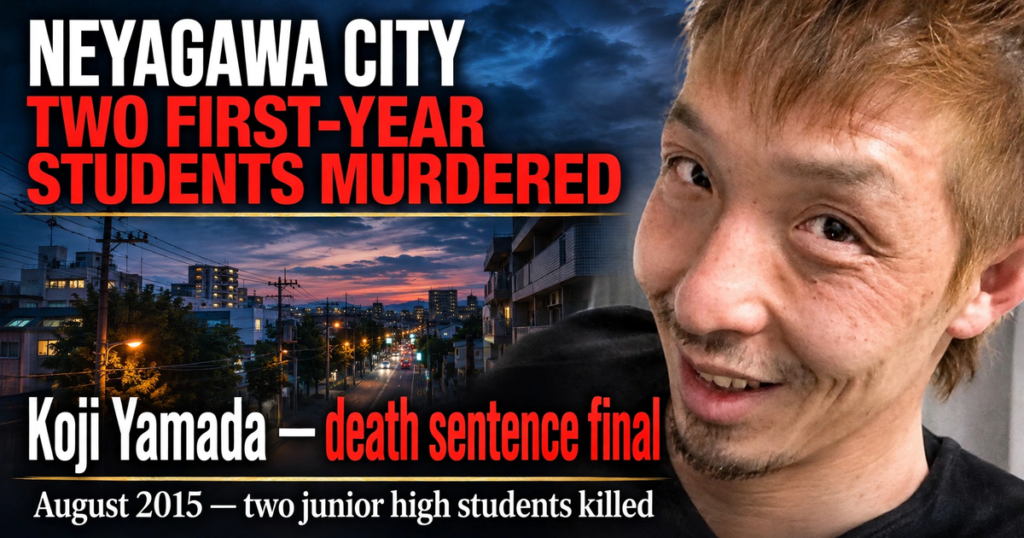
Thirteen-year-old Natsumi Hirata was found dead in a Takatsuki parking area late on 13 August 2015. Her 12-year-old classmate Ryoto Hoshino was found dead in a wooded area in Kashiwara eight days later. Kōji Yamada was sentenced to death by the Osaka District Court on 19 December 2018. The case did not receive a merits judgment from the High Court: the central appellate issue became whether Yamada's withdrawal of his appeal was valid. The Supreme Court rejected the defence's special appeal on 25 August 2021, leaving the first-instance death sentence final.
Two junior-high-school students disappeared in August 2015
In the early hours of 13 August 2015, Natsumi Hirata, a 13-year-old first-year junior-high-school student, and her classmate Ryoto Hoshino, aged 12, were together around Neyagawa City Station in Osaka Prefecture. Security-camera footage recorded the two moving through the area during the night and early morning. Their movements were later traced through footage from roads, shops and other locations. The final visible images around 5 a.m. became part of the investigation. The case involved two children who disappeared together, but their bodies were found at separate locations and on different dates.
Hirata was found in Takatsuki and Hoshino in Kashiwara
Late on 13 August, Hirata's body was found in a parking area near a logistics facility in Takatsuki. Her body had been wrapped with adhesive tape and bore multiple injuries. Hoshino remained missing. On 21 August, police found his body in a bamboo grove in Kashiwara after tracing a vehicle and investigating places where the suspect had stopped. The eight-day interval between the two discoveries was significant to the search and the reconstruction of the events. The two deaths were investigated together, but the evidence relating to each victim and the defence arguments concerning each death were examined separately at trial.
The investigation linked a vehicle to the two victims
Police gathered security-camera recordings from the station area, roads, shops and locations near the places where the bodies were found. Investigators compared the times and routes of a vehicle later associated with Kōji Yamada. The case did not depend on a single recording that showed the entire offence. Instead, the prosecution relied on a chain of circumstantial evidence, including the movements of the victims, the vehicle, communications and materials recovered during the investigation. Yamada was first arrested on suspicion of abandoning Hirata's body and was later prosecuted for the murders of both students.
The defence disputed intent and the cause of Hoshino's death
At trial, Yamada denied that he intended to kill the two students. The defence argued that Hirata's death might amount to injury resulting in death rather than murder. In Hoshino's case, the defence suggested that an unexpected medical event could have caused death and disputed that Yamada had killed him. The court examined the medical findings, the circumstances of the victims' deaths and the surrounding evidence. The prosecution argued that both students died from strong pressure to the neck and that the circumstances demonstrated murderous intent. The district court accepted the prosecution's case and rejected the defence arguments.
The Osaka District Court imposed the death penalty
On 19 December 2018, the Osaka District Court sentenced Yamada to death. It found him guilty of murdering both Hirata and Hoshino and found that he had full criminal responsibility. The court did not describe the killings as the result of a highly elaborate advance plan. Nevertheless, it considered the fact that two young teenagers had been killed, the circumstances of the offences, the disposal of the bodies and Yamada's criminal history. The defence appealed on the day of the judgment, and Yamada later also filed an appeal. The sentence was therefore not final at the moment it was delivered.
The first appeal withdrawal was disputed
On 18 May 2019, Yamada submitted a document withdrawing his appeal. If valid, the withdrawal would have allowed the district court's death sentence to become final without a High Court review of the merits. The defence argued that the withdrawal was invalid because of concerns about Yamada's mental state and his understanding of the consequences. On 17 December 2019, the Osaka High Court ruled that the first withdrawal was invalid and that the appeal proceedings should continue. Prosecutors challenged that procedural decision. On 25 February 2020, the Supreme Court dismissed their special appeal on procedural grounds, holding that the matter first had to be pursued through an objection within the High Court. That decision did not determine the validity of Yamada's withdrawal on the merits.
A second withdrawal and further procedural review
After further proceedings over the first withdrawal, Yamada submitted another withdrawal document on 24 March 2020. The Osaka High Court later considered whether he understood that withdrawing the appeal would make the death sentence final. On 26 November 2020, a High Court panel treated the second withdrawal as valid. The defence challenged that ruling, and the High Court rejected the objection on 22 March 2021. The defence then filed a special appeal to the Supreme Court. These steps were unusual because the courts were examining the validity of the appeal withdrawal rather than conducting a full appellate review of the evidence and sentence.
The Supreme Court's 2021 decision made the first-instance death sentence final
On 25 August 2021, the Supreme Court's Third Petty Bench dismissed the defence's special appeal. The withdrawal of the appeal was therefore treated as effective, and the death sentence imposed by the Osaka District Court on 19 December 2018 became final. The Supreme Court did not conduct a merits appeal on the murder convictions or the choice of the death penalty. It resolved the procedural challenge to the withdrawal. It is therefore inaccurate to say that the Supreme Court independently affirmed the factual findings or the sentence after a full merits review.
Why the procedural history matters
The final outcome was a death sentence, but the route to finality was not a conventional High Court judgment followed by a Supreme Court appeal. The first-instance court made the substantive findings. The appellate proceedings focused on whether Yamada's withdrawal of his appeal was valid. The Supreme Court's decision on 25 August 2021 ended that procedural dispute and left the district court judgment in place. This distinction matters to an accurate record of Japanese criminal procedure. The two victims must be remembered by name and age, while the legal history must distinguish a trial judgment from a final sentence reached through an effective appeal withdrawal.
The tape purchase and the sentence's status in 2026
Investigators also traced Yamada's purchase of adhesive tape at a shop near the area where Hoshino's body was later found on 13 August 2015. The purchase was one part of a wider chain of circumstantial evidence, not standalone proof. Yamada later changed his surname while in custody; contemporary reporting continued to identify him by the name used at trial, Kōji Yamada. The Japanese source reported that the death sentence had not been carried out as of 27 August 2026. The final sentence remains the 2018 Osaka District Court judgment, made final through the valid appeal withdrawal rather than a High Court or Supreme Court merits judgment.
Original Japanese record: 寝屋川市中1男女殺害事件|平田奈津美さん・星野凌斗さん殺害と控訴取下げで確定した死刑
Last updated: