The Miyazaki Family Triple Murder
On 1 March 2010, Akihiro Okumoto killed his wife, his mother-in-law and his five-month-old son at a home in Miyazaki City. The Supreme Court found that he had decided to kill all three several days earlier and had taken a hammer from work. He buried the infant's body at a worksite and staged the scene to suggest a robbery. His death sentence became final in November 2014.
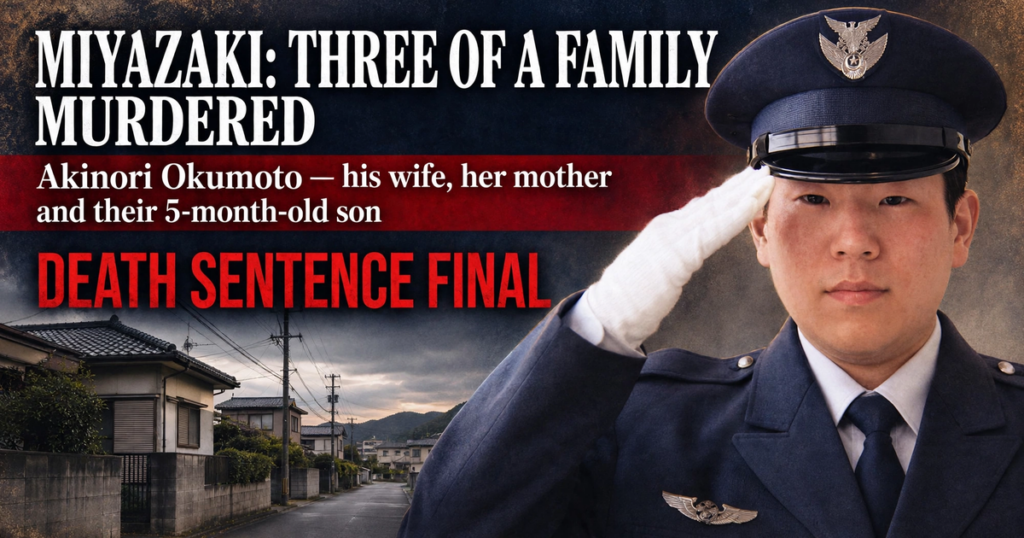
Three members of a family were killed on 1 March 2010
Early on 1 March 2010, Akihiro Okumoto, aged 22, killed three members of his family at a home in Miyazaki City. The victims were his wife, Kumiko, aged 24; his mother-in-law, Takako Ikegami, aged 50; and his five-month-old son, Yuto. The killings took place within the household where the four had been living. The infant's body was later buried at a materials-storage area at Okumoto's workplace. The bodies of his wife and mother-in-law remained at the home while he attempted to disguise what had happened.
The household had become strained after the marriage
According to the Supreme Court findings summarized in the Japanese article, Okumoto had married Kumiko about a year before the killings. He, his wife, their infant son and Ikegami lived together. The court found that Ikegami repeatedly criticized and reprimanded Okumoto, including in relation to his conduct and his parents. He had difficulty dealing with the conflict and wanted to escape the household situation. The judgment acknowledged that the pressure he experienced was relevant to the sentencing assessment, but it did not make the later killings lawful or excusable.
The Supreme Court found that he had decided to kill all three several days earlier
The Court found that Okumoto had decided to kill the three family members several days before the incident and had considered how to do it. On the night before the killings, he took a hammer from a storage area at his workplace. This evidence was important because it showed that the offences were not simply the result of a sudden argument on the morning of 1 March. The judgment described the plan as considerably deliberate, while not equating it with a long-term professional criminal operation.
The infant was killed first
The Supreme Court found that Okumoto first attacked his five-month-old son, Yuto. He compressed the child's neck with his hands and then submerged the child's body in bathwater, causing death by asphyxiation. Yuto was not involved in the conflict between Okumoto and his mother-in-law. The court regarded the decision to include the infant in the plan as a particularly grave feature of the case. The translation records the sequence and legal finding without unnecessary graphic detail.
Okumoto then killed his wife and mother-in-law
Okumoto attacked his sleeping wife with a kitchen knife. When she woke, he stabbed her in the neck and then struck the back of her head repeatedly with the hammer. The Supreme Court found that these injuries caused her death. When Ikegami woke and stood up, Okumoto struck her on the head with the hammer and continued the attack after she fell. The Court characterized the attacks on the two women as persistent acts carried out with a firm intent to kill.
He buried the infant's body and staged the home as a robbery scene
After the killings, Okumoto transported Yuto's body to a materials-storage area at his workplace, dug a hole and buried it. He considered moving the bodies of his wife and mother-in-law as well but did not do so. Instead, he disturbed the home and removed valuables to create the appearance that an outside robber had entered and killed the women. He hid some of the property in nearby vegetation. The staging was intended to divert suspicion toward an unknown intruder.
He called the police but eventually admitted the killings
Okumoto himself contacted the police after arranging the scene. As investigators questioned him, inconsistencies in his explanation raised suspicion. The child's body was found at the workplace. Okumoto then admitted killing all three family members. He did not contest the central acts charged at trial. As a result, the proceedings focused primarily on his motive, mental condition, degree of planning and whether the death penalty was appropriate, rather than on whether he was the person who had committed the killings.
The defence and prosecution addressed the death-penalty question
The prosecution sought the death penalty, emphasizing the three deaths, the inclusion of an infant, the advance decision to kill and the effort to disguise the scene. The defence argued that the difficult relationship with Ikegami and Okumoto's psychological condition should be taken into account. The Japanese article explains that the court did not treat the pressure from the mother-in-law as irrelevant. It considered it as a circumstance favourable to Okumoto, while also examining why he extended the killings to his wife and child.
The Supreme Court separated sympathy for the household conflict from responsibility for the other killings
The Supreme Court recognized that Okumoto had struggled with his mother-in-law's repeated criticism and that his desire to escape that situation had some basis for sympathy. But it found that this did not explain killing Kumiko and Yuto. Okumoto decided that he would kill his wife to avoid being arrested after killing Ikegami, and treated his infant son as inseparable from his wife. The Court regarded this as an extremely selfish expansion of the plan. The family conflict could be considered in mitigation, but it could not erase responsibility for the three deaths.
The Miyazaki District Court imposed death in December 2010
On 7 December 2010, the Miyazaki District Court sentenced Okumoto to death. He had admitted the offences, and the principal issue was sentence. The court considered the three victims, the preparation over several days, the use of a hammer taken from work, the concealment of the infant's body and the staged robbery scene. It also considered the circumstances within the household. The district judgment was the first stage of the criminal proceedings and was subject to appeal.
The Fukuoka High Court and Supreme Court maintained the sentence
On 22 March 2012, the Fukuoka High Court's Miyazaki branch dismissed Okumoto's appeal. The Supreme Court dismissed his final appeal on 16 October 2014. The Supreme Court acknowledged the difficult family circumstances but found the responsibility for killing three people, including his wife and infant son, extremely serious. The death sentence became final in November 2014. These are distinct procedural stages: the district court imposed death, the High Court dismissed the appeal, and the Supreme Court dismissed the final appeal.
The current legal status is a final death sentence
The Japanese article, updated in November 2026, lists Okumoto as a death-row inmate held at Fukuoka Detention Center. It does not report an execution. The case should therefore be described as one in which the death sentence became final in 2014, not as an executed sentence. The three victims must also remain individually identified in the record: Kumiko, Ikegami and the five-month-old Yuto. The sentencing analysis considered the household conflict, but the court found no basis to extend sympathy for that conflict to the killing of the wife and infant.
A retrial request was rejected, and Okumoto asked for earlier execution in 2025
After the death sentence became final, Okumoto sought a retrial, but the request was rejected and the death sentence remained in force. In 2025, he submitted a written request asking the authorities to carry out the sentence sooner. The request was a statement made by a condemned prisoner after finality; it did not reopen the case or alter the judgment.
Original Japanese record: 宮崎家族3人殺害事件|奥本章寛が妻・義母・生後5か月の長男を殺害、死刑確定まで
Last updated: