The Kawasaki Care Home Serial Falls
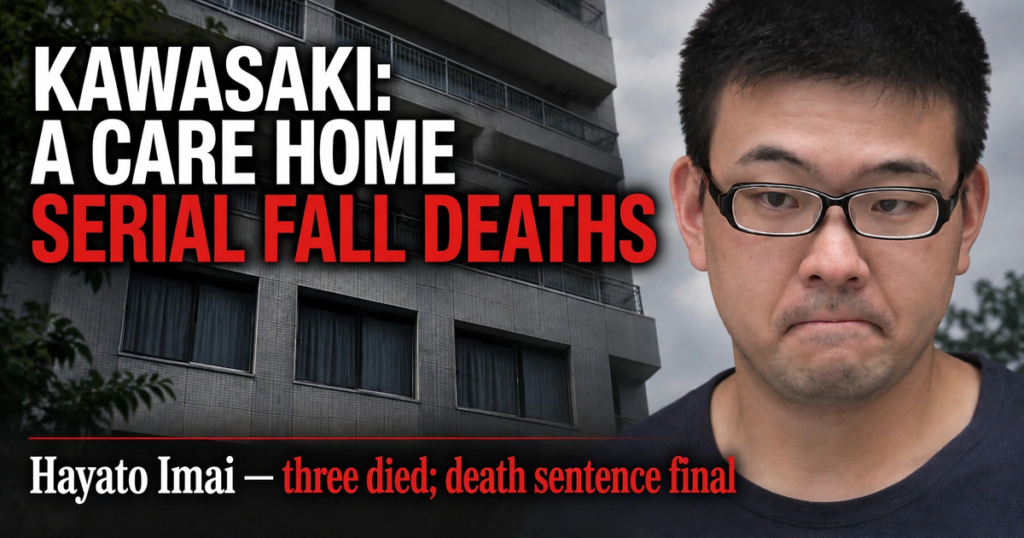
Three elderly residents died after falling from balconies at a care home in Kawasaki between November and December 2014. Care worker Hayato Imai was convicted of three murders and sentenced to death; the sentence became final after he withdrew his Supreme Court appeal in May 2023, and he later sought a retrial.
Three residents died at the same care home in late 2014
Between November and December 2014, three residents of S Amiyu Kawasaki Saiwaicho, an assisted-living care home in Saiwai Ward, Kawasaki City, died after falling from balconies. The deaths occurred at night or in the early morning and were initially treated as falls. The victims were elderly residents who required care: Tamio Ushizawa, aged 87; Chieko Nakagawa, aged 86; and Fumiko Asami, aged 96. The same facility and the short interval between the deaths later became central to the criminal investigation.
The three falls occurred on separate dates and floors
The first incident involved Ushizawa, who fell from the fourth-floor balcony of room 403 during the night of 3 to 4 November 2014. The Tokyo High Court judgment found that Imai carried him in his arms and took him over the balcony fence, causing him to fall approximately 10.5 metres to a courtyard. Nakagawa died after falling from a fourth-floor balcony on 9 December. On 31 December, Asami fell from the sixth-floor balcony of room 601, approximately 16.8 metres above the ground.
The possibility of accident or suicide was contested
The defence argued that the residents might have climbed over the balcony barriers themselves, either accidentally or intentionally. There was no video recording of the fatal acts and no eyewitness who saw the residents being pushed. The courts therefore considered the residents' physical condition, the balcony design, the locations where they landed and the circumstances of each fall. The district and High Courts rejected the explanation that the three residents had independently climbed over the barriers, finding that the deaths were caused by another person.
Imai's access to the residents was one part of the evidence
Hayato Imai was 22 and worked as a care worker at the facility at the time of the deaths. He was on duty on the nights when all three falls occurred and had access to residents and different parts of the building. Work schedules and the timing of each incident were examined. The courts did not treat his presence at work as sufficient by itself. They considered the opportunity to commit the offences together with the physical circumstances, statements made during the investigation and other evidence about events before and after each death.
Imai admitted the killings during questioning but denied them at trial
After his arrest in February 2016, Imai made statements admitting involvement in the three deaths. At trial, however, he denied the charges and said that the statements were false. The defence argued that he had felt pressure from investigators and believed that cooperation would protect him and his family from media attention. The credibility and voluntariness of the statements became important issues. The court had to distinguish a statement made during interrogation from a reliable account supported by the rest of the evidence.
The first-instance court imposed the death penalty in 2018
On 22 March 2018, the Yokohama District Court sentenced Imai to death for three murders. The court considered the deaths of three vulnerable residents, the use of his position as a care worker and his opportunities during night shifts. It also considered conduct after the falls, including false entries in facility records that the judgment treated as concealment. The sentence was a first-instance judgment and was subject to appeal; it did not become final on the day it was announced.
The Tokyo High Court reviewed the evidence and maintained the sentence
On 9 March 2022, the Tokyo High Court dismissed Imai's appeal and upheld the death sentence. The High Court revised aspects of the district court's reasoning about the motive for the second and third incidents, but it did not change the conclusion that Imai had committed all three murders. It also considered the defence challenge to the confession and the evidence about the circumstances of the falls. The appellate judgment maintained the conviction and sentence despite the changes in parts of the reasoning.
The court considered autism spectrum disorder and responsibility
Psychiatric evidence indicated that Imai had autism spectrum disorder. The court considered whether the condition affected his ability to understand the nature of his conduct or control his behaviour. A clinical diagnosis does not automatically remove criminal responsibility under Japanese law. The courts concluded that the condition had some relevance to his thinking but did not deprive him of the ability to understand that killing was wrong or to control his actions. They therefore found full criminal responsibility.
The death sentence became final through Imai's withdrawal of his appeal
After the Tokyo High Court judgment, Imai's defence lodged a further appeal to the Supreme Court. Imai himself withdrew that appeal on 11 May 2023. The Supreme Court's First Petty Bench later treated the withdrawal as valid in a decision dated 20 December 2023, and the death sentence became final. This was not a Supreme Court judgment dismissing the merits of his appeal. The distinction matters: the finality resulted from the defendant's own withdrawal, following the High Court's decision to uphold the conviction and sentence.
A retrial request does not erase the final conviction
On 17 October 2024, Imai filed a retrial request with the Yokohama District Court. The Japanese article reports that the defence relied on new material, including expert analysis questioning the reliability of the confession. A retrial request asks a court to decide whether the conditions for reopening a final case are met; it does not itself suspend or cancel the conviction. The legal status recorded in the article is therefore a final death sentence accompanied by a request for a retrial, not an acquittal or a new trial already under way.
The care home's wider problems are a separate issue
The deaths also prompted scrutiny of the facility's management and safety. Other allegations of abuse by staff and municipal oversight became public, and Kawasaki City took administrative action against the operator. Those matters form part of the institutional background but are not the same as Imai's three murder convictions. A careful record must not attribute every problem at the facility to him or treat administrative findings against the operator as proof of the individual murder charges.
Original Japanese record: 川崎老人ホーム連続転落死事件|自白の信用性を争い死刑確定、上告取り下げ後に再審請求
Last updated: