
The Sasebo Elementary-School Classmate Killing: Satomi Mitarai and the Protective Disposition for an 11-Year-Old Child
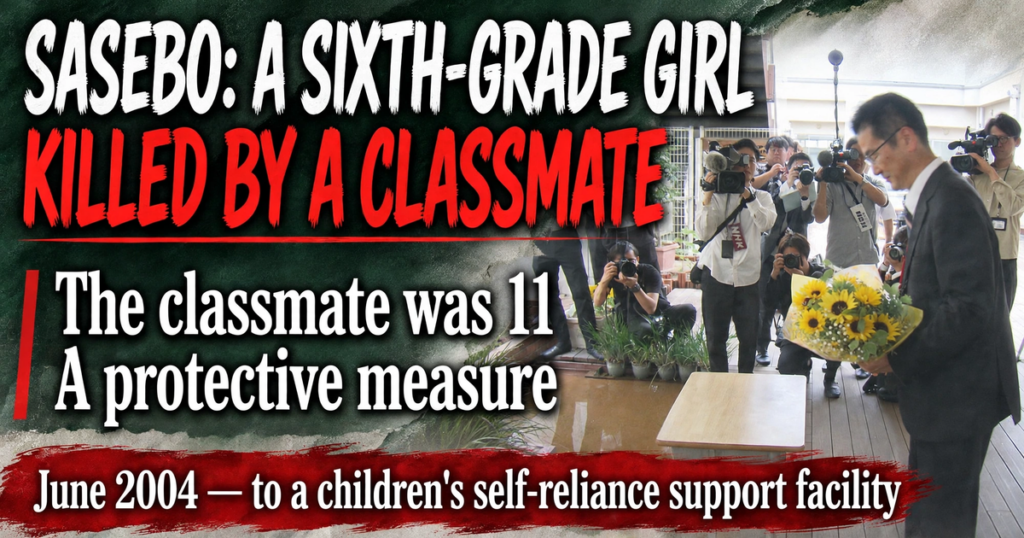
On 1 June 2004, 12-year-old sixth grader Satomi Mitarai was killed by an 11-year-old classmate in a learning room at Okubo Elementary School in Sasebo. Because the child responsible was under 14, she was below Japan's age of criminal responsibility and could not be prosecuted as an ordinary criminal defendant. The Sasebo Branch of the Nagasaki Family Court ordered placement in a child self-reliance support facility on 15 September 2004, with compulsory measures permitted for up to two years.
A fatal attack at Okubo Elementary School
On 1 June 2004, Satomi Mitarai, a 12-year-old sixth-grade pupil, was attacked by an 11-year-old female classmate in a learning room at Okubo Elementary School in Sasebo, Nagasaki Prefecture. Mitarai died from the injuries. The event took place inside the school, among children who attended the same class. It became known as the Sasebo elementary-school classmate killing. The description should remain factual and restrained: the victim was a child, the person responsible was also a child, and the case involved a grave act that had to be addressed under Japan's juvenile legal framework.
The age of the child determined the legal route
The girl who carried out the attack was 11. Under Article 41 of Japan's Penal Code, a person under 14 is not subject to criminal punishment. This means the case could not proceed as an ordinary prosecution in which the child would be indicted and sentenced in a criminal court. The legal system instead used the child-protection process. This distinction does not mean that the act was ignored or that the court found it unimportant. It means that the law required a protective response rather than criminal punishment for a child below the age of criminal responsibility.
The matter moved through the child guidance and family court system
After police investigated the incident, the matter was referred through the child guidance system and brought before the Nagasaki Family Court's Sasebo Branch. The family court was responsible for deciding what protective measures were necessary. On 15 September 2004, it ordered the girl to be placed in a child self-reliance support facility and authorised compulsory measures for a period of up to two years. The date and nature of the disposition are important. The court did not impose a prison sentence, and the child was not convicted in an adult criminal trial.
A protective disposition is not the same as an acquittal
In some legal systems, the absence of a criminal conviction may be mistaken for a finding that the act did not occur. That is not the correct way to understand this case. The family court considered the circumstances and made a protective disposition. It addressed the child's conduct and the need for continued supervision, education and support. The legal result was different from criminal punishment because of the child's age, not because the death of Mitarai was treated as insignificant. The court's function was to determine the appropriate child-protection response within the limits set by Japanese law.
The court considered the child's developmental needs
The Japanese source describes a prolonged psychological assessment. The reports discussed traits such as difficulty directing attention to interpersonal matters, a tendency to understand information in fragments, and difficulty expressing abstract ideas in words. The assessment did not establish a specific psychiatric disorder at a level that could simply be used as a diagnosis explaining the killing. The family court considered the child's characteristics and the need for treatment and education. It also considered the seriousness of the act and the possibility of harm to other children if the underlying difficulties were not addressed.
The finding of planning did not convert the disposition into a criminal sentence
The family court concluded that the killing had been planned. That finding concerns the court's understanding of the act; it does not change the legal rule that a child under 14 cannot be criminally punished. The court therefore selected a protective disposition rather than a criminal sentence. The distinction is especially important when the case is compared with later juvenile cases involving older teenagers. A child aged 11 is legally situated differently from a juvenile aged 14 or 15, even where the act under examination is extremely serious.
Why the facility and compulsory measures mattered
A child self-reliance support facility provides a structured setting for daily life, education and support. The family court authorised compulsory measures for up to two years, allowing the placement to include a period of more restrictive supervision where legally permitted. The order was not simply a short disciplinary response. It was intended to address the child's developmental and behavioural needs while protecting others. The precise duration and conditions of placement should not be embellished beyond the court's order and the reliable reporting described in the source.
Remembering the victim while respecting the juvenile's privacy
The case remains difficult because both the victim and the child responsible were very young. The victim, Satomi Mitarai, was 12 and died at school. The other child was 11 and therefore subject to a protective legal process. The record should not disclose identifying details about the juvenile or speculate about her later life. It should also avoid turning the event into a sensational account of childhood violence. The established legal outcome is the family court's order of 15 September 2004: placement in a child self-reliance support facility with compulsory measures permitted for up to two years.
Education measures and the annual memorial continued into 2026
After the case, Japan's Ministry of Education issued a priority programme addressing serious student behaviour, early recognition of warning signs, coordination with families and outside agencies, information ethics and social development. Okubo Elementary School has continued to hold a memorial gathering each 1 June. On 1 June 2026, 22 years after Mitarai's death, pupils again took part; Sasebo's education board also designates June as its “Life-Shining Emphasis Month.” These later measures should not be mistaken for a finding that internet communication alone caused the killing.
Original Japanese record: 佐世保小6女児同級生殺害事件|御手洗怜美さん殺害と11歳女児への保護処分
Last updated:
Related articles
Case record
The Nagasaki Abduction and Killing of a Four-Year-Old Boy: A Twelve-Year-Old Child, Juvenile Protection, and Destroyed Court Records
Case record
The Sasebo High-School Girl Murder: Aiwa Matsuo, Prior Warnings and a Type 3 Juvenile Training School Disposition

Case record
The 1997 Kobe Child Murders: Juvenile Justice and the Destruction of Court Records
Case record