
The Nagasaki Abduction and Killing of a Four-Year-Old Boy: A Twelve-Year-Old Child, Juvenile Protection, and Destroyed Court Records
On 1 July 2003, four-year-old Shun Tamemoto was taken from an electronics store in central Nagasaki. His body was found the following day below a multi-storey car park. The boy responsible was a 12-year-old junior-high-school student, below Japan’s age of criminal responsibility. He was dealt with through juvenile and child-welfare procedures, not an adult criminal trial. The later discovery that Nagasaki Family Court records had been destroyed raised questions about preservation and victims’ access to historic juvenile case files.
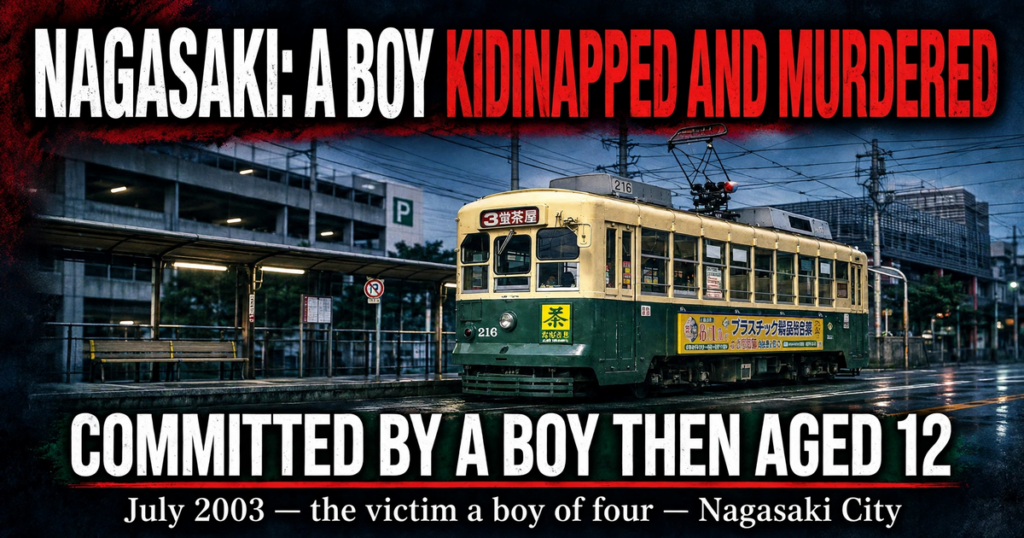
A four-year-old disappeared from a department-store electronics floor
On the evening of 1 July 2003, four-year-old Shun Tamemoto was with his parents at a large electronics retailer in central Nagasaki. He was playing with a demonstration game console when a 12-year-old junior-high-school student approached him. The family’s ordinary shopping trip turned into an abduction. The boy was found the next day, 2 July, dead below a multi-storey parking building in the city. The case shocked the local community because the victim was very young and the person identified by investigators was also a child.
The family-court decision set out the abduction and fatal fall
The Nagasaki Family Court’s published summary described the boy being approached in the store at approximately 7:20 p.m. The older child told him, in substance, that his parents had gone ahead and that he should follow them. The boy was thereby separated from his parents and taken to a multi-storey car park away from the main shopping area. At approximately 9:15 p.m., the court found, the child was dropped from the rooftop to the lower level, a fall of about 20 metres that caused fatal head and facial injuries. The English account avoids graphic detail while preserving the court’s core factual findings.
The suspect was 12 and therefore below the age of criminal responsibility
The boy identified by police was 12 years old and a first-year junior-high-school student. Under Japanese law, a person who is under 14 at the time of an act cannot be held criminally responsible under the Penal Code. The legal process therefore did not follow the adult sequence of arrest, indictment, trial, and criminal sentence. The child was handled as a “law-violating child” under the juvenile and child-welfare framework. It is inaccurate to say that he was tried and acquitted, or that a court found him not guilty in the ordinary criminal-law sense.
Police guidance and family-court proceedings took place in July 2003
Police located and guided the child on 9 July 2003. He was referred to Nagasaki Family Court on 10 July, and a juvenile protective process followed. A first hearing took place on 23 July. The court ordered observation and examination, including a psychiatric assessment that lasted 58 days from 24 July. These were not criminal-trial steps designed to determine a prison sentence. They were part of the juvenile court’s inquiry into the conduct, the child’s development and mental condition, and the protective measures considered necessary to prevent further harm.
The court ordered placement in a children’s self-reliance support facility
On 29 September 2003, Nagasaki Family Court ordered the child sent to a children’s self-reliance support facility. The court also authorized compulsory measures for up to one year. The facility was the National Musashino Gakuin in Saitama, which had facilities for restrictive treatment of boys. A children’s self-reliance support facility is a child-welfare institution focused on education, care, and rehabilitation; it is not a prison and its placement is not a custodial criminal sentence. The court’s order reflected the legal framework available for a child below the age of criminal responsibility.
The compulsory measures were extended in September 2004
In September 2004, the family court extended the period during which compulsory measures could be used for a further year. This extension was not an increase in a prison term. It was a decision within the child-welfare placement concerning the degree of restriction considered necessary while the child remained in the facility. The distinction matters because public discussion sometimes describes the period as a “sentence” or “term of detention.” The formal legal position was a protective disposition and an authorization of compulsory measures under the relevant child-welfare system.
The court examined development and family circumstances without treating a diagnosis as a cause
The family-court inquiry included the child’s developmental history, behaviour, family relationships, and psychiatric condition. The published summary discussed developmental characteristics and the child’s particular patterns of behaviour. Those findings should not be simplified into a claim that a diagnosis caused the offence. A diagnosis or developmental trait is not, by itself, an explanation of a particular act, and the court’s assessment concerned the individual child and the circumstances of the case. The decision attempted to connect the assessment to treatment, education, and the practical problem of providing a stable environment after placement.
The case contributed to debate about the juvenile system
The incident became part of a wider national discussion about how the law should respond when a child under 14 commits an extremely serious act. The government’s youth-policy agenda in December 2003 called for examination of police investigative powers in cases involving children below the criminal-responsibility age and for consideration of changes allowing juvenile training-school placement in serious cases. Later amendments to the Juvenile Act and related laws changed the available framework. In 2007, the law was revised to permit police investigations of law-violating children under a defined procedure and to allow juvenile training-school placement for certain children under 14. These developments should be described as later policy responses, not as criminal penalties imposed retroactively on the child.
Nagasaki Family Court later confirmed that the records had been destroyed
In 2022, it became known that Nagasaki Family Court had destroyed records from this case. The court said that the records had been disposed of between March 2018 and February 2019. Reports identified materials including the protective-disposition decision, statements, and the psychiatric assessment. The victim’s father, Tsuyoshi Tamemoto, had sought access to the juvenile records, but the request was not granted. The court’s public summary therefore remained one of the few sources describing the reasoning behind the disposition. Under the rules then applied to juvenile records, files in cases ending in protective measures could generally be retained until the child reached 26, unless they were designated for special preservation.
The missing records raised a separate issue from the original juvenile decision
The destruction of the file did not change the original protective disposition, and it did not create a criminal conviction or acquittal. It did, however, limit the ability of the victim’s family, researchers, and the public to examine the detailed basis for the family court’s decision. The case therefore has two distinct histories: the 2003 juvenile proceeding and the later dispute about preservation of court records. A responsible account must distinguish what the court publicly summarized at the time from information that can no longer be checked because the underlying records were destroyed.
The case also contributed to later rules on victims’ participation and record preservation
A 2008 amendment introduced a system under which victims or bereaved families could, in certain serious juvenile cases, observe family-court hearings if the court considered it appropriate. This was not applied retroactively to the 2003 proceedings. After the destruction of significant juvenile files became a national issue, the Supreme Court introduced a revised special-preservation system that took effect on 30 January 2024. The case illustrates two distinct concerns: protecting a child’s privacy during juvenile proceedings and preserving records so that serious cases can be examined in the future. The destroyed file cannot now be reconstructed from the original materials.
Original Japanese record: 長崎男児誘拐殺人事件|4歳の種元駿ちゃん死亡、12歳少年の保護処分と記録廃棄
Last updated:
Related articles
Case record
The Sasebo Elementary-School Classmate Killing: Satomi Mitarai and the Protective Disposition for an 11-Year-Old Child
Case record
The Sasebo High-School Girl Murder: Aiwa Matsuo, Prior Warnings and a Type 3 Juvenile Training School Disposition
Case record
The Murder of Nagasaki Mayor Iccho Ito: From a Death Sentence to Life Imprisonment

Case record