
The 1997 Kobe Child Murders: Juvenile Justice and the Destruction of Court Records
In 1997, five children were attacked in Kobe’s Suma Ward. Two died and three were injured. The fourteen-year-old boy arrested for the attacks was dealt with by the Family Court, which ordered placement in a medical juvenile training school. In 2022, it emerged that the court had destroyed the case and investigation records.
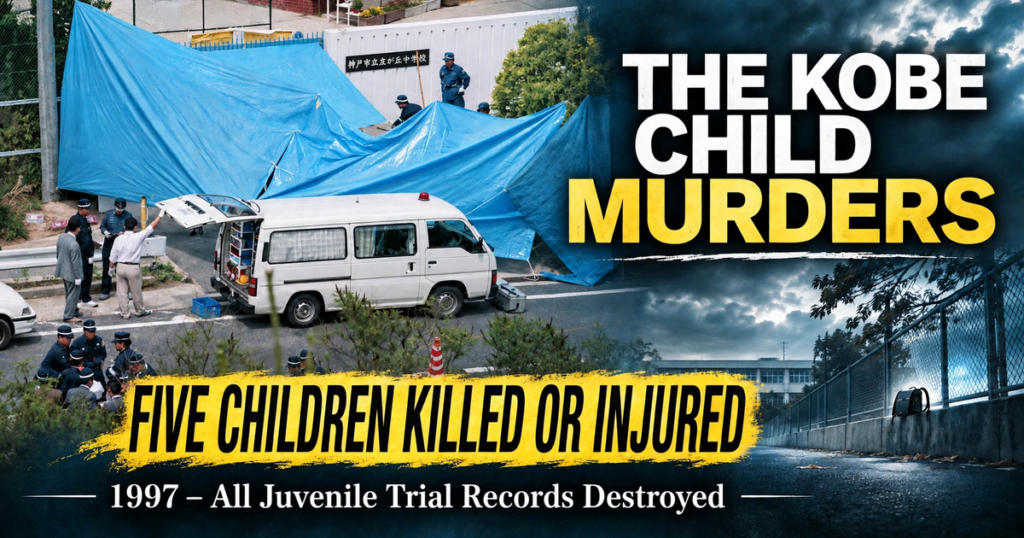
Five children were attacked in Suma Ward
A series of attacks on elementary-school children took place in Suma Ward, Kobe, between February and May 1997. Two children died: Ayaka Yamashita, aged ten, and Jun Hase, aged eleven. Three other children were injured. The first attacks occurred in February, when two girls were assaulted in the same area. One of them, Yamashita, later died from her injuries. Another girl was attacked in March. On May 24, Jun Hase left home and did not return. His body was later found, and on the morning of May 27 his head was discovered in front of the gate of his junior high school. A message intended to provoke the police was left at the school. The sequence of attacks caused fear among families in the area and led to a large investigation.
The school-gate message and the arrest on June 28
The message left at the school gate was not simply an attempt to conceal the victim’s body. It appeared to be intended to draw attention to the crime and challenge the investigators. In June, a further statement claiming responsibility was sent to the Kobe Shimbun newspaper. Investigators examined the wording, handwriting and materials used in the messages. Police also investigated the suspect’s connections with Hase, the geography of the area and physical evidence. On June 28, 1997, Hyogo Prefectural Police arrested a fourteen-year-old third-year junior-high-school student who lived in Suma Ward. The boy admitted involvement in the attacks on Hase and the earlier incidents involving children. The cases were referred to the Family Court for juvenile proceedings.
Fourteen was above the age of criminal responsibility
A common but inaccurate shorthand says that the boy could not face criminal responsibility because he was fourteen. Article 41 of the Penal Code excludes criminal punishment for a person who was under fourteen at the time of the act. A person who has reached fourteen is therefore above that threshold. The separate issue was the juvenile justice system in force in 1997. Under the Juvenile Act at that time, transfer to prosecutors for an adult criminal trial was generally limited to juveniles aged sixteen or older. The boy’s age meant that the case was handled through the Family Court rather than an ordinary public criminal trial. The distinction is important: the decision was not based on a finding that a fourteen-year-old could never be criminally responsible, but on the rules governing the available juvenile procedure.
The Family Court ordered placement in a medical juvenile training school
In October 1997, the Kobe Family Court found that the boy had committed the series of acts and ordered him sent to a medical juvenile training school. This was a protective disposition under the juvenile system, not an adult criminal sentence of imprisonment. A Family Court examines not only the acts but also the juvenile’s development, personality, home environment, risk of further offending and need for corrective education. A medical juvenile training school provides specialised treatment and education. The disposition reflected the seriousness of the conduct and the court’s assessment that a prolonged period of treatment and rehabilitation was necessary. Because the proceeding was a juvenile hearing, it was not conducted as an ordinary public criminal trial, and the information available to the victims’ families was limited.
The release process and the publication of the memoir
The boy remained in the medical juvenile training system for several years. He was provisionally released in 2004, a stage that did not mean the disposition had fully ended, and was formally discharged in January 2005. His post-release name, address and occupation have not been officially disclosed. Information circulated online should not be treated as reliable evidence of his current identity or life. In 2015, he published a memoir titled Zekka, describing the crimes, his time in the juvenile institution and his life after release. The families of Jun Hase and Ayaka Yamashita strongly objected, saying they had not received adequate prior explanation. The memoir is the former juvenile’s later account, not a substitute for the original juvenile investigation records or an independent judicial finding.
The relationship with the victims’ families changed after publication
After his release, the former juvenile sent letters to the families through representatives and made payments toward compensation. Hase’s father, Mamoru Hase, later described how he had tried to read signs of rehabilitation in the correspondence. The publication of Zekka changed that relationship. In 2026 reporting, Hase said he did not accept an offer to use the book’s royalties for compensation and decided not to bring a new damages claim. The criminal or juvenile process and the families’ experience did not end at the same time. A person’s return to society is one stage in a juvenile case; it does not require the victim’s family to accept the offender’s account or to experience the event as resolved.
The Family Court had destroyed the original records
In October 2022, it became known that the Kobe Family Court had destroyed the juvenile case file and the juvenile investigation records after their ordinary retention period expired. The case had attracted national attention and was of major historical and social importance, making it a strong candidate for special preservation. The destroyed material may have included statements taken during the investigation, scene examinations, expert reports and assessments prepared by Family Court investigators. The court acknowledged that the disposal was inappropriate. Although the outcome of the juvenile proceeding remained known, the underlying records that could have allowed future researchers and legal professionals to examine how the decision was reached were no longer available.
A 2023 review led to a new preservation system
In May 2023, the Supreme Court’s Secretariat published a report examining the destruction of the Kobe records and the broader system for retaining court files. The report identified problems that went beyond an isolated mistake by an individual employee. The criteria for special preservation and the responsibilities of those authorised to decide were not sufficiently understood, and there was no established practice of actively considering the historical importance of serious cases. The judiciary revised its system and began operating a new special-preservation framework in January 2024. Under the new approach, records with historical or social significance can be selected for long-term retention, and outside parties can request preservation. The reform cannot restore the Kobe records that were destroyed. The case therefore remains both a landmark in juvenile justice and a warning about the permanent loss of judicial records.
Original Japanese record: 神戸連続児童殺傷事件|児童5人殺傷の少年審判と、全記録廃棄が失わせた検証可能性
Last updated:
Related articles
Same case · Feature
The Kobe Child Murders: Why Did a Fourteen-Year-Old Attack Five Children? Lost Juvenile Proceedings and the “Juvenile Record” That Survived
Case record
The Nagasaki Abduction and Killing of a Four-Year-Old Boy: A Twelve-Year-Old Child, Juvenile Protection, and Destroyed Court Records
Case record
The Aizuwakamatsu Mother Murder: Two Psychiatric Assessments, a Medical Juvenile Disposition and Destroyed Records
Case record