
The Menda Case: Japan's First Postwar Retrial Acquittal of a Death-Row Prisoner
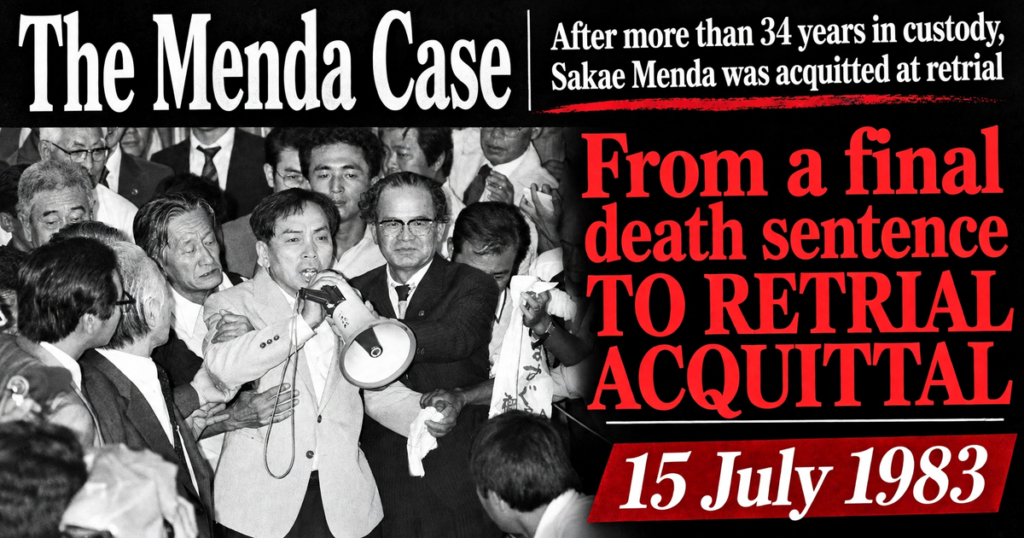
After a 1948 attack that killed a married couple and injured their daughters, Sakae Menda was sentenced to death. A series of retrial petitions eventually led to an acquittal in 1983, after more than 34 years in custody.
A family was attacked in Hitoyoshi City at the end of 1948
Late on 29 December 1948 and into the early hours of the following day, four members of a family were attacked in their home in Hitoyoshi City, Kumamoto Prefecture. The husband and wife were killed, while their two daughters suffered serious injuries. Money was taken, and police investigated the incident as a robbery involving murder and attempted murder. The case took place in the chaotic years immediately after the Second World War, when the criminal justice system was under pressure and forensic resources were limited. The investigation eventually focused on Sakae Menda, whose later conviction would become the first postwar Japanese death sentence to be overturned by a retrial acquittal.
Menda was detained in a separate theft case and questioned about the attack
In January 1949, Menda was taken into custody in connection with an unrelated theft. Investigators then questioned him about the attack on the family. He made statements admitting involvement, but he denied the crime in court and maintained that he had been somewhere else on the night of the killings. The later retrial focused on the reliability of the confession and the credibility of his alibi. The fact that a suspect signed or made a confession did not resolve whether it was voluntary or accurate. The courts would eventually have to consider whether the statements matched the timeline, the route and the objective circumstances of the crime.
The original courts imposed a death sentence
The Yatsushiro Branch of the Kumamoto District Court sentenced Menda to death on 23 March 1950. The Fukuoka High Court dismissed his appeal on 19 March 1951, and the Supreme Court rejected his final appeal on 25 December 1951. The sentence became final on 5 January 1952. Menda was still a young man, and he remained in custody under a final death sentence while continuing to assert that he had not committed the robbery and killings. The original judgment relied heavily on the confession and rejected his account of where he had been. The retrial process would later revisit both parts of that reasoning.
An earlier retrial order was overturned, and the later petitions continued
Menda's efforts to reopen the case extended over many years. A third retrial petition led to a district court decision to begin a retrial in 1956, but the Fukuoka High Court reversed that decision in 1959. That reversal did not end his efforts. He later filed a sixth retrial petition in 1972. The Yatsushiro Branch of the Kumamoto District Court rejected it on 30 April 1976. The appellate court then took a different view. On 27 September 1979, the Fukuoka High Court set aside the rejection and ordered a retrial. The prosecution filed a special appeal to the Supreme Court, so the retrial order was not yet final.
The Supreme Court confirmed the retrial order in December 1980
On 11 December 1980, the Supreme Court rejected the prosecution's special appeal, allowing the retrial order to become final. The decision meant that the original death sentence could be examined again in a new trial. It did not mean that Menda had already been acquitted. The retrial court still had to consider the evidence and decide whether the prosecution had proved the charges. This distinction is important in Japan: an order to reopen a case is a procedural ruling, while the final verdict comes only after the retrial proceedings. By this stage, more than three decades had passed since the attack on the family.
The retrial examined the alibi and the reliability of the confession
The retrial considered where Menda had been on the night of the attack, how the confession had been produced and whether the details in the statements were consistent with objective facts. The Fukuoka High Court's 1979 decision had already identified problems in the account of the route and timing. The retrial court accepted that the evidence supported Menda's alibi and found the confession unreliable. It also considered records that had not been presented at the original trial. The disclosure of previously unsubmitted investigative materials became an important feature of the case, demonstrating how information held by investigators could affect the fairness of a conviction when it was not available to the defence.
Menda was acquitted and released on 15 July 1983
On 15 July 1983, the Yatsushiro Branch of the Kumamoto District Court acquitted Menda of the charges arising from the attack on the family, including unlawful entry, robbery-murder and attempted robbery-murder. He was released that day. The prosecution decided not to appeal, and the acquittal became final. It was the first postwar Japanese case in which a person whose death sentence had become final was later acquitted in a retrial. The Saitagawa, Matsuyama and Shimada cases followed. Menda's acquittal did not erase the separate theft conviction that had brought him into custody; that unrelated offence resulted in six months' imprisonment, suspended for one year.
More than 34 years in custody could not be restored by compensation
Menda had been deprived of his liberty for more than 34 years. In 1988, the government told the Diet that the total criminal compensation paid in his case was 90,712,800 yen. Criminal compensation is a statutory payment for detention after an acquittal becomes final; it is not a finding that the lost years can be restored or that the payment fully reflects the harm. The case also became part of a wider debate about confession-led investigations and the disclosure of evidence. Government statements later acknowledged the need to test confessions against objective evidence and to collect both incriminating and exculpatory material. The Menda Case remains a landmark in Japan's history of wrongful convictions and retrial law.
Original Japanese record: 免田事件|一度取り消された再審開始、34年超の拘禁を覆した1983年無罪
Last updated:
Related articles
Case record
The Matsubase Case: A Confession Undone by a Surviving Piece of Cloth
Case record
The Hirosaki University Professor's Wife Murder: A Fifteen-Year Sentence Overturned by a Retrial Acquittal
Case record
The Kikuchi Case: Fujimoto Matsuo, a Death Sentence and the Hansen's Disease Special Courts
Case record