
The Kikuchi Case: Fujimoto Matsuo, a Death Sentence and the Hansen's Disease Special Courts
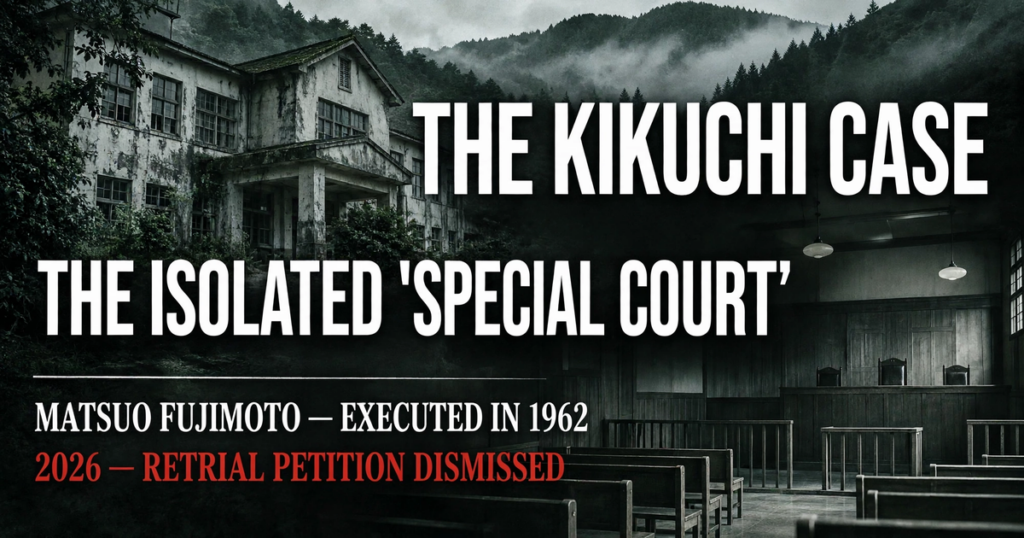
The Kikuchi Case concerned the 1952 killing of a former village official in Kumamoto Prefecture. Fujimoto Matsuo, a resident of Kikuchi Keifuen who had been treated as a person with Hansen's disease, was convicted in proceedings held in a special court at an isolation facility. His death sentence was upheld and carried out on September 14, 1962. The Supreme Court later acknowledged discriminatory and unlawful practices in the use of special courts. A fourth retrial request was rejected in January 2026; its immediate appeal remained pending in November 2026.
A murder case arose against the background of enforced isolation
The Kikuchi Case involved the killing of a former village employee in Kumamoto Prefecture in July 1952. The man accused was Fujimoto Matsuo, a man identified as having Hansen’s disease and required to enter a sanatorium. His case cannot be understood without recognising the legal and social environment of the time. Japan’s leprosy-prevention policy had imposed long-term segregation, and prejudice about the disease shaped how people living in sanatoriums were treated. Those conditions affected not only daily life but also access to ordinary legal institutions.
The earlier dynamite incident preceded the murder charge
The history began before the 1952 killing. On August 1, 1951, an explosive device was thrown at the home of a former village employee. Fujimoto was arrested in connection with that incident and denied the allegation. On June 9, 1952, the Kumamoto District Court sentenced him to ten years for attempted murder and violations of the Explosives Control Act. He appealed and remained in custody at the substitute detention facility inside Kikuchi Keifuen. On June 16, while the appeal was pending, he escaped from that facility. On July 7, 1952, the former village employee was found dead. The final judgment identified July 6 as the date of the killing. Investigators suspected Fujimoto, who was found and arrested on July 12.
Fujimoto denied the murder allegation
Fujimoto was indicted on August 2, 1952, for simple escape and later additionally indicted for murder. The prosecution alleged that he had killed the former village employee because of resentment connected with the earlier report that led to his admission to the sanatorium. Fujimoto denied the killing. The accusation was therefore contested, not admitted. The prosecution relied on the evidence collected during the investigation and the trial, but the fairness of the process itself would later become a central issue in the case’s long posthumous history.
The trial was held in a special court at the sanatorium
Rather than being tried in an ordinary courtroom open to the public, all hearings at first instance and on appeal were held at Kikuchi Keifuen or the adjacent medical prison branch. These were sittings of the ordinary district and high courts outside their regular premises under Article 69(2) of the Courts Act, not a separate judicial institution. Such special sittings were arranged under a practice that allowed courts to designate an external location for hearings involving people with Hansen’s disease. The stated concern was infection, but the practice was rooted in mistaken assumptions and the wider system of segregation. It restricted ordinary public access and subjected defendants to a different physical and procedural environment because of their illness.
The death sentence survived the appeals
On August 29, 1953, the Kumamoto District Court’s special court sentenced Fujimoto to death. The Fukuoka High Court dismissed his appeal on December 13, 1954. On August 23, 1957, the Supreme Court dismissed the final appeal, leaving the death sentence in place. Fujimoto’s first three retrial applications were also rejected. The third was rejected on September 13, 1962. On September 14, 1962, he was executed at Fukuoka Detention House. The execution is an established historical fact. It does not mean that a later court ever reconsidered the merits of the murder conviction and acquitted him.
The Supreme Court later acknowledged unlawful discriminatory treatment
On April 25, 2016, the Supreme Court published an investigation report on the designation of hearing locations because of Hansen’s disease, together with a statement by the justices’ conference. The report found that the practice had been used in a routine and discriminatory way for decades. Of 96 applications to hold hearings outside ordinary court premises on the stated ground of Hansen’s disease between 1948 and 1972, 95 were approved. The Supreme Court acknowledged that the practice had involved unlawful treatment and expressed regret and apology to those affected.
A later civil judgment addressed the special-court procedure
In a separate civil action concerning the special court used in the Kikuchi Case, the Kumamoto District Court in February 2020 recognised that the handling of the trial had violated constitutional guarantees. The court found violations of Articles 13 and 14(1) of the Constitution and raised doubts about compliance with the public-trial guarantees. It dismissed the compensation claims, finding no unlawfulness under the State Redress Act in the prosecutors’ failure to seek a retrial vis-a-vis the plaintiffs. The judgment became final without an appeal. It did not itself vacate Fujimoto’s murder conviction or declare him not guilty. The distinction is important: an official recognition that the trial procedure was unlawful is not the same legal act as a criminal retrial judgment overturning the conviction.
The fourth retrial request was rejected in January 2026
Fujimoto’s supporters and family continued to seek a posthumous retrial. A fourth retrial request was filed by 1,205 citizens on November 13, 2020; Fujimoto’s relatives filed a request on April 22, 2021. On January 28, 2026, the Kumamoto District Court rejected the fourth retrial request. The court found violations of Articles 13 and 14(1) of the Constitution and expressed serious doubts about compliance with the public-trial guarantee in Article 82(1). It considered that serious constitutional violations could justify reopening a case if they had caused serious errors in the factual findings, but found no such effect in this case. It also concluded that the new expert evidence did not meet the statutory test for a retrial. The defence filed an immediate appeal with the Fukuoka High Court on February 2, 2026. No retrial has begun and no posthumous acquittal has been entered.
The appeal remained active in November 2026
The immediate appeal was still being examined by the Fukuoka High Court in November 2026. In May, the High Court recommended disclosure of six items of evidence. In June, prosecutors replied that the items appeared to have been discarded, but disclosed an investigative record dated July 9, 1952. The defence subsequently sought disclosure of an inventory of the evidence held by prosecutors.
In September 2026, the Fukuoka High Court recommended that the Fukuoka High Public Prosecutors Office disclose the evidence inventory. At the three-party conference on November 13, it became clear that prosecutors were prepared to show the judges all evidence not yet submitted, instead of disclosing the inventory, on the condition that it be examined in camera, by the judges alone and without access for the defence. The defence asked the High Court to recommend disclosure in a form that would also allow defence counsel to examine the evidence. The offer does not establish that the evidence has been disclosed to counsel or that the six items reported missing in June have been found. As of November 24, 2026, the immediate appeal remained pending. No retrial order or acquittal had been issued, and the original conviction had not been overturned.
The hotel accommodation refusal was a separate incident
The name Kikuchi Case must not be confused with the 2003 hotel accommodation-refusal incident involving residents of Kikuchi Keifuen. In that separate matter, a hotel in Kurokawa Onsen refused accommodation to former patients taking part in a Kumamoto Prefecture homecoming programme. That event is commonly called the Kurokawa Onsen hotel refusal incident or the Hansen’s disease accommodation-refusal incident. The Japanese archive entry numbered 153 concerns Fujimoto Matsuo and the 1952 murder case, not the 2003 hotel incident. Keeping the two events separate is necessary for an accurate account of both.
Original Japanese record: 菊池事件|ハンセン病「特別法廷」で藤本松夫に死刑、2026年も続く死後再審
Last updated:
Related articles
Case record
The Menda Case: Japan's First Postwar Retrial Acquittal of a Death-Row Prisoner
Case record
The Matsubase Case: A Confession Undone by a Surviving Piece of Cloth
Case record
The Shimada Case: A Death Sentence Overturned After 35 Years as Confession and Forensic Evidence Collapsed
Case record