
The Shimada Case: A Death Sentence Overturned After 35 Years as Confession and Forensic Evidence Collapsed
Six-year-old Hisako Sano disappeared from a kindergarten in 1954. Masao Akahori was sentenced to death, but a retrial acquitted him in 1989 after the confession and forensic interpretation used to convict him were found unreliable. He had spent 12,668 days in custody.
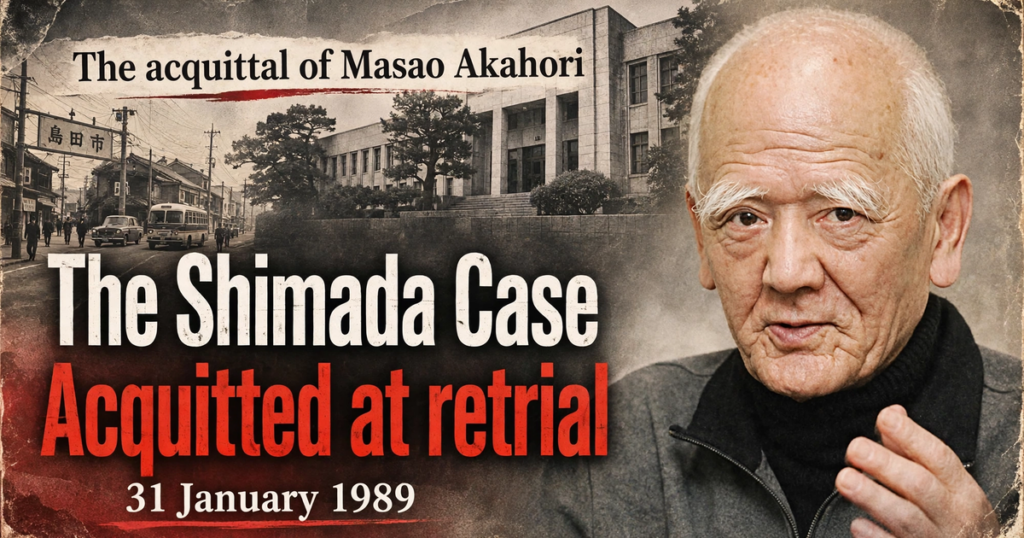
A six-year-old girl disappeared from a kindergarten in March 1954
On 10 March 1954, six-year-old Hisako Sano disappeared after being taken from a kindergarten in Shimada, Shizuoka Prefecture. Her body was found three days later in woodland near the Oi River, in an area that was then part of Haibara District and is now within Shimada City. The discovery turned what had first appeared to be a missing-child search into an investigation of abduction and murder. The case caused deep distress in the local community. Investigators faced the difficult task of identifying the person responsible, but the later prosecution would depend heavily on a confession rather than on physical evidence directly connecting the accused to the scene.
A separate arrest brought Masao Akahori into the investigation
Masao Akahori was 25 when police detained him in May 1954 on suspicion of an unrelated theft. Investigators then questioned him about Sano's death. Akahori was said to have admitted the crime during interrogation, but he denied responsibility when the case reached court. The circumstances in which the confession was obtained later became central to the retrial. Accounts cited by Japanese bar associations describe repeated questioning in a room at the police superintendent's residence rather than an ordinary interview room. The confession changed over time, and the defence argued that its contents had been shaped by investigators. A statement made during questioning was not, by itself, proof that the account was true.
The original conviction relied on a confession and forensic interpretation
The prosecution presented Akahori's statements as a detailed account of the crime. It also relied on forensic medical opinions that were said to be consistent with the injuries found on Sano. In the original trial, the confession and the medical interpretation were treated as mutually reinforcing: the statement appeared to describe the injuries, while the injuries were taken to support the statement. Yet there was little independent physical evidence placing Akahori at the scene. This created a fragile evidentiary structure. If the confession was unreliable, or if the medical findings did not support the precise sequence described in it, the remaining evidence was not enough to establish his guilt.
A death sentence became final after the ordinary appeals
The Shizuoka District Court sentenced Akahori to death on 23 May 1958. The Tokyo High Court dismissed his appeal on 17 February 1960. The Supreme Court rejected his final appeal on 15 December 1960; the death sentence formally became final on 26 December 1960, according to the government's later account to the Diet. In Japan, the ordinary criminal process generally ends when the Supreme Court has disposed of the final appeal, but the date of the Supreme Court ruling and the formal date of finality are not necessarily the same. A person who maintains that the conviction is wrong must pursue a separate retrial procedure rather than simply continue the original appeal. Akahori continued to insist that he had not killed Sano while held on death row.
The fourth retrial petition finally moved the case back into court
Akahori repeatedly sought a retrial. The fourth petition was initially rejected by the Shizuoka District Court, but in 1983 the Tokyo High Court set that decision aside and sent the matter back for further examination. The appellate court identified problems with the confession and with the evidence that had been used to support it. On 30 May 1986, the Shizuoka District Court ordered a retrial. The prosecution challenged that decision, but its immediate appeal was dismissed and the order to reopen the case became final. A retrial order did not itself declare Akahori innocent. It meant that the conviction could no longer safely stand without a new examination of the evidence in open court.
The retrial tested the confession against the physical facts
At the retrial, the court examined whether the injuries to Sano were actually consistent with the methods and sequence described in Akahori's statements. It also reconsidered the object identified as the weapon and the claim that the confession contained information only the perpetrator could have known. The court found discrepancies between the statements and objective facts. The supposed weapon did not provide the certainty claimed for it, and the alleged revelations were not persuasive proof of guilt. The forensic opinions that had once been used to corroborate the confession could no longer carry that weight. The important question was not whether the confession sounded detailed, but whether it survived comparison with independent evidence.
The Shizuoka District Court acquitted Akahori on 31 January 1989
On 31 January 1989, the Shizuoka District Court found Akahori not guilty in the retrial and released him that day. The prosecution did not appeal, so the acquittal became final. His period of detention was recorded as 12,668 days, or approximately 34 years and eight months. He had been 25 when first detained and was 59 when he was acquitted. The case is one of the four major postwar Japanese cases in which a death sentence was overturned by a retrial acquittal. The others were the Menda, Saitagawa and Matsuyama cases. Each involved different evidence and procedural histories, and the cases should not be treated as a single identical pattern.
The acquittal did not identify the person who killed Sano
The retrial established that Akahori could not lawfully be convicted of Sano's murder. It did not establish who had actually abducted and killed her. No different person was convicted through the retrial, and the original murder remained unresolved in the judicial sense. Akahori later spoke publicly about wrongful convictions and the death penalty. He died on 22 February 2024, aged 94. His supporters continued their work for decades after his release, and the group supporting him decided to disband in 2026 after completing a record of its activities. The case remains important because it shows how a final death sentence can rest on evidence that later examination finds unreliable, while the victim's family is still left without a judicially established answer about the perpetrator.
Original Japanese record: 島田事件|赤堀政夫さんの死刑確定から再審無罪、自白と鑑定が崩れた35年
Last updated:
Related articles
Case record
The Lucy Blackman Case: A British Woman's Disappearance and the Criminal Case Against Joji Obara
Case record
The Machida Art Student Disappearance: The Unresolved 1999 Disappearance of Mayo Ide
Case record
The Iwao Hakamada Case: From Death Row to a Final Acquittal
Case record