
The Mishima Student Murder: A Life Sentence Replaced by Capital Punishment
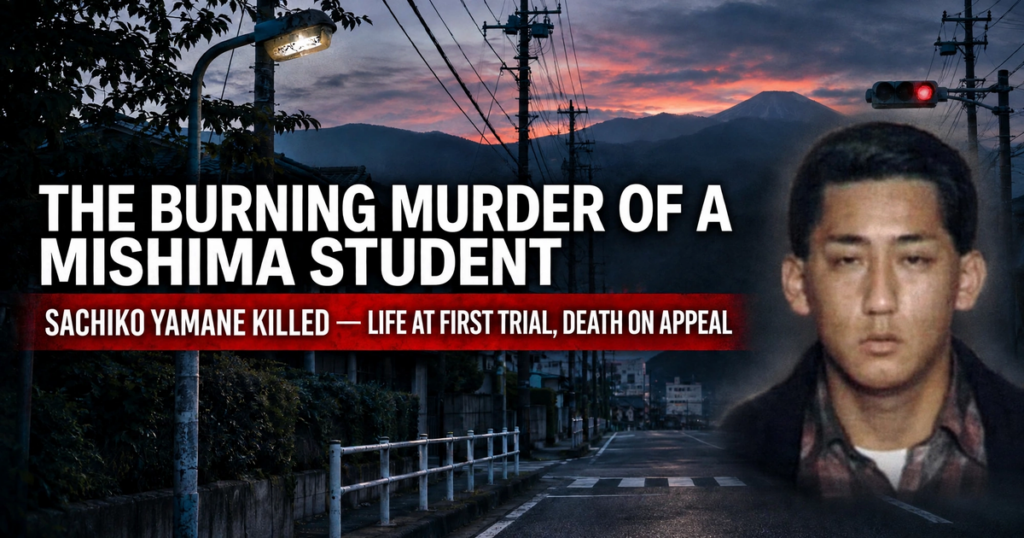
Nineteen-year-old Sachiko Yamane was abducted while cycling home from work in Mishima in January 2002, held for about three hours and murdered. The first court imposed life imprisonment, but the Tokyo High Court changed the sentence to death. The Supreme Court upheld it in 2008, and Hattori Junya was executed in 2012.
A nineteen-year-old student was attacked while cycling home from work
On the night of January 22, 2002, Sachiko Yamane, a nineteen-year-old junior-college student, was riding her bicycle home after finishing a part-time job in Mishima, Shizuoka Prefecture. She had no prior relationship with the man who attacked her. Junya Hattori was driving along a national highway when he noticed her. He drove ahead, blocked her route and forced her into his vehicle when she tried to escape. Yamane had been travelling home from work and had no reason to expect that a stranger would target her. The Supreme Court later emphasized that she had been going about an ordinary evening routine and was not involved in any dispute with Hattori.
Yamane was held for approximately three hours and sexually assaulted
Hattori drove Yamane to a secluded area and kept her in the vehicle for about three hours. During that time, he sexually assaulted her. The two had not known one another before the encounter. The Supreme Court's findings described the attack as a crime against a stranger who had been selected by chance. After the assault, Hattori considered releasing her, but he became afraid that the offence would be discovered. He also wanted to return to acquaintances with whom he used stimulants. Those concerns led him to decide to kill her. The court treated the transition from abduction and sexual assault to murder as a central part of the offence and of the later sentencing assessment.
Hattori killed Yamane in an isolated location
After deciding that Yamane could not be released without risking discovery, Hattori took kerosene from his family home and moved her to a place where few people were likely to be present. He restrained her and set her on fire with the kerosene. Yamane died from extensive burns. The details were examined in the criminal proceedings as part of the murder, not as a separate offence unrelated to the abduction and sexual assault. The prosecution charged Hattori with unlawful confinement, rape and murder. The Supreme Court later reviewed the entire sequence, including the initial seizure, the prolonged confinement, the sexual violence and the decision to kill in order to prevent the crime from being exposed.
DNA evidence connected the crime to Hattori about six months later
The investigation did not immediately identify Hattori through Yamane's personal relationships because the two had never met. Investigators examined biological evidence recovered from the scene and other relevant items. Hattori was already serving a prison sentence for an unrelated traffic offence. A DNA comparison connected him to the evidence from the Mishima case. On July 23, 2002, Shizuoka Prefectural Police arrested him on suspicion of unlawful confinement and related offences. The arrest came approximately six months after the murder. The case demonstrated the importance of forensic evidence in a crime where the victim had been selected at random and there was no prior relationship that would naturally lead investigators to a suspect.
The first-instance court imposed life imprisonment in January 2004
The Shizuoka District Court's Numazu Branch sentenced Hattori to life imprisonment on January 15, 2004. The prosecution had sought the death penalty. The first-instance court regarded the outcome and the manner of the crime as extremely serious, but it also considered that the decision to murder Yamane had not been carefully planned from the beginning. It took account of Hattori's statements of remorse and other circumstances that it considered relevant to sentencing. Both the prosecution and Hattori appealed. The prosecution sought a death sentence, while Hattori challenged the conviction and sentence. The central issue in the appellate proceedings became whether the life sentence adequately reflected the established facts and Hattori's criminal history.
The Tokyo High Court replaced the life sentence with a death sentence
On March 29, 2005, the Tokyo High Court overturned the life sentence and imposed the death penalty. The High Court emphasized that Yamane had been a stranger who was abducted while going home, that she had been confined for approximately three hours and sexually assaulted, and that Hattori killed her because he feared discovery. It also considered his criminal record and the fact that he had been released on parole only about nine months before the offence. Hattori had previously served a substantial prison term after committing another serious offence while on a suspended sentence. The High Court concluded that the combination of the crime's circumstances and his history made life imprisonment too lenient.
The Supreme Court upheld the death sentence on February 29, 2008
Hattori appealed to the Supreme Court. On February 29, 2008, the Supreme Court Second Petty Bench dismissed the appeal and left the death sentence in place. The judgment acknowledged that the murder had not been planned in detail from the outset and that Hattori had shown some signs of remorse. It nevertheless concluded that those factors did not outweigh the seriousness of the crime, the prolonged confinement and sexual assault, the decision to kill Yamane to avoid detection, his prior criminal history and the impact on her family. The fact that there was one murder victim did not automatically prevent the court from imposing the death penalty. The sentence became final with the Supreme Court's decision.
Hattori was executed on August 3, 2012
Hattori's death sentence was carried out at the Tokyo Detention House on August 3, 2012. He was forty years old. The execution came approximately four and a half years after the Supreme Court decision and about ten and a half years after Yamane was killed. The criminal proceedings had followed a significant change in sentencing: the first court imposed life imprisonment, both sides appealed, the Tokyo High Court replaced that sentence with death, and the Supreme Court upheld the capital sentence. The case is remembered not only for the killing of a nineteen-year-old student who was returning from work, but also for the way the appellate courts reassessed the seriousness of a single-victim murder in light of the offender's conduct and prior record.
Original Japanese record: 三島女子短大生焼殺事件|山根佐知子さん殺害、一審無期から死刑へ変わった量刑判断
Last updated:
Related articles

Case record
The Nara First-Grade Girl Murder: A Child Abducted on Her Way Home and a Death Sentence Final by Appeal Withdrawal
Case record
The Osaka Sisters Murder: A Planned Robbery, Two Deaths and a Death Sentence Final by Appeal Withdrawal

Case record
The Ogo Town High-School Girl Abduction-Murder: A Life Sentence Replaced by Death on Appeal

Case record