
The Otsu School Bullying Case: Three Separate Inquiries and the Civil Finding of Causation
A 13-year-old second-year middle-school student died on 11 October 2011. A municipal third-party inquiry, a settlement with Otsu City and civil litigation against former classmates followed separate paths; the Osaka High Court found a causal link between repeated bullying and the death in 2020.
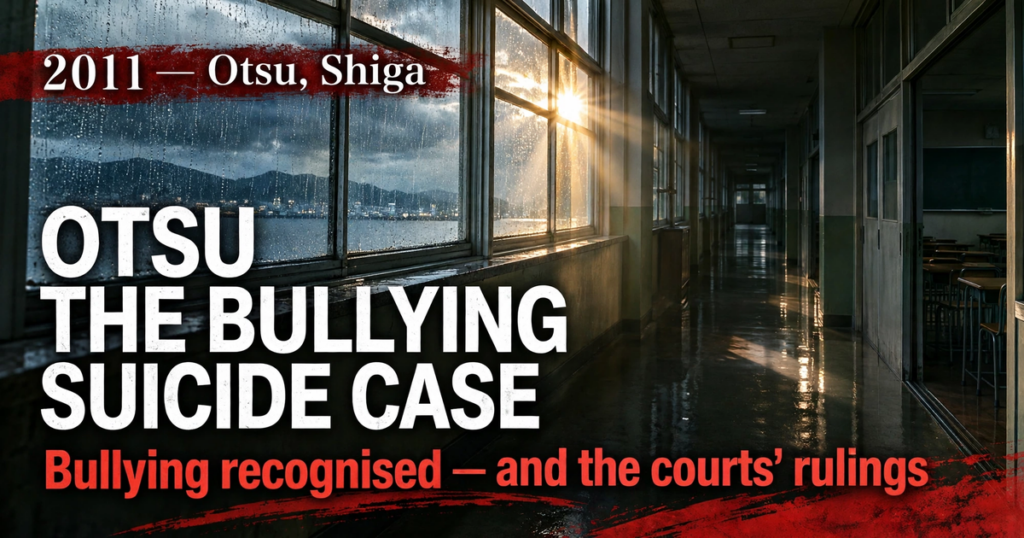
A 13-year-old student died on 11 October 2011
On 11 October 2011, a 13-year-old boy in the second year of a municipal junior high school in Otsu, Shiga Prefecture, died at his home. The death prompted questions about what had happened among students before his death and how the school and education authorities had responded. The public record that followed was not a single criminal trial. It developed through three distinct processes: an independent municipal investigation, a civil settlement between the bereaved family and Otsu City, and civil litigation against former classmates. Each process had a different purpose and legal effect. The third-party committee investigated school and administrative conduct; the settlement addressed the city's responsibility to the family; and the courts later considered the civil liability of individual former classmates.
The relationship among classmates changed from friendship to repeated one-sided conduct
The Osaka High Court later described the student and the former classmates as having initially been friends. Some early interactions resembled mutual joking. From around the middle of September 2011, however, the relationship changed and became increasingly one-sided. The conduct included holding the student down, hitting him, damaging or soiling his belongings, forcing him to take part in penalty games during a school sports event, and visiting his home unexpectedly to hide or take possessions. The High Court did not assess each incident in isolation. It considered the repeated conduct over a short period and the way the relationship became fixed, with the student placed in the position of the person being bullied. This pattern was central to the later civil finding of causation.
The school's response after the death became part of the public inquiry
After the student's death, the school conducted a questionnaire among students. Criticism grew over what the school had known about the bullying, how it had investigated the events and what it disclosed to the family. The questions were not confined to the acts committed by students. They also concerned whether the school and the education board had recognized the danger, whether information from students had been properly examined and whether the family had received an adequate explanation. Otsu City eventually established an independent third-party committee rather than leaving the review solely to the school and education administration. This distinction matters: an institutional investigation after a death is not the same thing as a criminal prosecution or a civil judgment.
The third-party committee was established in August 2012
Otsu City established the third-party investigation committee in August 2012. Its mandate included examining the facts leading to the death, the background to the student's suicide, the response of the school and education board, the post-death investigation and measures to prevent recurrence. The committee submitted its report on 31 January 2013. The report was organized around the events before the death, the response afterward and recommendations. It served as an administrative and educational review. It did not have the authority to convict anyone of a crime or to award damages. Its findings were important, but they had to be kept separate from later findings by a court applying civil law.
Otsu City settled the family's claim in March 2015
The family sought damages from Otsu City and former classmates. The claim against the city was resolved first. On 18 February 2015, the Otsu District Court recommended a settlement. Following approval by the city assembly, the settlement was concluded on 17 March 2015. The city apologized to the family in relation to the school's failure to discharge its duty of care for student safety, the failure to respond appropriately despite the foreseeability of a concrete risk of suicide, and problems in the post-death response. The settlement was a resolution of the civil claim against the municipality. It did not by itself determine the liability of former classmates, whose civil case continued separately.
The Osaka High Court found a causal link between bullying and the death
The civil claim against former classmates proceeded through the courts. The Otsu District Court found two former classmates liable, and the defendants appealed. On 27 February 2020, the Osaka High Court assessed the repeated acts as a connected course of bullying. It considered other circumstances, including the student's family environment, but concluded that without the malicious and persistent bullying and the deterioration of the relationships, the student would not have died by suicide. The court also considered that the risk of bullying contributing to a child's suicide was already known in educational materials and research. It therefore rejected the idea that the result was wholly unforeseeable in law. This was a civil finding about causation and damages, not a criminal conviction for causing the death.
The damages were reduced by 40 percent, but the court rejected victim-blaming arguments
Although the High Court recognized the causal connection, it reduced the damages by 40 percent by applying or analogizing the civil-law rule on comparative negligence. It considered circumstances affecting the student and his home environment, including the difficulty of obtaining emotional support within the family. The court did not say that bullying had no connection with the death. It treated the reduction as an allocation of civil damages. The former classmates also argued that the student had not reported the bullying to teachers or parents and had sometimes joined in games. The High Court rejected the suggestion that his failure to seek help should reduce the defendants' responsibility. It also held that participation in some earlier playful activity did not justify the later repeated bullying or break the causal connection.
The civil judgment became final in January 2021
The distinction between the High Court's judgment and finality is important. The Osaka High Court delivered its decision on 27 February 2020. On 21 January 2021, the Supreme Court rejected the appeal and refused the application for acceptance of the appeal, leaving the High Court's civil damages decision final. The case therefore did not end on the date of the High Court judgment. Otsu City has continued to publish recommendations from the third-party report and to maintain structures for preventing and responding to bullying. The three principal processes should remain separate in any account: the committee's administrative findings, the 2015 settlement with the city, and the final civil judgment against former classmates. None should be inaccurately described as a criminal verdict.
Original Japanese record: 大津いじめ自殺事件|第三者委・市との和解・大阪高裁判決がそれぞれ認定したこと
Last updated:
Related articles
Case record
The Tojinbo Cliff Murder
Case record
The Nagoya University Student Murder: Criminal Responsibility, Earlier Poisonings and a Final Life Sentence
Case record
The Sasebo High-School Girl Murder: Aiwa Matsuo, Prior Warnings and a Type 3 Juvenile Training School Disposition
Case record