
The Nagoya University Student Murder: Criminal Responsibility, Earlier Poisonings and a Final Life Sentence
A nineteen-year-old Nagoya University student murdered seventy-seven-year-old Tomoko Mori on December 7, 2014. The trial also covered earlier thallium poisonings and two fire-related incidents. The courts found full criminal responsibility and imposed a final life sentence in October 2019.
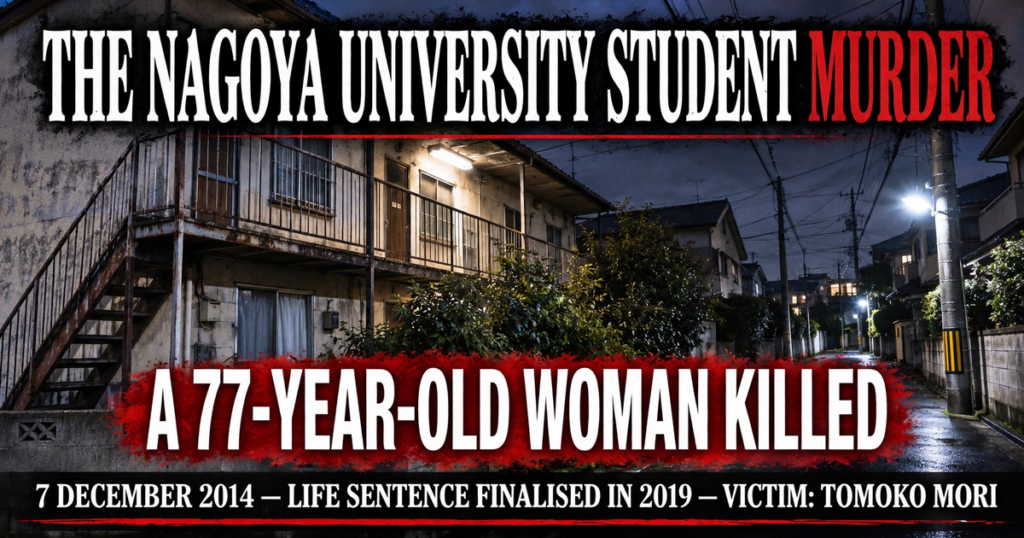
A woman met through a religious seminar was invited to the defendant's apartment
On December 7, 2014, a nineteen-year-old first-year student at Nagoya University invited Tomoko Mori, a seventy-seven-year-old woman from Chikusa Ward, to her apartment in Showa Ward. They had met through activities connected with a religious organization, and the student told Mori that she had many questions she wanted to ask. Once inside the apartment, the student attacked Mori with a small hatchet, striking her head repeatedly, and then strangled her with a scarf. The defendant was nineteen years and two months old at the time. After the killing, she left Mori's body in the apartment and returned to her family home in Sendai the following day. The victim's remains were not discovered for approximately fifty-one days.
Mori's disappearance led police to the apartment in January 2015
Mori's husband filed a missing-person report with the Chikusa Police Station. Investigators traced her last known contact to the university student. Police contacted the student at her family home in Sendai and asked her to return to Nagoya. She came back on January 26, 2015. The following day, she was interviewed at the police station and accompanied officers to her apartment, where Mori's body was found. The student was arrested on January 27 on suspicion of murder. The delay between the killing and discovery meant that investigators had to reconstruct the events from the victim's last movements, the defendant's statements and the condition of the apartment. The investigation also expanded to include other incidents from the defendant's earlier life.
The trial included two earlier thallium poisonings involving high-school students
The earliest offences considered in the proceedings occurred in 2012, when the defendant was still in high school. On May 27, she administered thallium sulfate to a female student who had attended middle school with her. On May 28 and July 19, she gave the same toxic substance to a male classmate at the high school she attended. Two students were affected over three separate dates. The defendant was charged with attempted murder in relation to the poisonings. She later said that she had wanted to observe the effects of the substance, and she disputed that she intended to kill the students. The courts had to distinguish her stated purpose from the legal question of whether she recognized and accepted the risk that the poison could cause death.
Two later fire-related incidents involved the same residence in Sendai
After entering university, the defendant was involved in two further incidents involving a house in Sendai. Between August 29 and 30, 2014, she used a firebomb against the residence, which she mistakenly believed belonged to a classmate of her younger sister. The incident resulted in damage to the property and charges under the Firearms and Swords Control-related provisions governing firebombs, as well as property damage. On December 13, six days after Mori's murder, she set another fire at the same residence with the aim of killing three people inside. The residents extinguished the fire, and the attempted killings and arson were not completed. These incidents were charged separately from the murder and were included in the overall criminal proceedings.
The Family Court ordered the case transferred to prosecutors after two psychiatric assessments
On September 29, 2015, the Nagoya Family Court decided that the defendant should be dealt with through the criminal process and sent the case to prosecutors. Two psychiatric assessments had been conducted before that decision. The Family Court recognized that the defendant had developmental difficulties, including problems understanding the feelings of other people. It nevertheless found that those difficulties had only a limited effect on the offences and did not deprive her of criminal responsibility. The decision did not deny that a mental or developmental condition existed. It assessed the extent to which the condition affected her judgment and control at the time of each offence. The case then proceeded to a criminal trial.
At trial, the defendant admitted the murder but disputed intent in the thallium cases
The jury trial began at the Nagoya District Court on January 16, 2017. The defendant admitted Mori's murder and the later attempted arson, but she denied that she had intended to kill the students who received thallium. The defense argued that her mental disorder was so serious that she lacked criminal responsibility for all the offences, including those she admitted. The prosecution argued that she had retained full responsibility and that the poisonings amounted to attempted murder. The questions were not identical: the court had to determine whether the defendant intended or accepted the risk of death in the thallium incidents, and separately whether her mental state allowed criminal responsibility for the whole series of acts.
The Nagoya District Court imposed life imprisonment on March 24, 2017
On March 24, 2017, the Nagoya District Court found that the defendant had full criminal responsibility and sentenced her to life imprisonment. It also found attempted murder in relation to the thallium poisonings. The court acknowledged that mental-health issues had influenced her life but concluded that they had not substantially impaired her ability to understand the wrongfulness of her conduct or control her actions. The sentence covered the murder of Mori, the poisonings and the other serious offences considered at trial. The judgment was life imprisonment, not a fixed thirty-year term. Although the presiding judge discussed the seriousness of the sentence in terms that referenced the upper end of fixed-term imprisonment, the formal sentence remained life imprisonment.
The appeals ended with a final life sentence in October 2019
The defendant appealed on April 5, 2017. On March 23, 2018, the Nagoya High Court dismissed the appeal and upheld the life sentence. The High Court also maintained the finding of full criminal responsibility and concluded that the defendant had recognized the danger associated with the thallium poisonings. The defendant then appealed to the Supreme Court. On October 15, 2019, the Supreme Court Third Petty Bench rejected the appeal. The life sentence became final on October 22, 2019. The public Japanese source article does not identify the defendant by name. This record therefore preserves that anonymity rather than adding a name not used in the source.
Original Japanese record: 名古屋大学女子学生殺人事件|責任能力をめぐる三審の判断と、タリウム・放火の余罪が示したもの
Last updated:
Related articles

Case record
The Sendai Arcade Truck Attack: Three Dead, Four Injured and a 28-Year Sentence Replaced by Life
Case record
The Matsudo Female University Student Murder-Arson: A Death Sentence Replaced by Life Imprisonment

Case record
The Nagoya Manga-Cafe Employee Death and Corpse-Abandonment Case
Case record