
The Fukawa Case: Two Men Exonerated After 44 Years
Shoji Sakurai and Takuo Sugiyama were convicted of a 1967 robbery-murder and spent about 29 years in custody. A retrial acquitted them in 2011, and a later civil judgment found unlawful conduct in parts of the investigation and evidence-disclosure process.
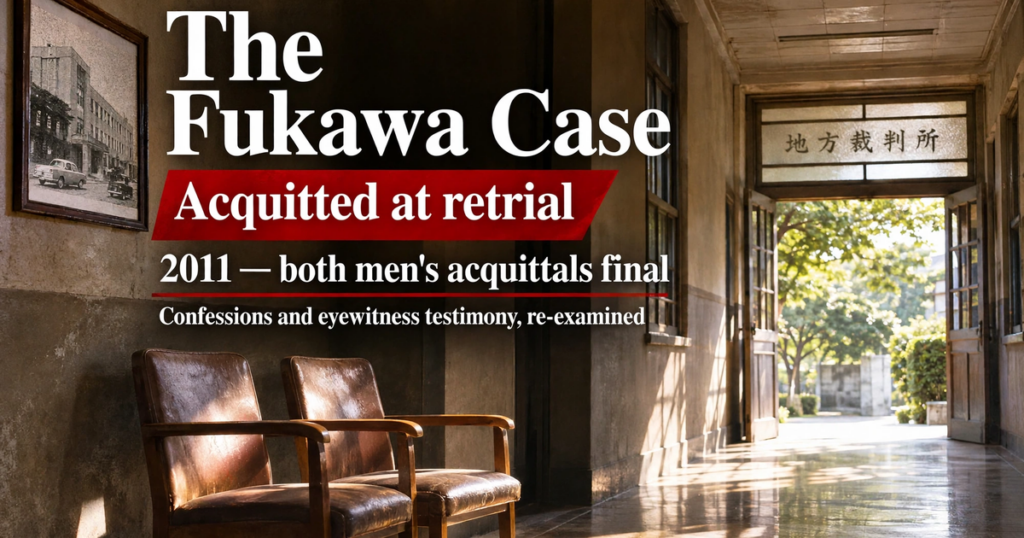
A 62-year-old man was found murdered in Fukawa in August 1967
The Fukawa Case concerned the robbery and murder of a 62-year-old man whose body was discovered early on 30 August 1967 in Fukawa, Tone Town, Ibaraki Prefecture. Shoji Sakurai and Takuo Sugiyama were convicted. The original case relied on their statements to police and eyewitness testimony said to place them near the victim's home and around Sakae Bridge over the Tone River. Both men denied the robbery-murder in court, but the courts accepted the prosecution's account. In 1970, the Mito District Court sentenced them to life imprisonment; the Tokyo High Court dismissed their appeals in 1973, and the Supreme Court rejected their final appeals in July 1978. The retrial exposed untested inconsistencies in the confessions and eyewitness accounts.
Sakurai was first detained in connection with a different theft
The chronology of the investigation is important. Sakurai was not initially arrested for the Fukawa robbery-murder. On 10 October 1967, he was arrested in Chiba Prefecture in a separate shoplifting case involving trousers and other items. Police began questioning him about the Fukawa case while he was already in custody. On 15 October, he made a statement admitting involvement. Sugiyama was also detained in connection with another matter and later made an admission. Both were formally arrested on suspicion of robbery-murder on 23 October. Sakurai's statements did not remain consistent: he later denied the offence, was temporarily released from the robbery-murder charge while other detention continued, and then again made admissions during questioning. The later civil judgment examined how officers used information about his claimed alibi and whether the questioning methods crossed legal limits. This history is relevant because the original trial treated the confessions as important evidence even though the statements had changed over time.
The original convictions rested on confessions and eyewitness accounts
The prosecution presented the confessions as detailed descriptions of the crime and relied on witnesses who said they had seen Sakurai and Sugiyama near the victim's home or had seen Sakurai near Sakae Bridge. Those accounts helped place the two men in the relevant area at the time of the killing. The original courts accepted the confessions and the eyewitness evidence and imposed life sentences. Later review, however, identified differences between the statements and the objective circumstances of the victim's body and the scene. The retrial process also examined changes in the accounts, the possibility that investigators had led the suspects toward particular explanations, and the existence of recorded interviews that were interrupted around significant changes in the statements. The point was not simply that a witness had made a mistake or that a confession had been withdrawn. The reliability of the evidence had to be assessed in light of the way it was obtained and the material that had not been disclosed during the original appeal proceedings.
An officer falsely told Sakurai that his alibi had been disproved
A later civil judgment found a concrete problem in the questioning of Sakurai. He said that he remembered an alibi concerning where he had stayed on the night of the crime. On 28 October 1967, an officer told him, in substance, that everything he had said had been checked and was false. The records showed that investigators had obtained statements from people connected with the accommodation that supported parts of his account. The Tokyo District Court later held that using this false assertion to keep Sakurai's confession in place was unlawful. The court did not hold that every long interrogation in a serious case was automatically illegal. It distinguished the overall length of questioning from specific methods, including knowingly giving false information and steering a suspect toward a particular account.
The first retrial request failed, but a second request reopened the case
Sakurai and Sugiyama filed their first retrial request in December 1983 while they were still serving their life sentences. The request was rejected, and the Supreme Court dismissed a special appeal in 1992. Both men were released on parole in November 1996, after approximately 29 years in custody. Their release did not erase the convictions; legally, they remained people with final life sentences. In December 2001, they filed a second retrial request. The new review focused on contradictions between the confessions and the physical circumstances, the reliability of the eyewitness accounts and investigative records that had not been available to the defence. The Mito District Court's Tsuchiura Branch ordered a retrial in September 2005. Prosecutors challenged that decision. The Tokyo High Court rejected the immediate appeal in July 2008, and the Supreme Court dismissed the special appeal in December 2009, making the retrial order final. A retrial order only permits a new trial; it does not itself establish innocence.
The retrial court acquitted both men on 24 May 2011
The retrial began in July 2010. Prosecutors again sought life imprisonment, so the acquittal was not automatic merely because a retrial had been ordered. On 24 May 2011, the Mito District Court's Tsuchiura Branch found both Sakurai and Sugiyama not guilty. It concluded that there was no objective circumstantial evidence sufficient to infer that they had committed the robbery-murder and rejected the reliability of the eyewitness testimony that had supported the original convictions. The court also found serious problems with the content and voluntariness of the confessions. Prosecutors did not appeal, and the acquittals became final in June 2011. The case therefore took nearly 44 years from the discovery of the victim's body to the final acquittal. The men had been outside prison since 1996, but the legal burden of the convictions remained until the retrial judgment became final.
A civil judgment found unlawful conduct in questioning and disclosure
After the acquittal, Sakurai brought a damages action against the national government and Ibaraki Prefecture. The issue was not whether the retrial court had correctly acquitted the men; it was whether police and prosecutors had committed acts that were unlawful under Japan's State Redress Act. On 27 May 2019, the Tokyo District Court ordered the state and prefecture to pay Sakurai 76,008,757 yen. It found that parts of the police questioning were unlawful and that prosecutors had unlawfully withheld important early investigative materials concerning eyewitness statements and the alibi inquiry. The Tokyo High Court's August 2021 judgment also recognized unlawful conduct by prosecutors. Neither the national government nor Ibaraki Prefecture appealed further, and the damages award became final. This civil ruling was separate from the criminal retrial: it addressed the legal responsibility of public authorities for specific investigative and prosecutorial conduct.
The case also revealed a long delay in formally publicizing the acquittal
The two men did not live to see every later development. Sugiyama died in 2015, and Sakurai died in August 2023. In November 2024, an inquiry to the Tsuchiura Branch revealed that the statutory public notice of the retrial acquittal had not been carried out. The court announced in March 2025 that staff had overlooked the requirement. The notice was finally published in the official gazette on 7 April 2025, about 13 years and 10 months after the acquittal. The delay did not reverse the final acquittals, but exposed another procedural failure after the men had died.
Original Japanese record: 布川事件|自白と目撃証言が崩れた再審、29年の拘束と国賠判決
Last updated:
Related articles
Case record
The Iwao Hakamada Case: From Death Row to a Final Acquittal
Case record
The Koto Memorial Hospital Case: A Twelve-Year Sentence Overturned by Retrial, and a Death Not Proven to Be Homicide
Case record
The Sayama Case: A Final Life Sentence, Disputed Evidence and a Fourth Retrial Request After Death
Case record