
The Takachiho Six Deaths
Six people—five members of one family and a friend who had come to mediate a domestic dispute—were found dead in Takachiho, Miyazaki Prefecture, on 26 November 2018. The man suspected by police, Masahiro Iiboshi, was found dead in a river that afternoon. He was referred to prosecutors after his death, so no criminal trial or judicial finding took place.
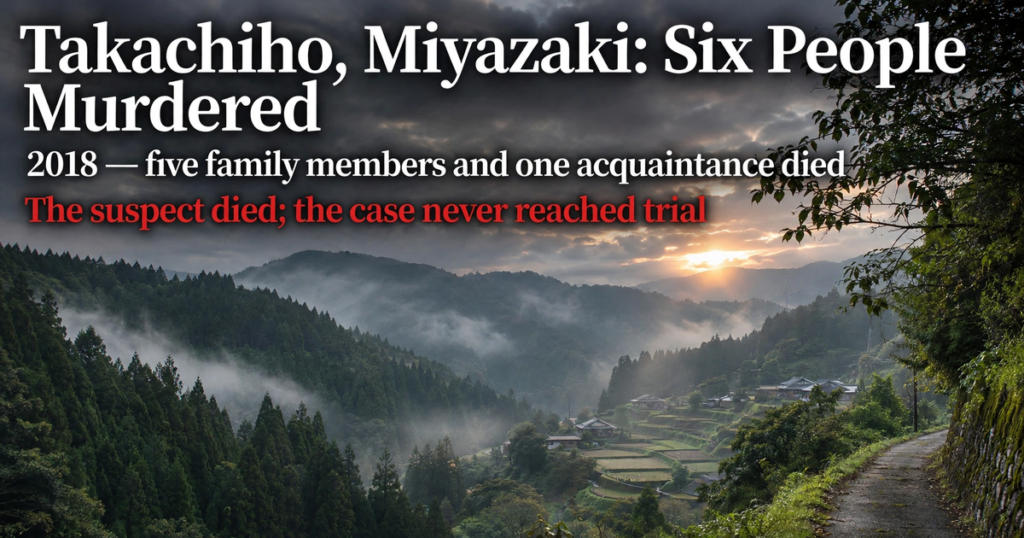
Six people were found dead in a home in Takachiho
On the morning of 26 November 2018, six people were found dead at a residence in Oshikata, Takachiho Town, Nishiusuki District, Miyazaki Prefecture. Five were members of the household and one was an acquaintance who had come to mediate a dispute between a married couple. The victims were 72-year-old father Yasuo Iiboshi, his 66-year-old wife Mihoko, their 41-year-old daughter-in-law Mikiko, their 21-year-old grandson Takumi, their seven-year-old granddaughter Yui, and 44-year-old Fumiaki Matsuoka. The deaths were discovered after relatives living outside the area could not contact the family and asked police to check the home.
The acquaintance had come to intervene in a domestic dispute
Matsuoka was not a member of the family. According to the accounts recorded in the Japanese source, he went to the Iiboshi home on the night of 25 November to mediate an argument between Masahiro Iiboshi and his wife. This circumstance helps explain why he was at the residence, but it does not establish the motive for the deaths. Reports immediately after the incident offered different explanations for the couple's dispute, including speculation about a relationship issue. Later reporting also included neighbours who said they had not heard of an affair. Because the suspected perpetrator died and no trial took place, those competing accounts cannot be converted into a definitive judicial finding.
The victims had different injuries and were found in different places
Investigative reporting described differences in the apparent methods of attack. Mikiko and seven-year-old Yui had marks consistent with pressure to the neck, while Yasuo, Mihoko, Takumi and Matsuoka had knife injuries to the head or neck. A bloodstained hatchet was reportedly found in a bedroom. Several bodies were discovered inside the residence, while Mihoko was found near an outdoor storage area. These details formed part of the police investigation into how the six deaths occurred. They do not establish a definitive sequence of attacks. The available evidence did not permit a court to determine precisely when each person was attacked or in what order.
Masahiro Iiboshi was missing when the six bodies were discovered
Masahiro Iiboshi, who lived in the house, was not present when the six bodies were found. Police began searching for him. That afternoon, a man's body was discovered in the Gokase River below Shinto Takachiho Bridge, approximately three kilometres from the residence. The body was later identified as Masahiro. Reports stated that his fingerprints were found on the bridge railing. No suicide note was confirmed. His death meant that investigators could not question him about what had happened in the house, and no statement from him was available to explain why he had gone to the bridge or what he had intended to do after the deaths.
The police treated the case as a suspected single-offender killing
Miyazaki Prefectural Police investigated the six deaths and concluded that Masahiro Iiboshi had acted alone. On 24 July 2019, police referred him to prosecutors on suspicion of murdering all six victims. Because he had died on the day the bodies were discovered, this was a referral after death. It did not lead to a criminal trial. A referral to prosecutors is not an indictment, and it is not a court judgment. The police conclusion about a suspected single offender should therefore be distinguished from a judicial finding of guilt, which never occurred in this case.
No criminal trial was held and no court determined the motive
The death of the suspected perpetrator ended the possibility of an ordinary criminal prosecution. There was no indictment, no trial, no examination of witnesses in court and no judgment determining criminal responsibility. The police referral was an investigative conclusion, not a conviction. The source article accordingly describes the case as one with no criminal trial and an unresolved motive. It is also important not to interpret the absence of a trial as proof that the police considered Masahiro unrelated to the deaths. The police had identified him as the suspected sole offender and sent the case to prosecutors after his death, but the judicial process that might have tested the evidence never took place.
The immediate dispute did not explain why six people died
The fact that Matsuoka came to mediate a dispute gives the event a known immediate context. It does not explain why the deaths included the parents, the wife, a 21-year-old son, a seven-year-old girl and the visiting acquaintance. The source notes that the specific nature of the couple's dispute was described differently in early reports. Without testimony from Masahiro or a trial in which the evidence could be challenged, no single explanation can be treated as established. The order of the attacks, the precise time each death occurred and the point at which Matsuoka became involved also remain uncertain. The case is not wholly without an investigative theory, but key questions remain unanswered.
The meaning of an unresolved case must be stated carefully
The Takachiho case is sometimes described as an unsolved mass murder, but that phrase can be misleading if it suggests that police had no suspect. Police identified Masahiro Iiboshi as the suspected offender and referred him to prosecutors for six murders. The unresolved elements concern the absence of a trial, the inability to obtain his account, the lack of judicial findings and the motive and detailed sequence of events. Those limits should remain visible in any account. The six deaths are established; the police's single-offender theory is established as the investigative conclusion; but criminal guilt was never adjudicated by a court.
Original Japanese record: 宮崎・高千穂6人殺人事件|家族5人と仲裁に訪れた知人が死亡、刑事裁判なきまま残った動機
Last updated:
Related articles
Case record
The Tokushima–Awaji Father-and-Son Murders: Eleven Years of Flight, No Trial
Case record
The Kitashinchi Building Arson: Twenty-Six Victims Killed, No Criminal Trial and the Fire-Safety Reforms That Followed
Case record
The Nishitokyo Deaths of a Mother and Her Three Children
Case record