
The Nishitokyo Deaths of a Mother and Her Three Children
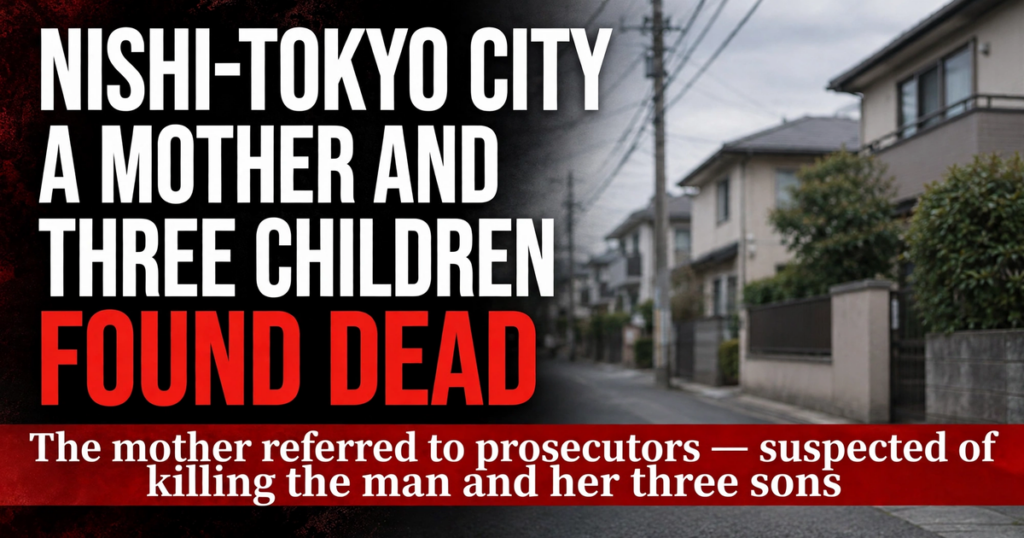
Four family members were found dead in a Nishitokyo home on 19 December 2025. Three days later, a man known to the mother was found dead in a rented apartment in Nerima. Police later referred the deceased mother to prosecutors on suspicion of killing the man and her sons; no criminal trial or judgment was possible.
Four family members were found inside a locked home
On the evening of 19 December 2025, a husband returning to his home in Kitamachi, Nishitokyo City, noticed that the entrance chain was fastened from inside. He had expected his wife and children to be away. After he called emergency services, police officers entered the residence and found his wife, Yuka Nomura, aged 36, and their three sons collapsed inside. All four were taken to hospital, where their deaths were confirmed. The initial discovery appeared to concern a mother and her children, but the investigation soon expanded to a second location and another deceased person.
The three boys were aged sixteen, eleven and nine
The children were identified as Haruto, aged 16 and in the first year of high school; Rikuto, aged 11 and in the fifth year of elementary school; and Reo, aged nine and in the fourth year of elementary school. The four bodies were found in the same house, but the injuries were not identical. Police examined each death separately. In the later referral to prosecutors, investigators alleged that Nomura had killed all three boys on 19 December. The reported methods differed: the eldest was allegedly stabbed, while cable ties or similar restraints were alleged to have been used against the younger two.
The first scene contained weapons but no clear sign of an outside intruder
Police found a bloodstained blade and an axe inside the Nishitokyo residence. The door was secured and investigators did not identify clear signs that an outsider had entered. In the immediate aftermath, the possibility of a family-related incident, including a murder-suicide, was considered. That was an early investigative hypothesis, not the final account of the wider case. The later discovery of a man's body in Nerima and the evidence linking the two locations led investigators to examine events that had taken place several days before the family members were found.
A rental contract in the mother's car led police to a Nerima apartment
During their examination of the Nishitokyo home and the family's vehicle, investigators found a rental contract for an apartment in Minami-Tanaka, Nerima Ward. The apartment was approximately 5.5 kilometres from the family home and had been rented in Nomura's name. On 22 December, police searched the property and found a man's body inside a bedroom closet. The closet had been sealed from the outside, and the apartment was locked. What had first appeared to be a single household tragedy was now being investigated as a case involving a second death at another address.
The man in the closet was identified as Shintaro Nakakubo
The body was identified as Shintaro Nakakubo, a 27-year-old company employee who was known to Nomura. He was believed to have been living alone in the apartment rented in her name. An autopsy indicated that he had suffered multiple stab wounds to the abdomen and back, with haemorrhagic shock considered the cause of death. Police also found a smartphone used by Nakakubo in Nomura's home and vehicle. These items, together with the rental contract and the apartment, connected the two locations in the investigation.
Investigators placed Nakakubo's death four days before the family deaths
In the referral made in April 2026, the Metropolitan Police Department alleged that Nomura stabbed Nakakubo several times in the Nerima apartment on 15 December 2025. Investigators also alleged that she concealed his body in the bedroom closet between 15 and 17 December. The deaths of the three boys were placed on 19 December, four days after the suspected killing of Nakakubo. This sequence is significant because the first four bodies found in Nishitokyo did not reveal the earlier death in Nerima. The second scene moved the investigative timeline back to 15 December.
Security footage and an air purifier became part of the reconstruction
Security-camera footage recorded Nomura entering the apartment on 17 December carrying an object that appeared to be an air purifier. When police searched the room, an air purifier was operating inside. The article also describes the use of smartphones, communication records and surveillance footage to reconstruct movements between the two locations. These materials helped investigators establish a chronology, but they should not be confused with a judicial finding. No court tested the evidence through a criminal trial because the person suspected of the killings had died.
Communication records suggested a relationship dispute, but motive was not tested in court
Investigative reporting cited in the Japanese article said that Nomura and Nakakubo had been in a romantic relationship and that Nakakubo had proposed ending it. LINE messages and other communication records were examined as part of the investigation. Police considered whether a dispute surrounding the end of the relationship formed part of the background to Nakakubo's death. However, Nomura died before any trial could take place. She therefore had no opportunity to explain the relationship or respond to the allegations in court, and the reported possible motive must not be presented as a judicially established fact.
The mother was referred to prosecutors after her death
On 24 April 2026, police sent the case papers to prosecutors naming Nomura as a suspect in the murders of Nakakubo and her three sons, and in the disposal of Nakakubo's body. In Japan, this procedure is commonly called document referral or referral of the case papers. It means that police have sent the investigative file to the prosecutor; it is not an indictment and does not amount to a criminal conviction. Because Nomura had died, she could not be prosecuted in an ordinary criminal trial. There was no judgment establishing her guilt.
Five deaths are linked by the investigation, but the legal status is not a conviction
The case involves five deceased people across two locations: Nakakubo, whose body was found in Nerima on 22 December, and Nomura and her three sons, who were found in Nishitokyo on 19 December. Police referred Nomura to prosecutors on suspicion of killing the man and the boys, but she was already dead. The available article describes the police theory and evidence, not a court's final findings. The distinction between an investigative suspicion, a document referral and a judicial verdict is essential. The case did not proceed to a trial in which the allegations could be proved or contested.
Original Japanese record: 西東京市母子4人死亡事件|中窪新太郎さんと息子3人殺害容疑、死亡した母親を書類送検
Last updated:
Related articles
Case record
The Kitashinchi Building Arson: Twenty-Six Victims Killed, No Criminal Trial and the Fire-Safety Reforms That Followed
Case record
The Takachiho Six Deaths
Case record
The Tokushima–Awaji Father-and-Son Murders: Eleven Years of Flight, No Trial
Case record