
The Shimonoseki Station Random Attacks
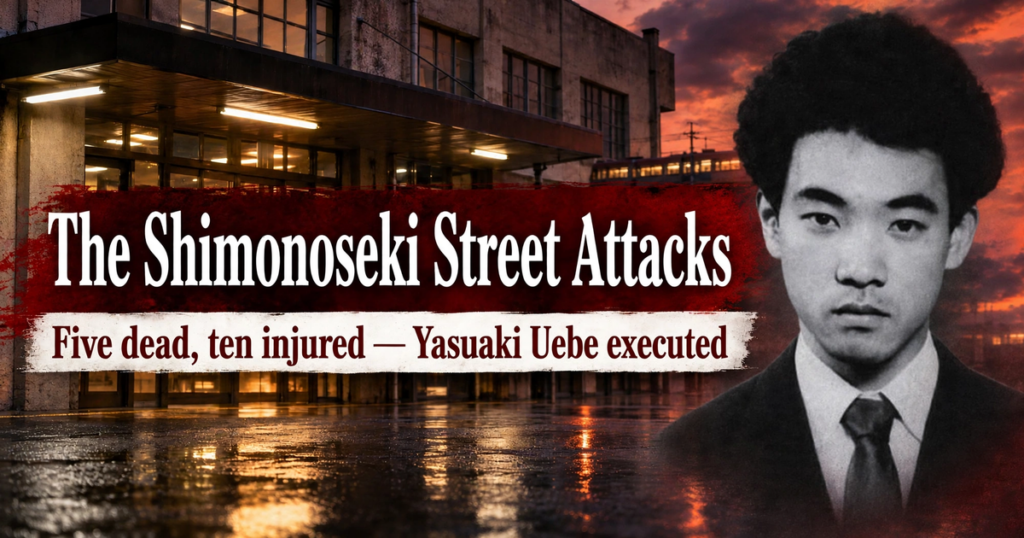
On 29 September 1999, Yasuaki Kamibe drove a rented car into JR Shimonoseki Station and then attacked people with a kitchen knife. Five people died and ten were injured. The courts rejected arguments that mental illness deprived him of criminal responsibility, and his death sentence was upheld and carried out in 2012.
A rented car entered the station concourse
At approximately 4:25 p.m. on 29 September 1999, a rented car mounted the pedestrian area at the east entrance of JR Shimonoseki Station in Yamaguchi Prefecture. It struck people, broke through the station's glass doors and entered the concourse. The driver, Yasuaki Kamibe, then left the vehicle and moved toward the ticket gates and platforms carrying a kitchen knife. The attack unfolded in a public transport hub, where people were commuting, travelling, attending appointments or going about ordinary daily activities.
Five people died and ten others were injured
The Japanese article divides the victims by the two methods of attack. Seven people were struck by the car: two died and five were injured. Eight people were attacked with the knife: three died and five were injured. The overall total was therefore five deaths and ten injured people, fifteen victims in all. None was known to Kamibe. The random nature of the victims was central to the courts' assessment of the seriousness of the crime and the absence of any grievance that could explain or mitigate the attack.
The offender's personal difficulties formed part of the background
Kamibe was 35 at the time. He had a history of social anxiety and had attended psychiatric services. The article describes growing frustration over his work and personal circumstances. On 24 September, a typhoon-related storm surge flooded the light truck he used for work, leaving it unusable while a loan remained outstanding. He sought financial help from his parents but did not receive the support he wanted. The first-instance judgment treated his resentment toward his parents and society as part of the background to his decision to attack strangers.
He had examined the station and prepared a two-stage plan
The attack was not an entirely spontaneous outburst. Kamibe initially considered carrying it out on Sunday, 3 October, when more people might be at the station. On 28 September he bought a kitchen knife and inspected the station area. He examined the route by which a vehicle could enter, the width of the glass doors and the movement from the concourse toward the platforms. His plan was to use a vehicle to injure as many people as possible and then continue with a knife if the car could no longer be used.
The attack was brought forward to 29 September
Kamibe changed the intended date and carried out the attack on 29 September. The Japanese article describes his use of a rented vehicle to reach the station and the sequence from the pedestrian area through the entrance into the concourse. After the vehicle had struck people, he continued the attack on foot with the knife. The division between the car victims and knife victims is not merely descriptive: it explains how the total of fifteen victims was reached and why the incident involved both vehicle-related and knife-related offences.
Mental-health evidence was disputed at trial
The central legal issue was whether Kamibe had criminal responsibility at the time of the attacks. His psychiatric history and psychological difficulties were examined, and expert opinions did not all point in the same direction. Under Japanese criminal law, a person who is unable to distinguish right from wrong or control conduct because of a mental disorder may be found to lack criminal responsibility or to have diminished responsibility. A diagnosis alone does not decide that question. Courts examine how the condition affected the person's understanding and control during the specific acts.
The courts relied on planning and conduct to find full responsibility
The courts considered the purchase of the knife, the inspection of the station, the choice of a vehicle, the intended route and the adjustments to the timing. They also examined Kamibe's conduct during the attack. These acts were treated as evidence that he could understand the nature of what he was doing and act in accordance with a plan. The courts rejected the arguments of insanity or diminished responsibility. The conclusion was not that his psychological difficulties did not exist, but that they did not remove or substantially reduce his criminal responsibility for the offences.
The district court imposed the death penalty in 2002
On 20 September 2002, the Shimonoseki Branch of the Yamaguchi District Court sentenced Kamibe to death. It placed weight on the five deaths, ten injuries, random selection of victims, preparation and the lack of a mitigating reason for attacking strangers. The court also considered matters that could favour the defendant, including his psychiatric treatment history and personality-related difficulties. It nevertheless concluded that the crimes were exceptionally grave and that a death sentence was unavoidable.
The High Court and Supreme Court upheld the judgment
The Hiroshima High Court dismissed Kamibe's appeal on 28 June 2005. He then appealed to the Supreme Court. On 11 July 2008, the Supreme Court's Second Petty Bench dismissed the appeal, leaving the death sentence final. The Supreme Court accepted the conclusion that Kamibe had not been in a state of insanity or diminished responsibility. It also considered the motive, the deliberate preparation and the scale of the harm. The appellate process therefore ended with the death sentence upheld, rather than with a new trial or a reduced sentence.
Kamibe was executed in 2012
Kamibe's death sentence was carried out at Hiroshima Detention House on 29 March 2012. The execution occurred about three years and eight months after the Supreme Court's decision. The legal sequence is distinct from the date of the attack: the crimes occurred in September 1999, the first-instance death sentence was imposed in September 2002, the High Court dismissed the appeal in June 2005, the Supreme Court dismissed the final appeal in July 2008, and the execution took place in March 2012. The case remains a major example of a court closely examining mental-health evidence while finding full criminal responsibility.
Original Japanese record: 下関通り魔事件|車と包丁で15人を無差別殺傷、完全責任能力を認めた死刑判決
Last updated:
Related articles
Case record
The Kakogawa Seven Murders

Case record
The 2008 Akihabara Attack: Seven Deaths and the Supreme Court's Sentencing Decision
Case record
The 1995 Tokyo Subway Sarin Attack: Victims, Criminal Trials and a Continuing Legacy

Case record