
The Tsuchiura Serial Stabbing Attacks
In March 2008, Masahiro Kanagawa killed two strangers in separate attacks in Ibaraki Prefecture and injured seven others. He said he wanted a death sentence. The first killing triggered a manhunt, but four days later he attacked passengers and passers-by near Arakawaoki Station.
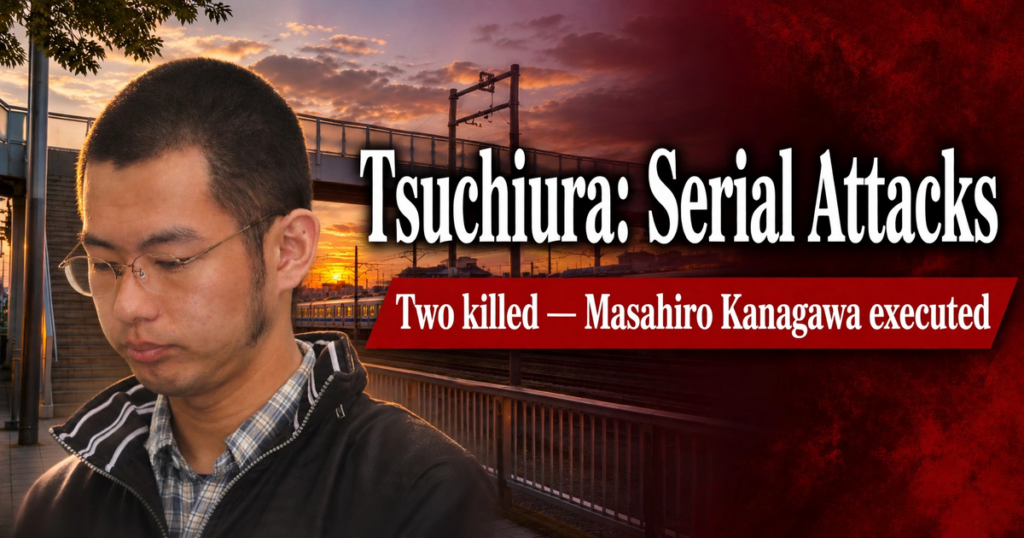
Two attacks, four days apart
The Tsuchiura serial stabbing attacks took place in Ibaraki Prefecture on 19 and 23 March 2008. The first victim was Yoshikazu Miura, a 72-year-old man killed near his home in Tsuchiura. Four days later, the same offender attacked people around JR Arakawaoki Station. Takahiro Yamagami, a 27-year-old company employee, was killed in the second attack, and seven other people were injured. The two incidents were linked by the suspect's preparation, movements and stated objective: he wanted to kill enough people to receive a death sentence.
Miura was approached under the pretext of borrowing a bicycle pump
On the morning of 19 March, Kanagawa went from house to house carrying a kitchen knife. He told residents that his bicycle tyre had gone flat and asked to borrow a pump. After one household was unavailable, he rang the bell at Miura's home. Miura lent him the pump. Kanagawa pretended to use it and returned it; when Miura turned away to put it back in the storage shed, Kanagawa attacked him from behind with a kitchen knife. The two men had no prior relationship. Miura was selected because he happened to answer the door.
The first killing led to an escape and a public manhunt
After the first attack, Kanagawa left his bicycle near the scene and fled. He noticed blood on his clothing, returned home to change, and travelled by train to Akihabara in Tokyo. There he had his hair cut very short, changed into a suit he had prepared, and stayed at a hotel under an assumed name. Police traced him through the bicycle left near the crime scene and other investigative information. His photograph was released and a public search began. The first killing had therefore become a manhunt for an identified suspect, not an unsolved attack.
He feared that one murder would not result in the punishment he wanted
Kanagawa learned that police were looking for him and became concerned that he would be arrested for Miura's murder alone. He believed one victim might not lead to a death sentence. On 21 March he began considering another attack. The following day he walked between Hitachino-Ushiku and Arakawaoki stations looking for an opportunity, but did not find a target. He also called emergency services from the station area and made remarks challenging police to catch him. The call was part of the information available to investigators before the second attack.
The second attack took place at Arakawaoki Station
On the morning of 23 March, Kanagawa went to JR Arakawaoki Station carrying a kitchen knife and a survival knife. He put on rubber gloves and attacked people in the station's free passageway. Eight people were attacked: Yamagami died and seven others were injured, including a police officer who had been assigned to watch for the suspect. The first killing of Miura and the station attack thus produced two deaths and seven injured survivors in total. The attack was not a confrontation with a particular individual; the people present were strangers who happened to be in the area.
He contacted police after the station attack
Kanagawa was not immediately arrested at the place where the stabbings occurred. He went to an unoccupied police box about 300 metres from the station's west exit and telephoned Tsuchiura Police Station, saying in substance that he was the offender. Officers who arrived arrested him on suspicion of Miura's murder. He still possessed the knives, but did not resist when police approached and discarded one of them. The trial judgment also described a further plan to attack people at a nearby toy store. The intended scale of the violence was therefore not limited to the people already injured at the station.
Police had deployed a substantial search operation but failed to prevent the second attack
After the first killing, Ibaraki Prefectural Police established an investigative headquarters and expanded patrols because a further attack was considered possible. Police Agency testimony to the Diet stated that about 170 officers were engaged in investigation and security on 23 March. Personnel were assigned to the station, railway services, Kanagawa's home and places he might visit. Plain-clothes officers were also present around Arakawaoki Station. Despite these measures and the suspect's earlier telephone call, he reached the station and attacked members of the public. The failure to prevent the second incident became a subject of official review.
The trial examined responsibility and the meaning of a death-seeking motive
Kanagawa did not substantially contest the basic sequence of the attacks. The main issues at trial included whether he had full criminal responsibility and whether a death sentence was appropriate when the defendant himself sought that outcome. The defence argued that imposing death would fulfil the purpose of the crimes and that life imprisonment would instead require him to live with the consequences. It also referred to his age, lack of prior convictions and possible prospects for rehabilitation. The court had to assess those arguments against the deliberate killing of strangers and the injuries inflicted on seven other people.
The district court imposed death, and Kanagawa personally ended the appeal
On 18 December 2009, the Mito District Court sentenced Kanagawa to death. It treated the plan to kill people in order to obtain a death sentence as an especially blameworthy motive, not a reason to reduce punishment. The court also considered the two deaths, seven injuries, the random selection of victims and the preparation over roughly two months. His defence counsel filed an appeal, but Kanagawa personally withdrew it on 28 December. The death sentence became final on 5 January 2010. It was not a Supreme Court ruling on the merits; finality followed the defendant's withdrawal of the appeal.
The sentence was carried out in 2013
Kanagawa was executed at Tokyo Detention House on 21 February 2013, aged 29. The sequence should be kept clear: the attacks occurred in March 2008; the Mito District Court imposed the death sentence in December 2009; the defendant's withdrawal made it final in January 2010; and the execution took place more than three years later. The case is unusual because the offender openly pursued capital punishment as the purpose of killing. The court nevertheless treated the victims' lives as independent and irreplaceable, and rejected the idea that his desired outcome should reduce his responsibility.
Original Japanese record: 土浦連続殺傷事件|「死刑になるため」2人を殺害、指名手配中の再犯と死刑執行
Last updated:
Related articles

Case record
The Ikeda Elementary School Attack: Eight Children Killed, a Death Sentence and Lasting Changes to School Safety

Case record
The 2008 Akihabara Attack: Seven Deaths and the Supreme Court's Sentencing Decision
Case record
The 1995 Tokyo Subway Sarin Attack: Victims, Criminal Trials and a Continuing Legacy
Case record