The Ikeda Elementary School Attack: Eight Children Killed, a Death Sentence and Lasting Changes to School Safety
On June 8, 2001, Mamoru Takuma attacked pupils and teachers at Ikeda Elementary School in Osaka. Eight children died and 15 people were injured. His death sentence became final after he withdrew his appeal; no High Court or Supreme Court judgment was issued. He was executed on September 14, 2004.
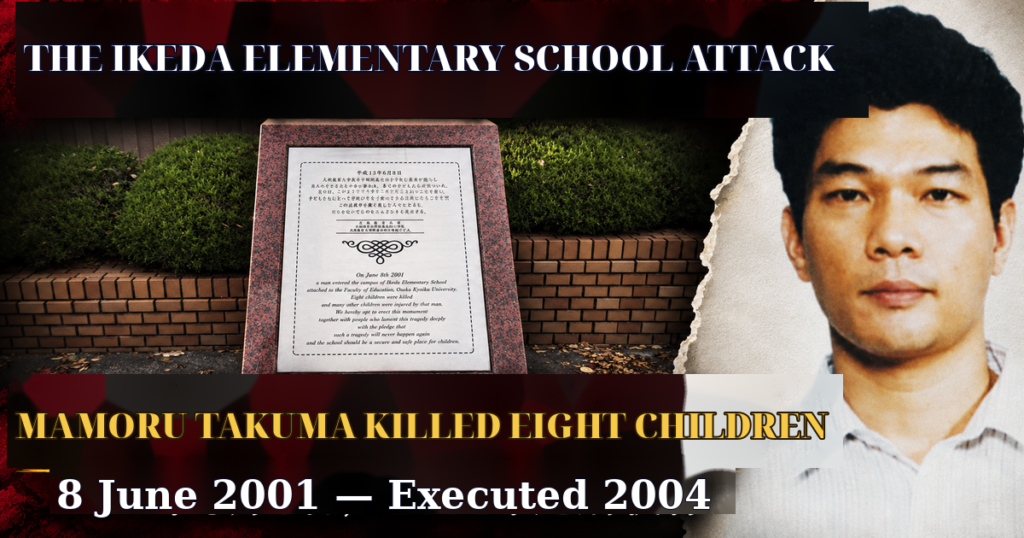
A man entered an elementary school through an open vehicle gate
Shortly after 10 a.m. on June 8, 2001, Mamoru Takuma entered Osaka Kyoiku University Ikeda Elementary School in Ikeda, Osaka Prefecture. The school's main southern gate was closed, but another gate intended for vehicles was open. Takuma passed through that entrance and attacked pupils and staff inside the school. The attack lasted about ten minutes before teachers and other staff restrained him. In that short period, he attacked 23 people. Eight children died: one boy in the first grade and seven girls in the second grade. Thirteen pupils and two teachers were injured. The attack took place in a school where young children should have been able to learn in safety.
The victims were first- and second-grade pupils
The eight children who died were all in the first or second grade. The fifteen injured people consisted of thirteen pupils and two teachers. These figures describe different groups and should not be merged into a single total of deaths or injuries. The incident left families, classmates, teachers and the wider school community facing a loss that could not be addressed only through criminal proceedings. The attack also raised immediate questions about how an outsider could enter a school, how staff could identify and respond to a threat, and how children could be protected without making schools inaccessible. Those questions became a central part of the subsequent institutional review.
The investigation examined the attack and Takuma's mental condition
Police arrested Takuma at the school and investigated murder, attempted murder, trespass and weapons-related offences. Prosecutors indicted him on September 14, 2001. The defence argued that his mental condition meant he lacked criminal responsibility or that his responsibility was diminished. The prosecution maintained that he understood the nature of his conduct and could control his actions. The Osaka District Court considered psychiatric evidence and Takuma's conduct before and during the attack. It found no mental illness that had deprived him of the ability to distinguish right from wrong or control his behaviour. A person's psychological difficulties do not automatically establish legal incapacity; the court had to assess his actual decision-making at the time.
The District Court imposed the death penalty in August 2003
On August 28, 2003, the Osaka District Court sentenced Takuma to death. The court considered the deaths of eight children, the injuries to fifteen others, the deliberate selection of a school and the vulnerability of the young pupils. It also considered the impact on the bereaved families and the wider community. The death sentence was not based on the number of victims alone. The court assessed the motive, the manner of the attack, the planning and the finding that Takuma retained full criminal responsibility. Takuma filed an appeal, which would ordinarily have allowed the High Court to review the judgment. However, the appeal did not proceed to a full hearing.
Takuma withdrew his appeal, so no appellate judgment was issued
On September 26, 2003, Takuma withdrew his appeal to the Osaka High Court. As a result, there was no High Court judgment and no Supreme Court judgment in the case. The death sentence became final through the withdrawal procedure, not because the Supreme Court dismissed an appeal. Government materials list December 5, 2003, as the date the sentence became final. This distinction matters when describing the legal history. It is inaccurate to say that the Supreme Court upheld the death sentence. The sentence was imposed by the District Court and became final after Takuma's own appeal was withdrawn.
The death sentence was carried out in September 2004
Takuma, who later changed his surname to Yoshioka, was executed at Osaka Detention House on September 14, 2004. The execution took place less than a year after the death sentence became final. His death ended the criminal process against him, but it did not end the work of the school, university and public authorities to examine the attack. The school community continued to address the needs of bereaved families and survivors, while educational institutions considered how to prevent a similar breach of safety. The criminal responsibility of the attacker and the institutional response to the emergency are separate questions, even though both arose from the same event.
The school's emergency response was examined after Takuma was restrained
The review by Osaka Kyoiku University identified serious problems even after Takuma had been restrained. Staff did not have a reliable school-wide picture of which children were injured, where they were, how many needed help or how serious their injuries were. The school could not organise a coordinated evacuation, first aid and transport to hospitals. Communication with parents about the hospitals to which their children had been taken was also delayed. The review concluded that the eight children who died had not all died immediately and that delays in emergency treatment contributed to deaths from blood loss. These findings concern the school's emergency response; they do not transfer responsibility for the attack from Takuma to the school.
School security and emergency procedures changed after the attack
The attack prompted schools and education authorities to reconsider physical access, visitor management, emergency communication and staff training. Measures included clearer control of entrances, procedures for identifying visitors, coordination with police and emergency services, evacuation plans and regular drills. Schools also needed systems for accounting for pupils and informing families quickly when an incident occurred. Physical security alone cannot guarantee safety, so the review emphasised organisational readiness as well as gates and locks. More than two decades later, the case remains a reference point in discussions of school safety. The lasting lesson is not only that an attacker must be stopped, but that schools must be able to locate, treat and communicate about every child when an emergency occurs. On June 8, 2003, the bereaved families, the national government, Osaka Kyoiku University and the school signed an agreement. The government accepted compensation responsibility for inadequate safety management, while the university and school committed to stronger access controls, emergency manuals, intruder-response drills and coordination with police, fire services and local authorities. By 2026, the school continued to employ three security guards, maintain emergency-alert systems and conduct regular safety inspections. It also continued its dedicated Safety subject, introduced in 2009, and held a memorial gathering on the twenty-fifth anniversary in June 2026. The case is therefore not only a closed criminal proceeding but also an ongoing school-safety programme.
Original Japanese record: 池田小児童殺傷事件|児童8人死亡、死刑確定と25年後も続く学校安全の継承
Last updated: