
The Toyokawa Family Five-Person Attack
In April 2010, Takayuki Iwase attacked five members of his household in Toyokawa, Aichi Prefecture, killing his father and his one-year-old niece, injuring three other relatives and setting the house on fire. The trial focused on intent and criminal responsibility in light of Iwase's intellectual disability and autism. The courts found full criminal responsibility and a life sentence was not imposed; the final sentence was 30 years' imprisonment.
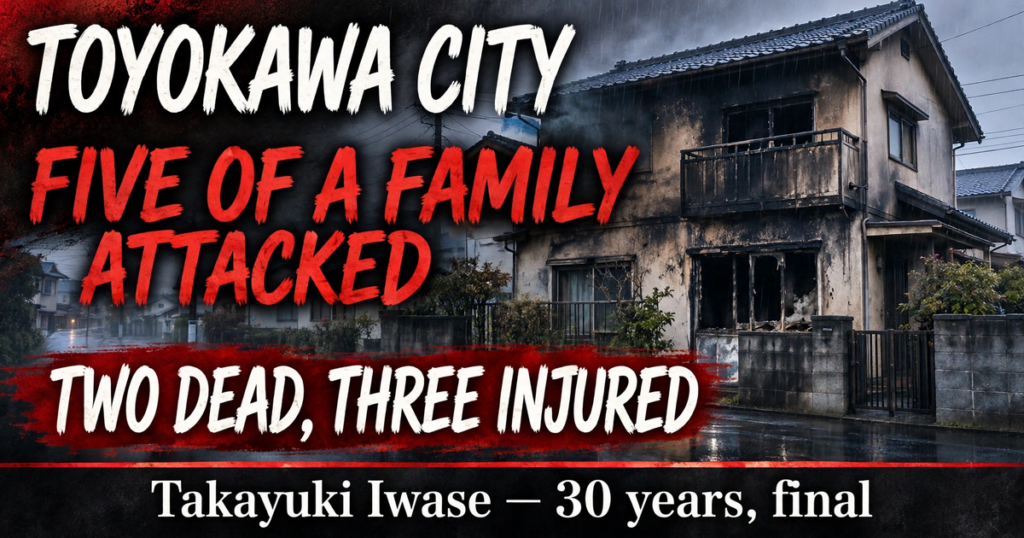
Five members of one household were attacked
In the early hours of 17 April 2010, Takayuki Iwase, then 30, attacked five members of his household at a residence in Ina-cho, Toyokawa City, Aichi Prefecture. He used a kitchen knife against family members and set fire to the home. His father, Kazumi Iwase, aged 58, and his one-year-old niece, Tomomi Kanemaru, died. His mother, younger brother and the brother's wife were injured. The case was prosecuted as a series of serious offences arising from one attack on members of the same household, with two deaths, three injured survivors and arson.
Family tensions had developed over money and daily life
Before the attack, Iwase had spent a long period living mainly at home. The Japanese article describes tensions involving online shopping, credit-card use under family members' names and disagreements about money. These circumstances were examined during the trial, but they should not be reduced to a single explanation such as anger about an internet connection being cancelled. The court considered the broader family situation, Iwase's living arrangements, his relationships with relatives and the events immediately before the attack. The prosecution and defence disputed the intent with which he had attacked each of the five people.
The surviving relatives and physical evidence were examined
Police and fire services responded after receiving an emergency report and secured Iwase near the home. The identity of the attacker was not the principal issue at trial. Investigators examined the accounts of surviving family members, blood traces, the knife and the circumstances of the fire to reconstruct the sequence of events inside the house. Iwase's statements and conduct after the attack were also considered. He told police that he had stabbed family members and set the house on fire. The fact that the attacker was known did not remove the need to determine the legal character of each act and whether he had intended to kill.
The defence disputed intent to kill
At the trial, Iwase said that parts of his memory of the attack were unclear and did not clearly admit that he had intended to kill his relatives. The defence argued that some of the conduct should be treated as causing injury resulting in death rather than murder. The court considered the locations of the wounds, the force and nature of the attacks, whether the victims could escape and whether Iwase understood the danger of using a knife. It found that he had attacked vital parts of the body and had obstructed the victims' ability to get away. On that basis, the first-instance court found murderous intent.
The psychiatric assessment identified intellectual disability and autism
A psychiatric assessment for the proceedings identified intellectual disability and autism. The defence argued that these conditions had substantially reduced Iwase's ability to control his actions and that he should be treated as having diminished capacity. Under Japanese criminal law, diminished capacity can affect punishment when a person's ability to understand the nature of an act or act in accordance with that understanding is substantially impaired. A diagnosis alone does not automatically establish that legal condition. The court had to examine how the conditions affected Iwase at the time of the offences, including his understanding of the knife, his responses to the victims and his conduct after the attack.
The court found that he retained full criminal responsibility
The prosecution argued that Iwase had responded to the movements of the people he attacked, understood the danger of the knife and continued his actions. It also relied on his conduct in setting the house on fire and explaining to police what he had done. The court ultimately found that his ability to understand the nature of his conduct and control his actions had not been lost or substantially impaired. It recognized the existence of intellectual disability and autism, and considered that those characteristics had indirectly affected his life and the circumstances leading to the offences. It did not, however, treat them as eliminating or substantially reducing criminal responsibility.
The prosecution sought life imprisonment; the court imposed 30 years
On 30 November 2011, the prosecution sought life imprisonment. On 7 December 2011, the Nagoya District Court's Okazaki Branch sentenced Iwase to 30 years' imprisonment. The court considered the deaths of two people, the injuries to three others and the danger created by the arson. It also considered the indirect influence of Iwase's disability, the way he had lived for a long period and his attitude after the offences. The sentence was the maximum fixed-term prison sentence available under the law applicable at that time. It was not a finding of diminished capacity; the court had found full criminal responsibility and selected a fixed term rather than life imprisonment.
The appellate courts upheld the 30-year sentence
The defence appealed, challenging the findings on murderous intent, criminal responsibility and sentence. The Nagoya High Court dismissed the appeal on 6 August 2012 and maintained the 30-year term. The Supreme Court's Second Petty Bench dismissed the final appeal on 19 November 2012. The first- and second-instance judgments therefore remained in place, and the 30-year sentence became final. The case illustrates the distinction between a medical diagnosis and the legal test for criminal responsibility, as well as the distinction between life imprisonment and a long fixed-term sentence under Japanese criminal law.
Original Japanese record: 豊川市一家5人殺傷事件|父と1歳姪を殺害、3人負傷・放火で懲役30年確定
Last updated:
Related articles
Case record
The Keio Line Stabbing and Train Fire: A Planned Mass Attack and Eleven Attempted-Murder Findings
Case record
The Nagoya University Student Murder: Criminal Responsibility, Earlier Poisonings and a Final Life Sentence
Case record
The Nagoya Manga-Cafe Employee Death and Corpse-Abandonment Case
Case record