
The Nagoya Manga-Cafe Employee Death and Corpse-Abandonment Case
Kato, a 41-year-old manga-cafe employee, disappeared in April 2012. Her remains were found in a field in Minamichita, Aichi Prefecture, one year later. The former operator of the cafe and his wife were convicted of abandoning her body, but the criminal prosecution for causing her death was not pursued. A separate civil judgment in 2018 found that the couple's violence had caused her death and ordered them to pay approximately 67 million yen.
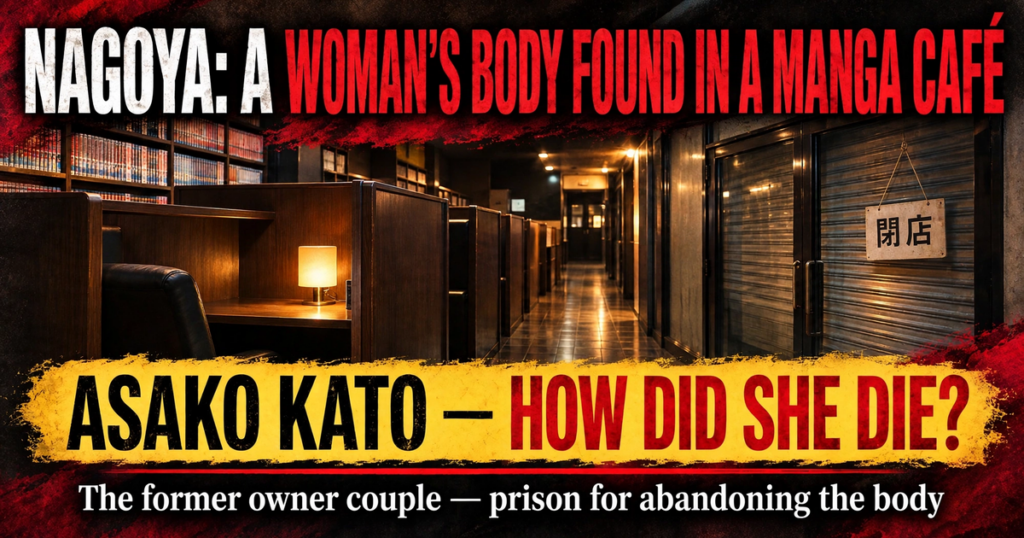
A manga-cafe employee disappeared in April 2012
Kato, aged 41, worked at a manga cafe in Nagoya. She disappeared in April 2012, and her family and colleagues were unable to establish where she had gone. The disappearance prompted an investigation that later focused on the former operator of the cafe and his wife. Kato's body was not found immediately. The interval between her disappearance and the recovery of her remains became central to the investigation of how she died and how her body had been concealed.
Her car was found near Nagoya Port with its number plates removed
After Kato went missing, her light passenger car was found in the area around Nagoya Port. Reports said that its number plates had been removed. In the later corpse-abandonment proceedings, the defendants' attempt to sink the vehicle in the sea was treated as part of an effort to conceal the crime. The vehicle therefore became an important part of the evidence about concealment and the steps taken after Kato disappeared. It did not, by itself, establish the cause of her death.
Her remains were found in a field in Minamichita in April 2013
About a year after the disappearance, in April 2013, skeletal remains were discovered in a field in Minamichita Town, Aichi Prefecture. The remains were identified as Kato. The recovery established that she had died and gave investigators a location at which to examine the handling of her body. The remains were found after a lengthy period during which the case had been treated as a missing-person matter. The discovery led to arrests on suspicion of corpse abandonment.
The former cafe operator and his wife were prosecuted for corpse abandonment
Investigators focused on the former operator of the manga cafe where Kato had worked, Mr. Sugimoto and his wife. The couple were accused of burying and concealing Kato's body. They were charged with corpse abandonment, a crime that concerns the handling and concealment of a body rather than the act that caused the person's death. The distinction became especially important because prosecutors later considered a separate allegation that the couple's violence had caused Kato's death.
Both defendants received prison sentences in March 2014
On 12 March 2014, the court sentenced each defendant to two years and two months in prison for corpse abandonment. The criminal judgment dealt with the concealment of Kato's remains. It did not convict either defendant of murder or of causing her death. The sentence must therefore be described by its actual offence and not expanded into a homicide conviction. The fact that the couple were punished for abandoning the body does not resolve every question about how Kato died.
The injury-resulting-in-death investigation did not lead to a criminal trial
In August 2013, the couple had also been re-arrested on suspicion of injury resulting in death. Investigators suspected that Kato had been assaulted at another restaurant operated by the couple, including an allegation that a metal rod used in food preparation had been used to strike her abdomen. The remains showed rib fractures that were thought to have occurred while she was alive. However, prosecutors did not bring the injury-resulting-in-death charge to trial. There was no criminal conviction for causing Kato's death.
A 2018 civil judgment found that the couple's violence caused her death
The case took a different legal path in civil court. On 14 March 2018, the Nagoya District Court found in a civil lawsuit that Kato had died as a result of violence by the couple and ordered them to pay approximately 67 million yen in damages. That judgment was a civil finding about liability and causation. It did not reverse the earlier criminal outcome or create a criminal conviction for murder or injury resulting in death. The different standards and purposes of civil and criminal proceedings must be kept distinct.
The criminal and civil outcomes must not be conflated
The case is unusual because the defendants were convicted of corpse abandonment, while the civil court later found that their violence had caused Kato's death. In criminal proceedings, the injury-resulting-in-death allegation was not prosecuted. In civil proceedings, the court determined liability and awarded damages. Saying that the couple were criminally convicted of killing Kato would therefore misstate the legal record. The criminal sentence was two years and two months for each defendant on the corpse-abandonment offence.
The case remains a record of a death with different legal findings
The known chronology begins with Kato's disappearance in April 2012 and ends with the discovery of her remains in Minamichita in April 2013. The former cafe operator and his wife were punished for concealing her body. A separate civil judgment attributed her death to their violence, but the criminal case did not produce a conviction for causing death. The case must be understood through these separate legal outcomes rather than a simplified description that treats the civil finding as a criminal verdict.
Original Japanese record: 名古屋漫画喫茶女性従業員遺体事件|死体遺棄は実刑、民事で認定された加藤麻子さんの死亡経緯
Last updated:
Related articles
Case record
The Toyokawa Family Five-Person Attack
Case record
The Nagoya University Student Murder: Criminal Responsibility, Earlier Poisonings and a Final Life Sentence
Case record
The Nagoya Couple Murders: Two Young Victims, Six Offenders and the Appeal That Replaced a Death Sentence with Life Imprisonment
Case record