
The Nagoya Nishi Ward Housewife Murder: A 26-Year DNA Breakthrough and a Case Still Awaiting Trial
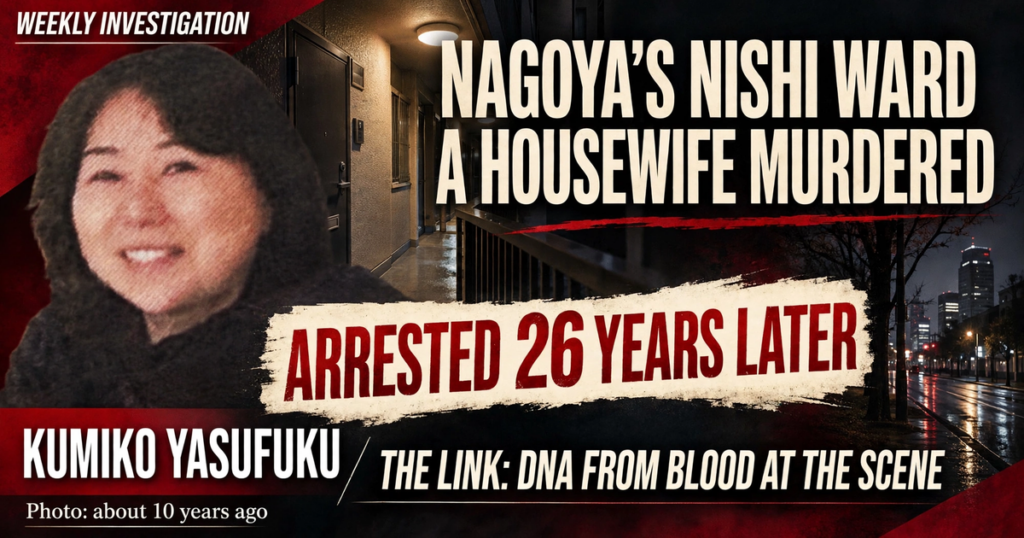
Namiko Takaba, 32, was stabbed to death in her apartment in Nagoya's Nishi Ward on November 13, 1999. Blood left near the entrance yielded a DNA profile that remained preserved for decades. Kumiko Yasufuku was arrested on October 31, 2025, and indicted for murder on March 5, 2026. As of October 28, 2026, the criminal trial had not begun; a separate civil damages action was also under way.
A 32-year-old woman was killed in her apartment
On November 13, 1999, Namiko Takaba, aged 32, was attacked inside an apartment in Nagoya's Nishi Ward. She suffered multiple stab wounds, including injuries to her neck, and died from blood loss. Signs of a struggle were found inside the room. Near the entrance, investigators discovered blood that did not belong to the victim. The case became a long-running unsolved murder because the person responsible was not identified at the time. The bloodstain, however, became a piece of evidence that could be preserved and examined again as investigative techniques and the pool of possible suspects changed.
The bloodstain preserved a DNA profile from the crime scene
The blood near the entrance was believed to have come from the assailant, who may have injured a hand during the attack. Investigators retained the sample and obtained a DNA profile. At the time, the profile did not lead to an identified suspect. Its importance lay in the fact that the biological material and the resulting profile remained available for later comparison. The case illustrates the difference between evidence that cannot immediately identify a person and evidence that has no investigative value. The preserved DNA profile eventually became a central link between the crime scene and the woman arrested more than a quarter-century later.
The victim's husband kept the apartment for 26 years
Namiko's husband, Satoru Takaba, continued renting the apartment where she had been killed so that investigators could examine the original scene if a suspect was identified. Reports said that the rent paid over 26 years, through 2025, amounted to approximately 22 million yen. Keeping the apartment did not itself prove who committed the murder and was not a legal requirement for an arrest. It did, however, preserve the layout and physical setting. After the arrest in 2025, investigators were able to conduct a scene inspection with the suspect present and compare the original environment with the evidence gathered in 1999.
Kumiko Yasufuku emerged during a renewed review of old leads
Investigators revisited people connected to the case and examined the records of those who had known the victim's family. Kumiko Yasufuku, who had attended high school with Satoru Takaba, came under scrutiny. Reports said that she had met him at a school reunion about five months before the murder. Yasufuku and Namiko were not believed to have known one another. These relationships formed part of the investigative background, but they were not proof of the killing. The crucial forensic development was the comparison between Yasufuku's DNA and the DNA profile obtained from the bloodstain at the apartment.
Yasufuku was arrested on October 31, 2025
Aichi Prefectural Police arrested Yasufuku on October 31, 2025, on suspicion of murder. The match between her DNA and the blood left at the scene was a major basis for the arrest. Reports after the arrest said that she had spoken about injuring her hand during the incident. She was also reported to have initially made statements accepting the allegation before later remaining silent during questioning. Those statements were investigative information, not a court finding. Whether they can be admitted and what weight they should receive are matters for the criminal proceedings.
A psychiatric examination preceded the murder indictment
The Nagoya District Public Prosecutors Office placed Yasufuku in a period of expert examination to assess her mental condition at the time of the offence. The examination continued until February 27, 2026. Prosecutors concluded that she could be held criminally responsible and indicted her for murder on March 5, 2026. The indictment alleged that she stabbed Namiko repeatedly in the neck and other parts of the body in 1999, causing her to die from blood loss. An indictment means that prosecutors have decided to pursue the charge; it is not a finding of guilt.
The criminal trial had not begun by late October 2026
According to reporting dated October 28, 2026, Yasufuku's criminal trial had still not begun. The court had therefore not made a finding on whether she committed the murder, what her motive may have been or how the DNA evidence should be evaluated in the context of the entire case. The bloodstain comparison is an important piece of objective evidence, but the trial must consider the circumstances in which the blood was deposited, the suspect's movements and the reliability of any statements. The account must not present the indictment as a conviction.
The 2010 abolition of the murder limitation period allowed prosecution
When the murder occurred in 1999, the Criminal Procedure Code still contained a limitation period for murder. In 2010, the limitation period for crimes punishable by death was abolished. The reform applied to earlier cases in which the limitation period had not yet expired when the amendment took effect. Because fewer than 15 years had passed between the 1999 killing and the 2010 reform, the limitation period had not been completed. That legal change meant that investigators could arrest and prosecutors could indict a suspect in 2025 and 2026. The case is not an example of a limitation period being revived after it had already expired.
The family's civil claim is a separate legal dispute
In March 2026, Satoru Takaba and other relatives filed a civil damages action against Yasufuku. The claim includes compensation for emotional suffering and the rent paid to preserve the apartment. The civil proceedings raised a different limitation issue under the former Civil Code, which generally treated 20 years from the tort as a long-stop period. Yasufuku's side argued that the period had expired, while the family disputed that result in light of the circumstances. The Nagoya District Court held the first oral hearing on September 8, 2026. The civil claim does not decide the criminal charge, and the criminal indictment does not automatically resolve the civil limitation question.
The case remains a prosecution, not a completed trial
The established timeline is that Namiko Takaba was killed on November 13, 1999; a bloodstain and DNA profile were preserved; Yasufuku was arrested on October 31, 2025; and she was indicted for murder on March 5, 2026. The criminal trial had not begun as of October 28, 2026. A separate civil damages case was also in progress. The preserved crime scene and DNA evidence helped move the investigation forward, but the court has not yet determined guilt. Any account that describes Yasufuku as convicted, states a settled motive or treats the civil dispute as a criminal finding would go beyond the verified record.
Original Japanese record: 名古屋市西区主婦殺害事件|26年後の逮捕、現場血痕DNAと安福久美子の起訴
Last updated:
Related articles
Case record
The Hekinan Pachinko-Manager Couple Murders: Preserved DNA Evidence and Three Different Outcomes

Case record
The Wanted Suspect in the 1999 Nagoya Pachinko Shop Robbery-Murder
Case record
The Nagoya Couple Murders: Two Young Victims, Six Offenders and the Appeal That Replaced a Death Sentence with Life Imprisonment
Case record