
The Manila Insurance Murders
Two Japanese men, Toba and Nakamura, were shot and killed in Las Piñas City in the Manila metropolitan area in 2014 and 2015. Japanese courts found that the killings were connected to life-insurance arrangements and a plan to have local perpetrators carry them out. Iwama denied conspiring in the murders but received a death sentence, which became final in 2023. He died in Tokyo Detention House later that year without being executed.
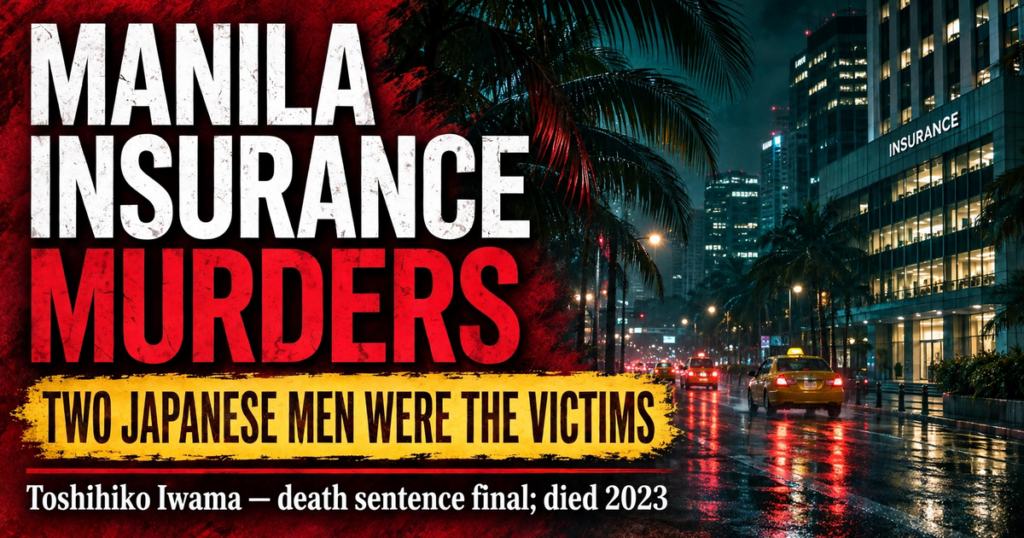
Two Japanese men were killed in separate shootings in Manila
In October 2014 and September 2015, two Japanese men were shot and killed in Las Piñas City, within the Manila metropolitan area of the Philippines. The victims were Toba, aged 32, and Nakamura, aged 42. The killings occurred in separate incidents, but Japanese investigators and courts treated them as connected through a plan involving life insurance and people in Japan who arranged for local killers to carry out the shootings. The case became known as the Manila insurance murders.
The victims were drawn overseas as part of a wider plan
The victims were invited to travel to the Philippines. The prosecution's account was that the overseas journeys formed part of a plan to place the men in the hands of local killers. The case was not simply a pair of unrelated street shootings: the Japanese proceedings examined the arrangements made before the victims travelled, the relationships among the people involved and the financial structures connected to the deaths. The exact role of each participant was considered through testimony and documentary evidence in the criminal trial.
Life-insurance arrangements were central to the prosecution case
The two killings were linked to life-insurance contracts arranged in Japan and to the use of a company structure. The court found that the insurance arrangements and business mechanisms were part of the plan to profit from the victims' deaths. The prosecution relied on the relationship between the policies, the movements of money and the arrangements with the people who carried out the shootings. The insurance element was not a general background detail; it was central to the explanation of why the victims were targeted and how the scheme was organised.
Iwama was treated as the central figure in the Japanese proceedings
Iwama was identified as the central figure in the prosecution. He consistently denied conspiring to murder the two men. The court considered testimony from accomplices, LINE messages, transfers of money and documents relating to insurance procedures. It assessed these materials together rather than relying on a single statement. The trial therefore focused on whether the evidence established Iwama's role in arranging the killings, despite his denial of the conspiracy.
The Kofu District Court imposed the death penalty in 2017
On 25 August 2017, the Kofu District Court sentenced Iwama to death. The court found him responsible for the conspiracy connected to the two killings. The judgment considered the seriousness of arranging murders for financial gain and the evidence linking the Japanese insurance and company arrangements to the local perpetrators. The death sentence was the first-instance outcome. Iwama challenged the judgment, and the case proceeded through the appellate courts.
The Tokyo High Court upheld the death sentence in 2019
On 17 December 2019, the Tokyo High Court rejected Iwama's appeal and maintained the death sentence. The appellate court did not overturn the district court's central assessment of the evidence. Iwama continued to contest the finding that he had conspired in the murders. The case then reached the Supreme Court. The procedural stages matter: the 2017 sentence was not final immediately, and the 2019 decision was an appellate judgment rather than the final step in the case.
The Supreme Court made the death sentence final in June 2023
On 5 June 2023, the Supreme Court's First Petty Bench dismissed Iwama's final appeal. He then filed a petition for correction, which the Supreme Court dismissed on 21 June 2023. The death sentence became final after that correction petition was rejected, on 21 June 2023. The distinction matters: 5 June was the date of the original appeal dismissal, not the date on which the post-judgment correction procedure ended.
Iwama died in detention after the sentence became final
On 24 August 2023, Iwama died at Tokyo Detention House. His death occurred after the death sentence had become final, but before it was carried out. It is therefore important not to describe the case as an execution. The judicial outcome was a final death sentence; the subsequent event was his death while in detention. The distinction is part of the case's legal history and explains why the sentence remained final but was never implemented.
The two murders and the Japanese trial must be understood together
The case connected two fatal shootings in the Philippines with insurance arrangements and planning in Japan. Toba and Nakamura were the victims; Iwama was convicted as a central conspirator, while the local perpetrators were treated as the people who carried out the shootings. The courts relied on a combination of accomplice testimony, electronic communications, money transfers and insurance documents. The final outcome was a death sentence upheld through the Supreme Court, followed by Iwama's death in detention. The sentence was not executed.
Original Japanese record: マニラ保険金殺人事件|鳥羽信介さん・中村達也さんを海外へ誘い、岩間俊彦に死刑確定
Last updated:
Related articles
Case record
The SM Club Robbery Murders
Case record
The Yoshinobu-chan Kidnapping and Murder: A Failed Ransom Exchange and a Death Sentence
Case record
The Cosmo Research Case: Two Abductions, One Hundred Million Yen and Litigation After the Executions
Case record