The Yoshinobu-chan Kidnapping and Murder: A Failed Ransom Exchange and a Death Sentence
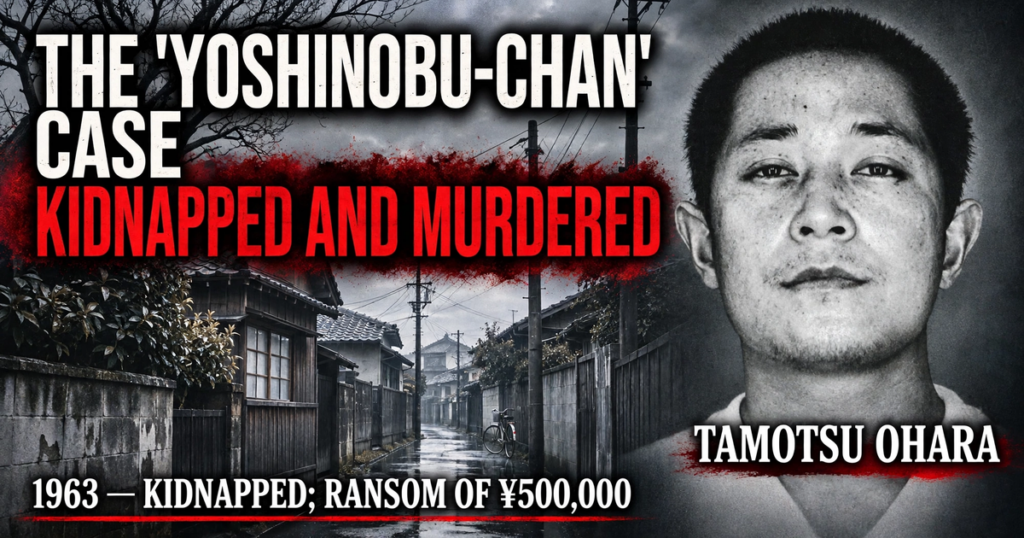
Four-year-old Yoshinobu Murakoshi disappeared on March 31, 1963, while playing near his home in Taito Ward, Tokyo. In April, his family received a demand for 500,000 yen. His mother placed the money at the location specified by the caller, but the offender took it and the child was not returned. Police had an opportunity to come into contact with the offender but failed to arrest him, and the investigation became a prolonged nationwide search. On July 4, 1965, police arrested Tamotsu Kohara. His account and a sketch led investigators to a temple cemetery in Arakawa Ward, where Yoshinobu's body was found the next day. Kohara was sentenced to death in 1966 and executed on December 23, 1971.
A four-year-old boy disappeared from a familiar place near home
On March 31, 1963, four-year-old Yoshinobu Murakoshi disappeared while playing with other children at a park near his home in Taito Ward, Tokyo. His disappearance turned an ordinary afternoon into an urgent search for a missing child. The family and police initially had no confirmed information about where he had been taken. The following weeks brought a demand for money, but the central priority remained finding the child alive. The case occurred during Japan's rapid postwar economic growth, with the 1964 Tokyo Olympics approaching, at a time when police resources and specialist systems for kidnapping cases were not as developed as they later became.
The offender demanded 500,000 yen and took the money
In April 1963, a caller contacted Yoshinobu's family and demanded 500,000 yen. His mother carried the money to the place designated by the caller and left it as instructed. The offender took the cash, but Yoshinobu was not released. The ransom exchange therefore failed to secure the child's return. Police had been able to make contact with the offender and had an opportunity to arrest him, but did not succeed. The failure became one of the most criticised aspects of the investigation and contributed to the case remaining unresolved for more than two years.
Police and the press entered into an early reporting agreement
The case became an important moment in the relationship between police and news organisations. TBS archival material describes it as the first Japanese kidnapping case in which police and the press concluded a reporting agreement. The purpose was to limit the publication of information about the kidnapping and the investigation for a period, reducing the risk that the offender would learn that police were waiting or that the child would be harmed. The arrangement raised a difficult question: reporting can help generate public information, but in a hostage situation it can also expose the victim to danger.
The investigation shifted from secrecy to a public appeal
After the ransom was taken and Yoshinobu was not returned, police moved toward a public appeal. The offender's telephone calls had been recorded, and the voice was broadcast on television and radio. Listeners were asked whether they recognised the voice, accent or manner of speaking. A large volume of information reached investigators. The challenge then became checking each lead against the person's movements, financial circumstances, regional connections and possible alibis. Public appeals expanded the pool of information, but they also required investigators to distinguish useful evidence from mistaken identifications.
Police criticism led to broader changes in criminal investigation
The National Police Agency later recorded that investigators had opportunities to contact and arrest the offender but failed to use them. The criticism was not treated solely as an error by individual officers. In 1963, the agency adopted a plan to strengthen criminal investigations, including improvements to investigative training, equipment, staffing and organisational structure. The Yoshinobu case became one of the examples used in later police white papers to explain why the criminal-investigation system needed reform. The failure to secure the child or arrest the offender at the ransom exchange became part of the institutional history of Japanese policing.
Tamotsu Kohara had been considered before, but was not arrested until 1965
Kohara had come to police attention relatively early, but investigators did not initially have enough evidence to arrest him. The investigation was later reorganised, and his background and alibi were reviewed again. On July 4, 1965, police arrested him on suspicion of commercial kidnapping and extortion. At the time, he was already serving a sentence for unrelated fraud and theft offences. He had not been arrested in 1963, and the later breakthrough came after investigators re-examined information that had not previously produced a sufficient evidentiary basis.
Kohara's account led police to Yoshinobu's body
During questioning, Kohara described where he had buried Yoshinobu and prepared a sketch of the location. Investigators searched a temple cemetery in Arakawa Ward. In the early hours of July 5, 1965, they found the child's remains beneath a gravestone behind the temple's main hall. The discovery confirmed that Yoshinobu had died and gave investigators physical evidence that could be compared with Kohara's account. A confession alone can be unreliable, but the recovery of the body from a location described by the suspect provided an important check on the accuracy of his statements.
Later records indicate that the child had been killed before the ransom was collected
Later investigative records and nonfiction accounts describe Kohara as having killed Yoshinobu on the day of the abduction and then demanded money from the family. That chronology means the family was asked to pay after the child had already been killed. It should be attributed to those later records rather than presented as something the family could have known at the time. The mother placed the money at the location specified by the caller in the hope of securing her son's safe return. The failure of the exchange was not caused by the family; the offender had already deprived them of the possibility of bringing the child home alive.
The 1964 law reform did not apply retroactively to Kohara's crime
The case contributed to public pressure for stronger penalties for kidnapping for ransom. In 1964, the Penal Code was amended to create a separate, more serious offence for kidnapping or abduction for ransom, with provisions covering demands and receipt of ransom and related conduct. However, Yoshinobu was abducted in 1963. The later amendment could not be applied retroactively to increase punishment for an earlier offence. Kohara's prosecution therefore proceeded under the law in force at the time, including commercial kidnapping, extortion, murder and disposal of a body. The law reform and Kohara's own conviction are related historically but legally distinct.
Kohara was sentenced to death and executed in 1971
On March 17, 1966, the Tokyo District Court sentenced Kohara to death. The defence appealed, but the Tokyo High Court dismissed the appeal. On October 13, 1967, the Supreme Court dismissed the final appeal, and the death sentence became final. Kohara was executed on December 23, 1971, at Miyagi Prison, aged 38. The case had a lasting impact on kidnapping investigations, press agreements and the law on ransom offences. But its starting point remains the disappearance of a four-year-old child, the failed ransom exchange and the long wait before his body was found.
Original Japanese record: 吉展ちゃん誘拐殺人事件|身代金50万円を奪われた捜査失敗から小原保の死刑確定まで
Last updated: