
The Koto Memorial Hospital Case: A Twelve-Year Sentence Overturned by Retrial, and a Death Not Proven to Be Homicide
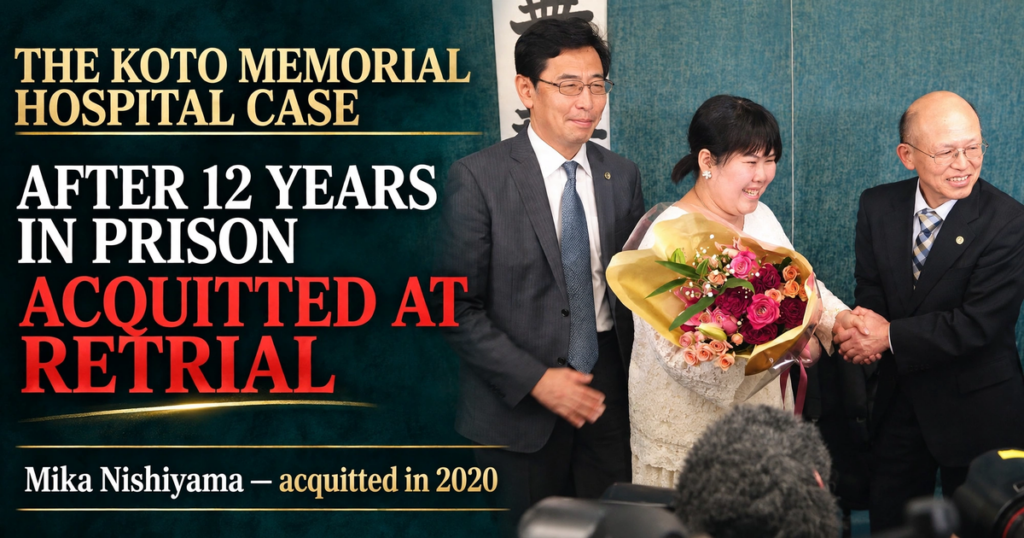
A 72-year-old patient died at Koto Memorial Hospital in Shiga Prefecture on 22 May 2003. Nursing assistant Mika Nishiyama, then 23, was convicted of murder and served a 12-year sentence after confessing during interrogation and later denying the charge at trial. A retrial began after new medical and evidentiary review. On 31 March 2020, the Otsu District Court acquitted her, finding no evidence that the patient had been killed. The acquittal became final on 2 April 2020.
A patient with serious respiratory disease died at the hospital
On 22 May 2003, a 72-year-old male patient died at Koto Memorial Hospital in what was then Koto Town, Shiga Prefecture, now part of Higashiomi City. The patient had chronic respiratory failure and other serious health problems and was receiving mechanical ventilation. The initial investigation treated the death as a homicide in which the ventilator tube had been removed and the oxygen supply stopped. The medical premise that the patient died because of an interruption in ventilation later became a central issue in the retrial.
Nishiyama was questioned and arrested more than a year later
Mika Nishiyama was 23 and working as a nursing assistant at the hospital. According to the published chronology, she made a confession on 2 July 2004 and was arrested on 6 July. The investigation relied heavily on her statements about the ventilator and the events surrounding the patient’s death. The public record does not describe a piece of physical evidence that independently identified her as the person who caused the death. The case therefore depended substantially on the medical interpretation of the death and the credibility of the confession.
She confessed during interrogation but denied the charge at trial
During questioning, Nishiyama said that she had removed the ventilator tube. After indictment, she denied killing the patient and argued that her confession was not true. The prosecution relied on her statements as an important part of the case. A central question later became whether the statements came from her own memory and experience or whether they had been shaped by information and suggestions supplied during interrogation. The difference between a confession and a reliable confession became decisive in the retrial.
The alarm and ventilator operation became disputed evidence
The original prosecution account included the idea that Nishiyama had repeatedly pressed the ventilator’s alarm-silencing button so that the device would not alert other staff. The retrial examined whether she had the technical knowledge needed to do this and how her descriptions of the machine changed during questioning. Medical and nursing records were also reviewed. The later court assessment questioned both whether the tube had in fact been removed and whether any interruption in oxygen supply could be proved to have caused the death.
The first conviction imposed 12 years in prison
On 29 November 2005, the Otsu District Court convicted Nishiyama of murder and sentenced her to 12 years’ imprisonment. The Osaka High Court dismissed her appeal on 5 October 2006, and the Supreme Court dismissed the final appeal on 21 May 2007. The conviction therefore became final in 2007. Nishiyama continued to maintain her innocence. She served the sentence and was released after completing it on 24 August 2017. The later retrial did not erase the fact that the original conviction had been final for many years.
The first retrial application was rejected
Nishiyama filed her first retrial request on 21 September 2010. The Otsu District Court rejected it on 30 March 2011, and the Osaka High Court dismissed the immediate appeal on 23 May. The Supreme Court rejected a special appeal on 24 August 2011. This first attempt did not lead to a new trial. A second request was filed on 28 September 2012, supported by further medical analysis and a renewed examination of the confession and the evidence concerning the ventilator.
The Osaka High Court ordered a retrial in December 2017
The Otsu District Court rejected the second retrial request in September 2015. On 20 December 2017, however, the Osaka High Court overturned that decision and ordered a retrial. The court reasoned that, without the confession, the evidence did not establish that oxygen supply had been interrupted in the way alleged. Even when the confession was considered, its changing content meant that it could not confidently be treated as a statement based on actual experience. The court found that a natural death remained a reasonable possibility.
The Supreme Court made the retrial order final in March 2019
The prosecution challenged the retrial order through a special appeal. On 18 March 2019, the Supreme Court’s Second Petty Bench rejected that challenge. This made the decision to reopen the case final. It did not yet mean that Nishiyama had been acquitted. The legal effect was that the criminal case had to be heard again in a retrial. The distinction between a final order granting a retrial and a final acquittal is important to the chronology.
The retrial court found no proof that the patient had been killed
On 31 March 2020, the Otsu District Court acquitted Nishiyama. The court considered the patient’s medical condition and found that a fatal arrhythmia or another natural cause could not be excluded. It also found serious problems with the confession and the interrogation process. The judgment did not merely conclude that the prosecution had failed to identify the correct perpetrator. It held that the evidence did not establish that the patient had been killed by another person at all. The case’s alleged homicide foundation was therefore not proved.
The acquittal became final on 2 April 2020
After the acquittal, the Otsu District Public Prosecutors Office did not appeal and waived its right to do so on 2 April 2020. Nishiyama’s retrial acquittal became final. This was not a case in which another killer was found. The retrial conclusion was that the evidence did not establish that the patient had died as a result of a criminal act. The original 12-year sentence was overturned, and Nishiyama was legally acquitted.
A separate civil case addressed police conduct and government liability
After the acquittal, Nishiyama brought a damages action against Shiga Prefecture and the national government. On 17 July 2025, the Otsu District Court found unlawful conduct in the police investigation, including improper pressure during questioning, and ordered Shiga Prefecture to pay 31,314,841 yen. The court did not find the prosecution’s conduct unlawful and rejected the claim against the national government. Shiga Prefecture did not appeal, so the award against the prefecture became final. Nishiyama appealed only the part concerning the national government.
The Osaka High Court rejected the claim against the state in June 2026
On 25 June 2026, the Osaka High Court dismissed Nishiyama’s appeal against the national government. The court did not find that prosecutors could have inferred that her confession was false because of unlawful police pressure. The ruling concerned civil liability for the prosecution’s conduct and the decision to challenge the retrial order; it did not alter the final criminal acquittal. Nishiyama’s side announced that it would appeal to the Supreme Court, and reports in July 2026 said the appeal was filed. That civil dispute remained separate from the acquittal.
Original Japanese record: 湖東記念病院人工呼吸器事件|懲役12年から再審無罪、事件性そのものが否定された経緯
Last updated:
Related articles
Case record
The Himi Case: A Wrongful Conviction, a Prosecutor's Retrial Request and an Acquittal
Case record
The Ashikaga Case: How DNA Evidence and a False Confession Led to a Wrongful Conviction
Case record
The Maizuru High School Girl Murder: An Acquittal Based on Reasonable Doubt

Case record