
The Matayoshi Takeo Wanted Case: The 1990 Killing of Two Okinawa Police Officers and an Unresolved Search
Two Okinawa Prefectural Police officers, Inspector Masao Higa and Assistant Inspector Shokichi Haine, were shot and killed in Okinawa City late on 23 November 1990 while monitoring a gang conflict. Takeo Matayoshi was identified as a suspect and placed on a nationwide wanted list; the National Police Agency later designated him an important wanted suspect. His whereabouts remain unknown. Reports that he may have died have never been confirmed by police, and no criminal trial has established his guilt.
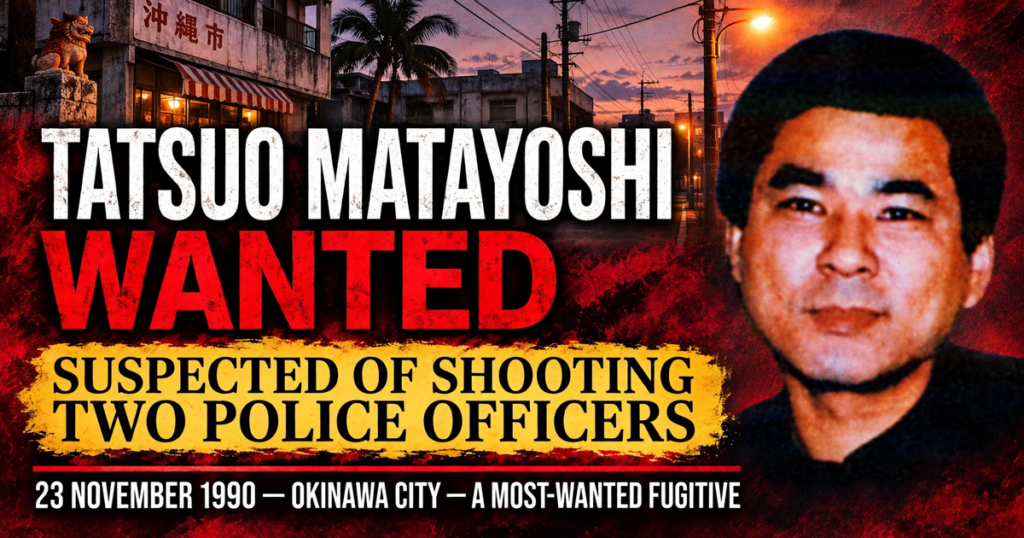
Two officers were killed while monitoring an organized-crime conflict
Late on 23 November 1990, two Okinawa Prefectural Police officers were shot and killed in Okinawa City. Inspector Masao Higa was 43, and Assistant Inspector Shokichi Haine was 42. They were in plain clothes and travelling in a police investigation vehicle while monitoring an area near a base associated with a faction of the Third-generation Asahikai. The killings occurred during a period of serious conflict within Okinawa’s organized-crime groups. The officers were carrying out surveillance duties, not participating in a public confrontation.
The background was a split within the Asahikai
The police investigation placed the killings in the context of the Sixth Okinawa Gang Conflict, associated with divisions and rivalries within the Asahikai. The organization’s internal split had heightened tensions, and police were monitoring the situation to prevent further violence. The fact that the officers were in plain clothes and using an investigative vehicle reflected an effort to observe the relevant area. The broader gang conflict is context for the investigation; it does not, by itself, establish who fired the shots or prove the responsibility of any individual suspect.
Matayoshi Takeo was publicly identified as a murder suspect
Okinawa Prefectural Police named Takeo Matayoshi as a suspect in the killing of the two officers and issued a nationwide wanted notice. The National Police Agency designated him an important wanted suspect. The police information identifies him as born on 13 October 1949 and approximately 172 centimetres tall. He was 41 when the officers were killed. The published information concerns a suspect sought in connection with murder; it is not a judicial finding that he committed the crime.
The wanted notice has remained active for decades
The police wanted notice has continued to appear in official information years after the killings. Okinawa Prefectural Police updated its page on 6 July 2026, and the suspect remained listed in the material reviewed in November 2026. The length of time does not change the legal status: Matayoshi has not been publicly reported as arrested or brought before a court. The police continue to seek information about his whereabouts and the circumstances surrounding the two officers’ deaths.
Reports of possible death have not been confirmed
The last concrete trace of Matayoshi reported by the Okinawa press was in October 2000, when he was said to have attended a hospital in Kyoto using another person's health-insurance card. Reporting stated that medical examinations found cancer that had metastasized to the spinal cord and was at an advanced stage. Investigators consequently considered the possibility that he had already died. Reports in 2018 and 2020 discussed the possibility of preparing a case file on the assumption of death, but no remains or identity-confirming evidence were publicly announced. The wanted notice remained in force.
The officers’ identities and service should remain central to the record
A person described as one of those involved in carrying out the shooting was prosecuted for murder-related offences and served a sentence, according to reporting marking the thirtieth anniversary of the case. That prosecution did not resolve Matayoshi's own legal position. He was described as a person suspected of directing the attack, but he was never brought before a court. A conviction of another participant cannot be transferred to Matayoshi, and no judgment has established his personal guilt.
A wanted notice is a police investigative measure, not a conviction
Okinawa Prefectural Police assembled a tracking team and sent investigators outside the prefecture, including to locations associated with organized-crime groups on the mainland. Reporting described efforts to trace vehicles and motorway movements during a period when Matayoshi was believed to have been in the Kansai region. Investigators also considered whether other people or organizations had helped him remain hidden. These accounts describe the scope of the police investigation; they do not establish the identity or criminal liability of any person who may have provided assistance.
The passage of time creates investigative difficulties but does not settle the facts
The prefectural police also conducted a broad crackdown on the organizations involved in the Sixth Okinawa Gang Conflict. Official figures cited by the archive article recorded 220 people apprehended, including 11 senior leaders and 88 executives, 522 searches, and the seizure of 5,452 items, including 42 handguns. The campaign helped bring the wider conflict under control, but it did not result in Matayoshi's arrest. The end of a gang conflict and the resolution of an individual homicide are separate matters. In November 2011, the Fourth-generation Asahikai and Okinawa Asahikai, which had split during the conflict, merged and adopted the name Asahikai.
The case remains unresolved as of November 2026
In November 2018, a memorial for Higa and Haine was established on the grounds of Okinawa Police Station, with support from police-related and anti-organized-crime organizations. These later events show that the deaths remained part of the prefectural police's institutional memory. They did not close the murder investigation or establish Matayoshi's fate. As of 21 November 2026, the publicly confirmed position is that Higa and Haine were killed on 23 November 1990, another participant was prosecuted, and Matayoshi remains wanted as a suspect in the murder. His last specifically reported trace was the October 2000 hospital visit in Kyoto, but neither his death nor his later movements have been confirmed. No trial has been held against him.
Original Japanese record: 又吉建男指名手配事件|比嘉正雄警部・拝根正吉警部補殺害容疑、36年続く公開捜査
Last updated:
Related articles
Case record
The Torigoe 2-Chome Murder and Arson: The Killing of an Indian Jewelry Worker and the Search for Diwakar Sethia
Case record
The Wanted Case of Tsuyoshi Yoshiya: The 1999 Ayase Group Attack
Case record
The Wanted Suspect in the 1999 Nagoya Pachinko Shop Robbery-Murder
Case record