
The Wanted Suspect in the 1999 Nagoya Pachinko Shop Robbery-Murder
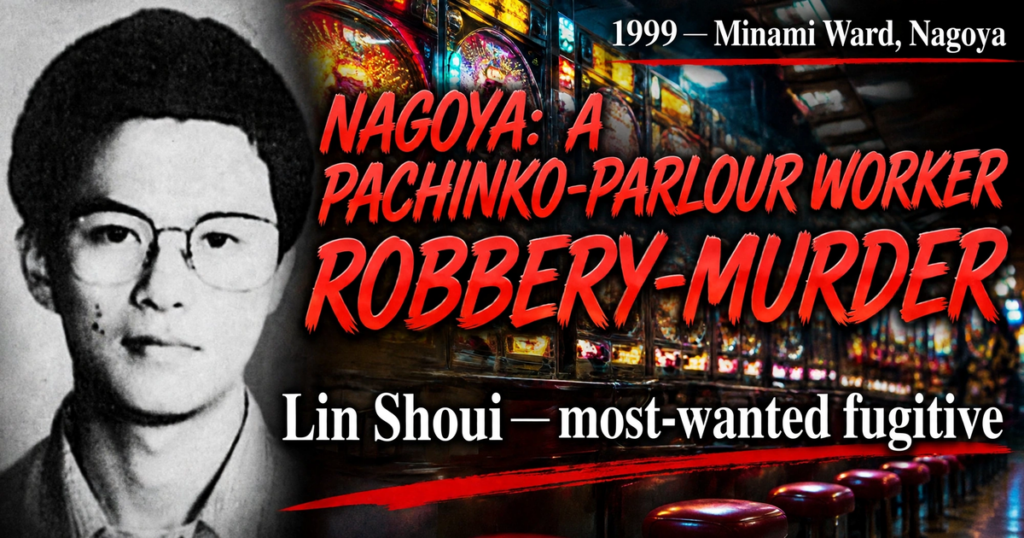
A pachinko shop employee was stabbed to death after pursuing a man suspected of illegally diverting medals in Nagoya on 1 October 1999. Chinese national Lin Shaowei, known in Japanese as Rin Shōi, remains wanted on suspicion of robbery-murder; he has not been arrested or tried.
A shop employee followed a man suspected of diverting medals
On the evening of 1 October 1999, an employee at a pachinko parlor in Minami Ward, Nagoya, noticed a man using a device to divert medals improperly. The man left the premises after being noticed. An employee pursued him outside the shop. On a street in the same ward, the employee was stabbed in the chest with an object described by police as something like a knife and died. The sequence was brief, but it transformed an alleged attempt to obtain medals unlawfully into a fatal robbery-murder investigation. The Japanese police description identifies the case as the robbery-murder of an employee at a pachinko parlor in Naruhama-cho, Minami Ward. The public record does not identify the victim by name, and the English account should not invent one. The central facts are the suspected medal diversion, the escape, the pursuit and the fatal stabbing.
Police named Lin Shaowei as the wanted suspect
Aichi Prefectural Police identified the wanted man as Lin Shaowei, written in Chinese characters as 林紹葳 and read in Japanese as Rin Shōi. Police records describe him as a Chinese national born in 1973. On 5 February 2000, approximately four months after the killing, Minami Police Station issued a wanted notice on suspicion of robbery-murder. The publicly released description gives his height as approximately 178 centimetres and says that he was thin and wore glasses at the time. The photograph used in the notice was taken in 1996, about three years before the offence. It should therefore be understood as an older image, not as a reliable depiction of his present appearance. The wanted notice is an investigative measure based on suspicion and an arrest warrant; it is not a judicial finding that Lin committed the offence.
The alleged offence has not been tested in a criminal trial
Lin has not been arrested, indicted or brought before a criminal court in connection with the case. As a result, there has been no trial in which he could enter a plea, challenge the evidence, or offer an account of the events. The police description says that he is suspected of stabbing the employee while escaping after the alleged medal diversion. That is the public allegation, not a fact established by a final judgment. The victim's death is established, but the suspect's individual criminal responsibility remains unresolved. The available police material does not establish a motive beyond the alleged sequence of events, and it does not provide a confirmed account of Lin's movements after the incident. It would therefore be inappropriate to state that he fled to a particular country, died, or remains in a particular location. Those possibilities are not established by the public record.
The wanted notice has remained in place for more than 26 years
The Aichi Prefectural Police continued to publish Lin's wanted information more than 26 years after the incident. The case remained on the prefecture's public cooperation page in August 2026, and Lin was also listed among nationally designated important wanted suspects. The police have asked the public to provide information to the special investigation headquarters at Minami Police Station. The long interval creates a practical problem: the photograph was taken in 1996, and the physical description reflects his appearance at that time. Age, changes in hairstyle, weight and other features can make identification difficult. The police material does not state that the old photograph shows how he looks today. It is safer to refer to the published identifying details as historical information and to avoid making unsupported claims about his current appearance or whereabouts.
The abolition of the limitation period keeps the investigation legally relevant
The case also illustrates the effect of Japan's 2010 reform of criminal limitation periods. On 27 April 2010, legislation took effect abolishing the statute of limitations for certain offences resulting in death that are punishable by death, including murder and robbery-murder. The reform applied to earlier cases for which the limitation period had not already expired. Because the 1999 offence was still within the former limitation period when the law took effect, the passage of time did not end the possibility of prosecution. This does not mean that Lin has been found guilty or that an arrest is inevitable. It means only that the offence remains legally capable of prosecution if the suspect is located and the evidence supports an indictment. The distinction between an open investigation and a completed criminal case remains essential.
The case remains an unresolved homicide investigation
The public record establishes a fatal attack on a pachinko employee after a suspected attempt to divert medals, the date and location of the incident, the police identification of Lin as the wanted suspect, and the date on which the wanted notice was issued. It does not establish his present location, whether he is alive, or what he would say if questioned. Nor has a court determined his guilt. More than two decades of public searching have not changed the legal status of the case: Lin remains wanted on suspicion of robbery-murder, and the investigation remains open. The responsible way to describe the case is to distinguish the police allegation from a proven fact, preserve the uncertainty around the suspect's later movements, and avoid turning the passage of time into an assumed resolution.
Original Japanese record: リン・ショウイ指名手配事件|名古屋パチンコ店員強盗殺人、26年以上続く公開捜査
Last updated:
Related articles

Case record
The Gunma Family Murders: Three Victims and the Search for Hiroshi Kogure

Case record
The Wanted Case of Tsuyoshi Yoshiya: The 1999 Ayase Group Attack
Case record
The Matayoshi Takeo Wanted Case: The 1990 Killing of Two Okinawa Police Officers and an Unresolved Search
Case record