
The Death of Maritime Self-Defense Force Member Mutsuhiko Mikasa: Reinvestigation, Parliamentary Questions, and a Non-Prosecution Decision
Mutsuhiko Mikasa, a 33-year-old Maritime Self-Defense Force member, was found dead near the Fukui River in Anan, Tokushima, in December 1999. Police concluded that his death followed a single-vehicle accident and a fall from a bridge; his family questioned that account and sought further investigation, but no one was prosecuted.
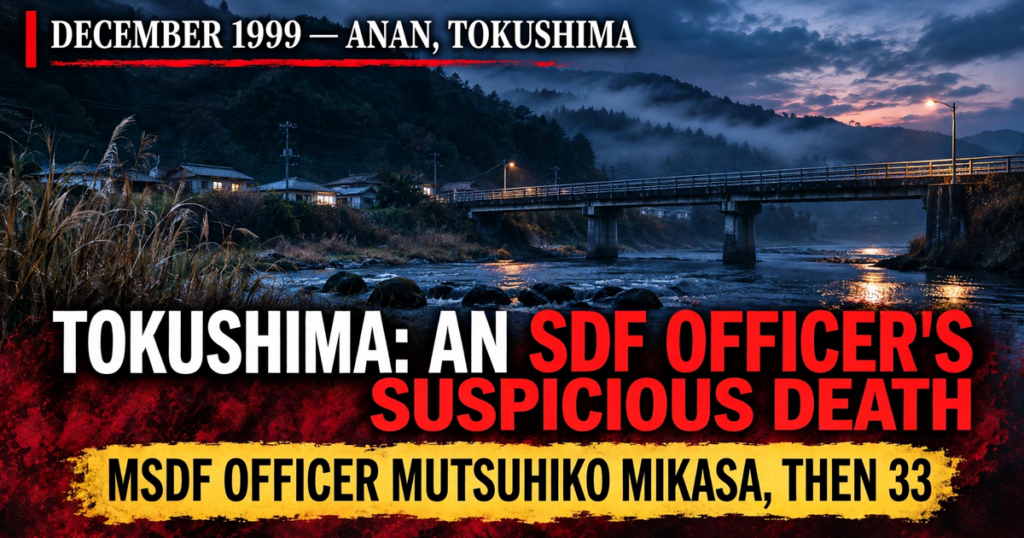
A Maritime Self-Defense Force member was found dead beside the Fukui River
In the early hours of 27 December 1999, Mutsuhiko Mikasa, a 33-year-old member of the Japan Maritime Self-Defense Force, was found dead near the Fukui River in Fukui-cho, Anan, Tokushima Prefecture. He was from Tokushima but worked at the First Technical School of the Maritime Self-Defense Force in Etajima, Hiroshima Prefecture. He had returned to Tokushima for the year-end holiday. His vehicle was found nearby. The circumstances of his death became the subject of a prolonged disagreement between the police and his family. The family questioned the official explanation and continued to seek clarification for years.
Mikasa disappeared after going out during his holiday
Mikasa had gone out on 25 December and did not return home. His family became concerned when they could not locate him. By the following day, his vehicle had been found in Anan, but he was not with it. The car showed damage that police considered consistent with a single-vehicle accident. The discovery of the damaged vehicle without its driver became one of the first points of dispute. The family questioned whether the initial search and examination of the surrounding area had adequately considered the possibility that another person had been involved. Police, by contrast, focused on a sequence in which Mikasa had an accident and then moved away from the vehicle.
Police concluded that he had caused an accident and jumped from a bridge
The police explanation was that Mikasa had been involved in a single-vehicle accident, moved from the vehicle to a nearby bridge, and jumped. The body was found near the bridge, but not directly beneath it. A written question submitted to the House of Representatives in 2004 described the bridge as approximately 15 metres high and the body as being about 4.2 metres from the point directly below it. The same parliamentary document referred to chest injuries and a fatal injury to the thoracic aorta. These details were presented by the questioner as matters requiring explanation; the parliamentary question itself was not a judicial finding that a third party had killed Mikasa.
The family challenged the explanation and conducted its own investigation
Mikasa's relatives did not accept the suicide conclusion. They questioned the position of the body, the damage to the vehicle, the nature of the chest injuries, and whether the proposed sequence of an accident followed by a jump could account for the physical evidence. They also sought information from people who might have seen vehicles or individuals near the scene. A television documentary later described the family's independent efforts, including repeated visits to the location and attempts to locate witnesses, as an investigation lasting approximately 1,200 days. Their work did not produce a court finding of homicide, but it brought the family's questions into public discussion.
Police reopened the investigation in 2003, including the possibility of murder
Reports in February 2003 said that Tokushima Prefectural Police had begun a renewed investigation that included the possibility of murder. Investigators reconsidered the injuries, the condition of the vehicle, the location where the body was found, and information about people or vehicles reportedly seen in the area. The fact that police reopened the inquiry did not mean that they had concluded a homicide had occurred. In November 2003, reporting indicated that police had found no basis to change their view that Mikasa had not been murdered. The reinvestigation therefore did not lead to an identified suspect or an indictment.
A parliamentary question documented the family's concerns
On 5 August 2004, House of Representatives member Kazuo Inoue submitted a written question titled “Investigation into the Death of a Self-Defense Force Member in Tokushima Prefecture.” The question text gives 26 December 1999 as the date Mikasa was found, while the Japanese source article's detailed timeline places the discovery in the early hours of 27 December. The two records therefore differ by one calendar day; the translation preserves that discrepancy rather than silently harmonizing it. The question listed the body's location, the bridge, the chest injuries, marks on the vehicle, reported witness accounts, and concerns about the initial investigation. It also referred to a police explanation that an airbag had caused the aortic injury. Those statements were the questioner's account of issues raised by the family, not findings made by Parliament or proof that the official explanation was false.
The government said that police and prosecutors had completed the necessary investigation
The government answered the parliamentary question on 11 August 2004. Its response stated that it understood Tokushima Prefectural Police and the Tokushima District Public Prosecutors Office to have carried out the necessary investigation. It declined to answer some specific questions about investigative methods and evidence assessment, referring to the nature of investigative activity. The response did not make a new determination about whether Mikasa had been killed by another person. It instead maintained the position that the relevant investigative authorities had completed the necessary work. The family remained dissatisfied with the explanation.
The Prosecutorial Review Commission found non-prosecution appropriate
The Tokushima District Public Prosecutors Office did not indict anyone in connection with Mikasa's death. In April 2005, a report carried by the Tokushima Shimbun said that the Tokushima Committee for the Inquest of Prosecution had decided that the non-prosecution was appropriate. The report described the committee's consideration of the body's condition, vehicle damage, and witness information, and said it found insufficient evidence to overturn the prosecutor's decision. A committee review is not the same as a criminal trial and does not establish the precise physical sequence of death as an absolute scientific fact. It does mean that the decision not to prosecute was maintained.
The case has no homicide conviction or identified criminal suspect
The legal outcome must be distinguished from the family's unresolved questions. No person was indicted for murder, no criminal trial was held, and no court judgment found that a third party killed Mikasa. Police maintained the conclusion that his death followed an accident and a jump from a bridge. His family continued to question the location of the body, the injuries, the vehicle, the witness accounts, and the initial investigative response. Describing the matter as a proven murder would go beyond the public record. Equally, it would be inaccurate to erase the family's documented objections. The record consists of the official conclusion, the reinvestigation, the parliamentary exchange, and the family's continuing disagreement.
Original Japanese record: 徳島自衛官変死事案|三笠睦彦さんの死をめぐる再捜査、国会質問と不起訴判断
Last updated:
Related articles
Case record
The Tokushima–Awaji Father-and-Son Murders: Eleven Years of Flight, No Trial
Case record
The Torigoe 2-Chome Murder and Arson: The Killing of an Indian Jewelry Worker and the Search for Diwakar Sethia
Case record
The Wanted Suspect in the 1999 Nagoya Pachinko Shop Robbery-Murder
Case record