
The Metal Baseball Bat Parents Murder: A Planned Cover-Up and a Thirteen-Year Sentence
At about 2:30 a.m. on November 29, 1980, 20-year-old Nobuya Ichiyanagi killed both of his parents, Mikio and Chieko, while they were asleep at their home in Takatsu Ward, Kawasaki. The case became a symbol of Japan's intense university entrance competition, but the court did not explain the murders simply as a reaction to examination pressure. The judgment examined Ichiyanagi's repeated unauthorised use of his father's cash card, a confrontation on the night before the killings, alcohol consumption, the decision to attack and the elaborate attempt to stage a burglary. The court did not find legal diminished responsibility. On April 25, 1984, it sentenced him to thirteen years, crediting 900 days of pretrial detention; he did not appeal.
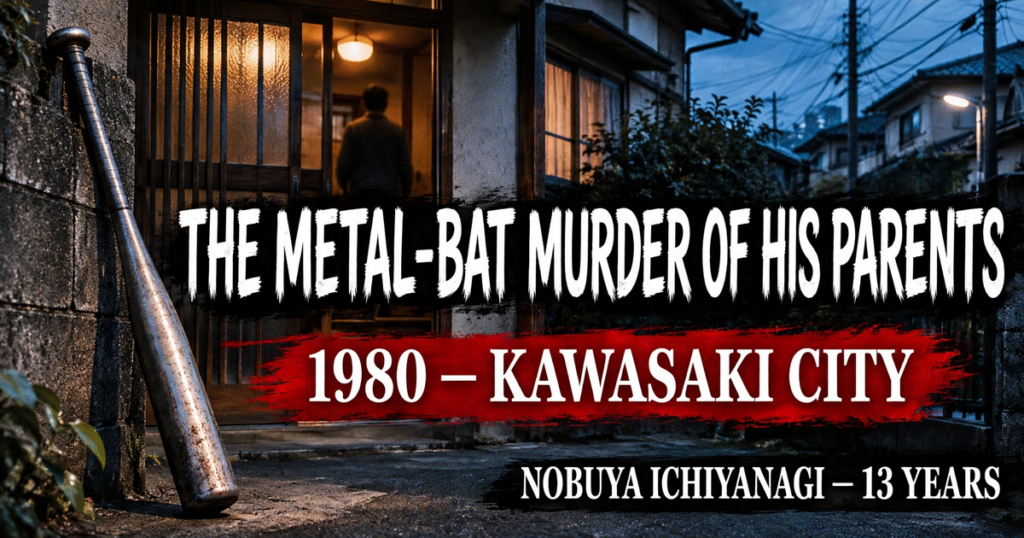
The killings occurred inside the family home
At about 2:30 a.m. on November 29, 1980, a 46-year-old married couple were attacked while asleep in their home in Takatsu Ward, Kawasaki City. The victims were Mikio Ichiyanagi and his wife Chieko. Their second son, Nobuya Ichiyanagi, was 20 years old and preparing for university entrance examinations after failing to enter his preferred university. He attacked both parents with a metal baseball bat. The crime later became widely known as the Metal Baseball Bat Parents Murder. It was often used in public discussion of academic pressure, but the court's findings described a much more specific sequence of family conflict, unauthorised withdrawals and concealment.
Academic disappointment formed part of the background, but it was not the whole explanation
Ichiyanagi had hoped to attend a prestigious private high school associated with Waseda University but failed the entrance examination and enrolled at Kaijo High School instead. He later struggled to form friendships and lost motivation to study. He applied to universities including Waseda and Meiji but was unsuccessful, and began a period of repeated entrance-examination preparation. His father urged him to seek employment after another unsuccessful year. With the support of his mother and older brother, he was allowed one more year to try again. The judgment recognised the pressure he felt, but did not treat examination competition as a sufficient explanation for the murders.
He had repeatedly used his father's cash card without permission
While preparing for university examinations, Ichiyanagi received small amounts of spending money from his mother and brother. He nevertheless took his father's cash card from a commuter-pass case and made three withdrawals of 10,000 yen each in July and November 1980. On November 26, he again took the card and withdrew 10,000 yen to buy whisky and other items. This time he failed to return the card to its usual place and hid it in his room. His father noticed that it was missing. The discovery of the card use became the immediate issue that brought the family into confrontation.
The confrontation on November 28 intensified his resentment
At about 11:30 p.m. on November 28, Mikio called his son and questioned him about the missing cash card. Ichiyanagi admitted using the card, but denied taking other cash that had also gone missing. His mother, who had sometimes defended him, did not accept his explanation. Ichiyanagi felt that his parents were treating him as responsible for more than he had done. Later, when he returned to his room and drank whisky, his father came in, criticised his drinking and kicked him in the right side of the abdomen. His father also told him, in substance, to leave the house the next day.
He spent about two hours drinking before deciding to kill his parents
The court did not find that Ichiyanagi immediately attacked his parents during the argument. He remained in his room for about two hours, drinking approximately 320 millilitres of whisky and thinking about his resentment. At around 2:30 a.m., he decided to kill his sleeping parents. He changed into clothes that would be easier to move in, put on rubber gloves and took the metal bat downstairs. He also considered that his older brother was unlikely to return at that hour. The judgment relied on these preparatory steps when assessing the degree of planning and his ability to understand and control his actions.
He killed his father first and then attacked his mother
Ichiyanagi entered his father's room and struck Mikio repeatedly with the metal bat while he was asleep. He then moved to his mother's room and attacked Chieko with the same weapon. The court found that he had considered how to avoid alerting his parents, including the way he used the lights. Both parents died from the attacks. The prosecution charged two murders. The victims were his father and mother, not other members of the household, and the judgment's sentencing analysis treated the double killing as a single criminal episode involving two separate deaths.
After the murders, he tried to make the scene look like a burglary
Ichiyanagi washed blood from the bat and rubber gloves. He then searched drawers and furniture to create the appearance that an intruder had entered the house to steal property. He wore the gloves while rearranging items, opened drawers in a way he believed would look like a burglar's work and left a bankbook in a position intended to suggest that a thief had been unable to find a seal. The court considered these actions significant because they showed deliberate efforts to conceal the crime. They later became important evidence in the assessment of criminal responsibility.
He did not voluntarily surrender to police
Ichiyanagi waited until morning and planned to make it appear that he had discovered his parents' bodies after waking up. He went to a neighbour's home so that the neighbour would call police, rather than making the report himself. On November 30, police contacted relatives to ask further questions. An aunt asked Ichiyanagi whether he had committed the killings, and he did not clearly deny it. The information was then passed to police through his older brother. The court did not recognise this as voluntary surrender under criminal law: allowing relatives to inform police was not the same as freely reporting the crime and seeking prosecution.
Psychiatric opinions differed, but the court did not find diminished responsibility
Criminal responsibility was a central issue at trial. Doctors involved at the investigation stage did not find a psychotic condition or pathological intoxication. A court-appointed expert suggested that Ichiyanagi may have experienced a transient episode of a condition described at the time as schizophrenia, while other specialists discussed what were then called “apathy syndrome” or “adolescent frustration syndrome.” The court found the expert opinions inconsistent and did not conclude that he had a mental illness. It accepted that his judgment and behavioural control had been substantially weakened, but held that they were not impaired to the degree required for legal diminished responsibility.
The court imposed thirteen years, with 900 days credited
On April 25, 1984, the Kawasaki Branch of the Yokohama District Court sentenced Ichiyanagi to thirteen years in prison. The court credited 900 days of pretrial detention toward the sentence and ordered the metal bat confiscated. The prosecution had requested eighteen years. In setting the sentence, the court considered the deaths of both parents and the deliberate cover-up, but also took account of his age, lack of prior criminal history, emotional immaturity, the fact that the killings had not been planned long in advance and his later statements of remorse. Ichiyanagi did not appeal, so the thirteen-year sentence became final.
Original Japanese record: 金属バット両親殺害事件|「受験戦争」だけでは説明できない犯行と懲役13年判決
Last updated:
Related articles
Case record
The Fujisawa Devil-Exorcism Murder
Case record
The Kawasaki Serial Stabbing Attacks
Case record
The Murder of Junko Furuta: A Case That Tested Japan's Juvenile Justice System
Case record