
The Fujisawa Devil-Exorcism Murder
A musician was killed in an apartment in Fujisawa in February 1987 by two people close to him. The case became known as the Devil-Exorcism Murder, but the Yokohama District Court did not treat the killing as a formal religious rite. It examined the defendants' intent, the influence of unusual beliefs and their criminal responsibility, ultimately imposing prison terms of 14 and 13 years.
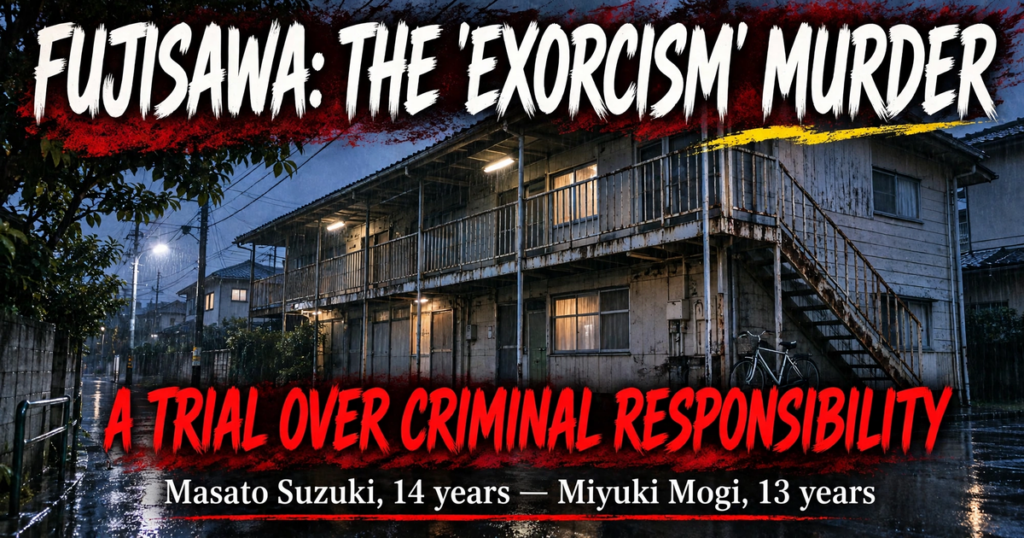
A musician was killed in an apartment in Fujisawa
At about 3 p.m. on 22 February 1987, Masahiro Mogi, a 32-year-old musician, was killed in an apartment in Fujisawa, Kanagawa Prefecture. The people prosecuted were Suzuki Masato, a relative of Mogi, and Suzuki's wife, Mogi Miyuki. The two were accused of acting together. The case did not end with the death itself: the handling of the body continued over the following days, and police discovered what had happened after entering the apartment on the night of 25 February.
The case nickname can create a misleading impression
The incident became known as the Devil-Exorcism Murder because the people involved used language about demons and exorcism. That label can suggest that the killing was a formal act directed by a religious organisation. The judgment described a more complicated situation. Suzuki had visited a branch facility associated with a religious organisation but had not become a member by the time of the offence. Mogi and Miyuki had previously belonged to the group but had left before the killing. The court did not find that the organisation ordered the crime.
The three people had begun living together
Before the killing, Mogi's music career had reached a difficult period. Suzuki spoke to him about a supposed role in creating a divine song and encouraged him to devote himself to composing. Mogi accepted the idea, and he, Miyuki and Suzuki began living together in Suzuki's apartment. The arrangement was not equally desired by all three. The court found that Miyuki had initially wanted to live with her husband alone. Over time, ideas about God, demons, music and everyday conduct became part of the household's relationships.
The abusive treatment intensified shortly before the death
On 21 February, Suzuki began rubbing salt against Mogi's skin, claiming that something described as the essence of a demon was inside him. Miyuki initially found the conduct unpleasant and was not fully convinced. She nevertheless joined in after Mogi urged her to trust Suzuki. The treatment became more severe the next day. Mogi resisted at points but grew increasingly weak. The court examined the sequence of conduct and the defendants' changing attitudes rather than accepting the phrase Devil-Exorcism as a complete explanation.
The court found that both defendants intentionally participated in the killing
The Yokohama District Court found that Suzuki became intensely frustrated with Mogi's condition and with what he regarded as Mogi's failure to meet expectations. Miyuki also had grievances concerning her husband and the household. At about 3 p.m. on 22 February, Suzuki strangled Mogi while Miyuki restrained his legs and helped hold him down. The cause of death was asphyxiation. The court rejected the defence account that they believed they were only removing a demon and did not intend to kill.
The destruction of the body continued until the police arrived
According to the judgment as summarised in the Japanese article, the destruction of the body began about thirty minutes after the killing and continued intermittently until the evening of 25 February. The translation does not reproduce graphic details. The court found that the defendants acted together and that Miyuki's nursing experience was used during the process. They also went out to obtain items and responded to visitors while the activity continued. When police entered on the night of 25 February, the defendants were still engaged in the process.
Psychiatric evidence did not produce one agreed explanation
The defence relied on claims involving hallucinations, a shared or induced psychotic state sometimes described as a three-person psychosis, and impaired control. Different psychiatric opinions discussed possible conditions and the influence of religious or unusual beliefs. The district court did not simply select one expert's conclusion. It considered the assumptions behind each opinion, the defendants' statements, their memories and their conduct before and after the killing. It placed weight on their ability to carry out complex actions and continue concealment over several days.
The court rejected insanity and diminished responsibility
Under Japanese criminal law, insanity means that a person lacked the ability to understand the nature of the act or to act in accordance with that understanding. Diminished responsibility applies where those abilities were substantially impaired and can reduce punishment. The court found that neither defendant met either standard. It nevertheless considered that prolonged abusive conduct and fixation on exorcism had narrowed their psychological perspective to some extent. That could be considered in sentencing without amounting to a finding that they lacked criminal responsibility.
The sentences reflected different roles and circumstances
The Yokohama District Court sentenced Suzuki to 14 years' imprisonment and Miyuki to 13 years. It treated Suzuki as the leading participant and recognised that Miyuki directly assisted in the killing and subsequent destruction of the body. The court also considered psychological circumstances, lengthy pre-trial detention and Miyuki's family situation. The one-year difference did not mean that one defendant had no responsibility; both were convicted of serious offences, but their roles and individual circumstances were assessed separately. The article does not establish a later appellate disposition.
Original Japanese record: 藤沢悪魔払い殺人事件|茂木政弘さん殺害、「悪魔払い」と責任能力をめぐる判決
Last updated:
Related articles
Case record
The Kanagawa Two Robbery Murders: An Acquittal Reversed and a Death Sentence Later Upheld

Case record
The Four-Prefecture Four-Murder Case: Twelve Years for the First Killing and Death for Three Later Murders
Case record
The Kawasaki Serial Stabbing Attacks

Case record