
The Nishitetsu Bus Hijacking: Fifteen and a Half Hours, One Death and a Medical Juvenile Disposition
On May 3, 2000, a 17-year-old passenger hijacked a Nishitetsu highway bus travelling from Saga Station Bus Center to Tenjin in Fukuoka. Armed with a large kitchen knife, he forced the driver to change course and held passengers hostage as the bus travelled through Yamaguchi Prefecture and into Hiroshima. Passenger Tatsuko Tsukamoto was killed, and Yumiko Yamaguchi and others were injured. The standoff lasted approximately fifteen and a half hours and ended when police entered the bus at Koya Service Area in Higashihiroshima early on May 4. The perpetrator was dealt with through juvenile proceedings; the Saga Family Court ordered a medical juvenile training school disposition on September 29, 2000.
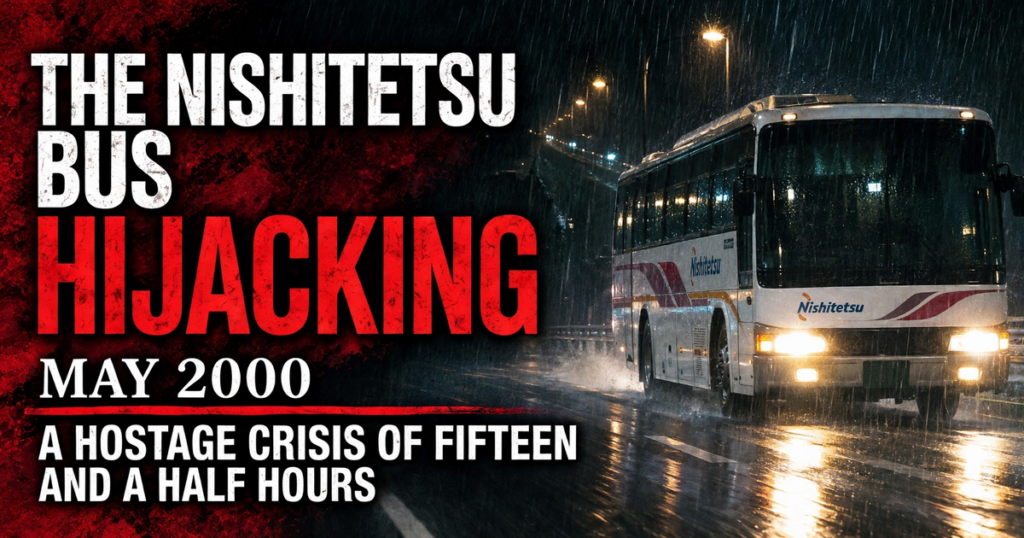
A scheduled highway journey became a hostage crisis
At around midday on May 3, 2000, a 17-year-old boy hijacked the Nishitetsu highway bus Wakakusa-go. The bus had left Saga Station Bus Center and was heading for Tenjin in Fukuoka City. Approximately twenty minutes after departure, the boy stood up near the front of the vehicle, displayed a large kitchen knife and announced that he was taking control of the bus. He ordered passengers to move toward the rear and directed the driver to leave the normal route. The passengers and driver were suddenly confined in a moving vehicle under the control of an armed teenager.
The driver was forced to travel away from the intended destination
The hijacker instructed the driver to change course from the Fukuoka–Tenjin route. The bus travelled from Kyushu onto the main island, passing through Yamaguchi Prefecture and continuing into Hiroshima Prefecture. The driver had to respond to road and traffic conditions while following the orders of a person carrying a knife. Police could not simply stop the bus at any point without considering the risk to the passengers. The vehicle remained under observation as the police attempted to manage the danger and communicate with the hijacker.
Passengers were attacked while the bus continued along the highway
During the journey, the boy threatened passengers with the knife and attacked several of them. Tatsuko Tsukamoto was stabbed and died. Yumiko Yamaguchi suffered serious injuries, including substantial blood loss, and other passengers were also injured during the incident or while escaping and being rescued. The National Police Agency's 2000 Police White Paper described the event as a bus hijacking involving five casualties. Contemporary reports did not always count injuries in the same way, depending on whether they included people injured during escape or rescue. The English record therefore retains the official total of five casualties rather than inventing a more precise breakdown.
Tsukamoto and Yamaguchi were at the centre of the human consequences
Yamaguchi later explained that she and Tsukamoto had boarded the bus to travel to a concert together. She was seriously wounded during the attack and recalled losing strength as she bled inside the bus. Tsukamoto, who had accompanied her, was killed. The incident is often summarised as a teenage boy hijacking a bus, but that description can obscure the experience of passengers who remained trapped for hours. Elderly people and children were among those on board. Some passengers were released at stops, some escaped through windows or other openings, and others remained hostages until the final police operation.
The bus moved through three prefectures as police followed it
The bus travelled from Saga through Yamaguchi and into Hiroshima. It stopped at parking areas and service areas during the standoff, and some hostages were released. Police continued to follow the vehicle while taking account of the danger that a sudden intervention could provoke further attacks. The incident was broadcast for many hours, and people across Japan watched the hostage situation unfold. The prolonged movement of the bus made the operation difficult: the police had to monitor its route, protect surrounding road users and wait for a situation in which they could intervene without exposing the hostages to an even greater risk.
Police entered the bus at Koya Service Area after about fifteen and a half hours
The standoff continued overnight. In the early morning of May 4, 2000, the bus stopped at Koya Service Area in Higashihiroshima, Hiroshima Prefecture. Police units entered the vehicle and secured the boy. The operation brought the hostage crisis, which had lasted approximately fifteen and a half hours, to an end. Video footage preserved by local television shows officers entering the bus amid smoke and taking the knife from the hijacker. After he was taken into custody, the matter moved from the immediate hostage response to the investigation and juvenile justice process.
The prosecutor's opinion did not determine the final juvenile disposition
The case involved conduct serious enough to raise the question of criminal prosecution. The Hiroshima District Public Prosecutors Office reportedly took the view that criminal disposition was appropriate. A psychiatric assessment was also conducted. However, the fact that the perpetrator was 17 did not automatically dictate that he would be sent to a criminal trial or automatically require a particular juvenile disposition. Under the juvenile procedure then in force, the family court had to consider the delinquent facts, the young person's mental condition and whether treatment and correctional education were more appropriate than adult punishment.
The Saga Family Court ordered medical juvenile training school on 29 September 2000
On September 29, 2000, the Saga Family Court ordered that the boy be sent to a medical juvenile training school. This was a protective disposition, not an acquittal and not a decision that no offence had occurred. Nor was it a prison sentence expressed as a fixed number of years. The family court concluded that medical treatment and correctional education were required within the juvenile system. The legal outcome must therefore be described as a medical juvenile training school disposition, rather than as a term of imprisonment imposed after an adult criminal trial.
The juvenile records were formally placed under special preservation
Court materials published in 2022 listed the bus hijacking as a juvenile case whose records deserved special preservation. The Saga Family Court had placed the case file and juvenile investigation records under a special-preservation procedure on March 2, 2016. The decision recognised the historical importance of preserving the records even though the perpetrator had been a juvenile. This later record-preservation step is separate from the 2000 disposition itself and does not change the legal result reached by the family court.
The internet nickname does not explain the cause of the hijacking
Because the boy had posted on an anonymous internet forum before the incident, the case became widely known online as the “Neo-Mugicha” incident. His internet activity received substantial attention, but the forum posts alone do not establish why he hijacked the bus. Reports also discussed his family circumstances, school attendance and contact with psychiatric services. The Japanese article cautions against reducing the offence to a single cause such as the internet. The confirmed account is that a 17-year-old hijacked a bus, killed Tsukamoto, injured other passengers and received a juvenile protective disposition.
Original Japanese record: 西鉄バスジャック事件|塚本達子さん死亡、15時間半の人質事件と医療少年院送致
Last updated:
Related articles
Case record
The Oita Family-of-Six Attack: A 15-Year-Old, the Juvenile Justice System and Destroyed Court Records
Case record
The Sasebo Elementary-School Classmate Killing: Satomi Mitarai and the Protective Disposition for an 11-Year-Old Child
Case record
The Omuta Four Murders: A Family's Robbery and Killing of Four Victims, and Four Death Sentences
Case record