
The Oita Family-of-Six Attack: A 15-Year-Old, the Juvenile Justice System and Destroyed Court Records
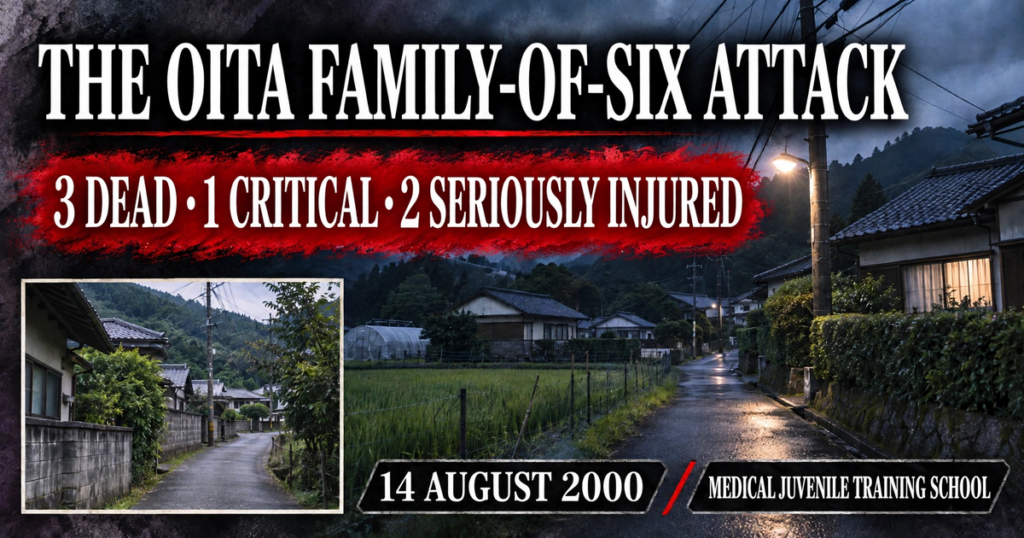
On 14 August 2000, a 15-year-old boy attacked six members of a neighbouring family in Notsu Town, Oita Prefecture. Three died and three survived with serious injuries. The Oita Family Court ordered his placement at Kyoto Medical Juvenile Training School in December 2000. The juvenile case records were later destroyed, prompting a Supreme Court investigation into the court's preservation procedures.
Introduction: A family attacked in Notsu Town
In the early hours of 14 August 2000, a 15-year-old first-year high-school student attacked six members of a family living next door in Notsu Town, Oita Prefecture, now part of Usuki City. Three family members died, one was critically injured and two were seriously injured. Police arrested him at 6:45 a.m. on 14 August 2000 on suspicion of murder and attempted murder.
He was dealt with by the Family Court and received a protective disposition, not a sentence in an adult criminal trial.
The attack and the immediate aftermath
The boy lived next door to the family. The Japanese article says that he entered the house through the bathroom area and attacked family members while they were asleep. It identifies a survival knife as the weapon; this translation does not repeat graphic details.
Six people were attacked. Three were found dead when police arrived. The other three were taken to hospital: one was unconscious and in critical condition, while two had serious injuries. The boy also sustained a minor injury during the incident. He was arrested on suspicion of murder and attempted murder. Those were the arrest allegations; the later Family Court disposition was a separate legal process.
The reported grievance between neighbouring households
The victim's family and the boy's family lived next door and had previously had contact as neighbours. The attack therefore involved households that knew one another, rather than strangers who had met by chance.
Contemporary reporting attributed to the boy a statement that he had been accused of looking into the family's bathroom about a week earlier. He reportedly denied doing so and said he resented being blamed. This was a statement reported during the police investigation, not a finding that the alleged peeping had occurred. Whether he had actually looked into the bathroom has not been established in the public material available for this translation. The precise motive cannot be treated as conclusively proven, especially because the Family Court record was later destroyed.
The Family Court's protective disposition
After the police investigation, the case was sent to the Oita Family Court. Under Japanese juvenile procedure, the Family Court examines both the alleged conduct and the young person's circumstances before deciding on a disposition. On 26 December 2000, at its second hearing, the court ordered the boy to be sent to Kyoto Medical Juvenile Training School.
Contemporary Asahi Shimbun reporting said that the court relied on a psychiatric assessment describing a severe conduct disorder. The reporting also stated that his capacity for criminal responsibility was affirmed despite the diagnosis. The court concluded that long-term specialised treatment and education were necessary, with the stated aim of addressing the boy's immature development and teaching the value of life. This was a protective disposition under the Juvenile Act, not a prison sentence imposed after an adult criminal trial.
A medical juvenile training school is an institution for juveniles who require specialised medical or therapeutic treatment as part of rehabilitation. It is distinct from an adult prison.
Later placement and the reported civil settlement
The Japanese article further states that he was later transferred to a special juvenile training school in the Kanto region. This is presented as a report made by the article, not as independently corroborated information.
The article also reports a civil settlement involving ¥240 million in compensation and a condition requiring the perpetrator to report personal information and related details until he turned 35. The Japanese article itself cautions that this account is supported only by a single Wikipedia source and has not been independently verified. The settlement amount and reporting condition should therefore be treated as unconfirmed, not as established facts.
The law in force when the attack occurred
The legal position requires precision. It is inaccurate to say that a 15-year-old was below Japan's general age of criminal responsibility: Penal Code Article 41 provides that a person under 14 is not punishable. The relevant restriction was instead in the Juvenile Act. Before the 2000 amendment, a Family Court could send a juvenile case to prosecutors for criminal proceedings only when the juvenile was at least 16 at the time of the offence. Because the boy was 15, that route was unavailable.
This did not mean that the Family Court could take no action. The juvenile system could impose protective measures, including placement in a juvenile training school. What was unavailable was transfer to prosecutors for a criminal trial and criminal sentence under the age threshold then in force.
The Juvenile Act was amended after the incident
The Diet enacted the Act Partially Amending the Juvenile Act and Other Laws on 27 November 2000. It was promulgated on 6 December and took effect on 1 April 2001. The amendment lowered the age for possible criminal disposition from 16 to 14. It also introduced a principle of referral to prosecutors for certain intentional offences committed by juveniles aged 16 or older that caused a victim's death, subject to a statutory exception where a protective disposition was considered appropriate.
The Notsu attack occurred on 14 August 2000, before the amendment was enacted or brought into force. The new provisions could not be applied retroactively. It is important to distinguish the lowered age for possible criminal disposition from the separate rule on principle referral, which applied to certain fatal offences committed by juveniles aged 16 or older.
The Family Court records were destroyed
In October 2022, Oita Broadcasting System (OBS) reported that the Oita Family Court had destroyed the juvenile case records relating to the incident. Judges had used the file to train judicial apprentices, and it had repeatedly been borrowed for use in judges' offices.
The Supreme Court's 2023 investigation report later described the administrative failure. Before the retention period expired, a meeting of court managers discussed whether the case should receive special preservation. They decided to consider it closer to the disposal date, but the discussion was not passed on to the next manager. When the disposal process took place, the approval list did not identify the case details, and the manager did not realise that the file was included. The matter was not referred to the chief judge for a decision on special preservation.
The report explains how the failure occurred but does not establish the precise date on which the records were physically destroyed. It would therefore be inaccurate to claim that they were destroyed before the ordinary retention period expired. What is established is that the court did not complete the required consideration of special preservation before disposal.
Later reforms to court-record preservation
The destruction of this and other juvenile files prompted a wider review of how Japanese courts preserve historically important records. The Supreme Court published an investigation report in 2023, and revised special-preservation procedures were introduced in 2024. The new approach allows records of historical or social importance to be considered for long-term preservation and provides for outside views to be taken into account.
These reforms did not restore the Oita Family Court file. Public reporting and the Supreme Court's report preserve some information about the case and the administrative process, but they cannot replace the destroyed juvenile record.
At a glance
Incident: Oita Family-of-Six Attack, also called the Notsu Town Family Attack. Date: 14 August 2000. Location: Notsu Town, Oita Prefecture (now Usuki City). Victims: six family members; three died, one was critically injured and two seriously injured. Suspect: a 15-year-old boy from the neighbouring household; his name is withheld. Arrest: 14 August 2000 at 6:45 a.m., on suspicion of murder and attempted murder. Disposition: Kyoto Medical Juvenile Training School, ordered by Oita Family Court on 26 December 2000 at its second hearing; the article states that he was later transferred to a special juvenile training school in the Kanto region. The court records were later destroyed; the Supreme Court investigated the handling in 2023.
Original Japanese record: 大分一家6人殺傷事件|15歳の少年への保護処分と少年法改正前夜、失われた審判記録
Last updated:
Related articles

Case record
The Kyotanabe Police Officer Murder: A 16-Year-Old Daughter and the Family Court's Decision Not to Transfer
Case record
The Sasebo Elementary-School Classmate Killing: Satomi Mitarai and the Protective Disposition for an 11-Year-Old Child

Case record
The Beppu Case of Murder and Attempted Murder Against Two University Students
Case record