
The Kitakyushu Hospital Director Abduction-Murder: 950,000 Yen Stolen, a 20-Million-Yen Demand and Two Executions
On November 4, 1979, hospital director Kaoru Tsuda was lured away in Kitakyushu by two men, Yoshiaki Sugimoto and Kazumi Yokoyama. They threatened him with a shotgun and a knife, injured him and took approximately 950,000 yen. They then made him telephone his wife and demand that she prepare a further 20 million yen. When the additional money could not be obtained, they killed Tsuda, dismembered his body and disposed of it at sea. Both defendants received death sentences, which became final in 1988, and both were executed on July 11, 1996.
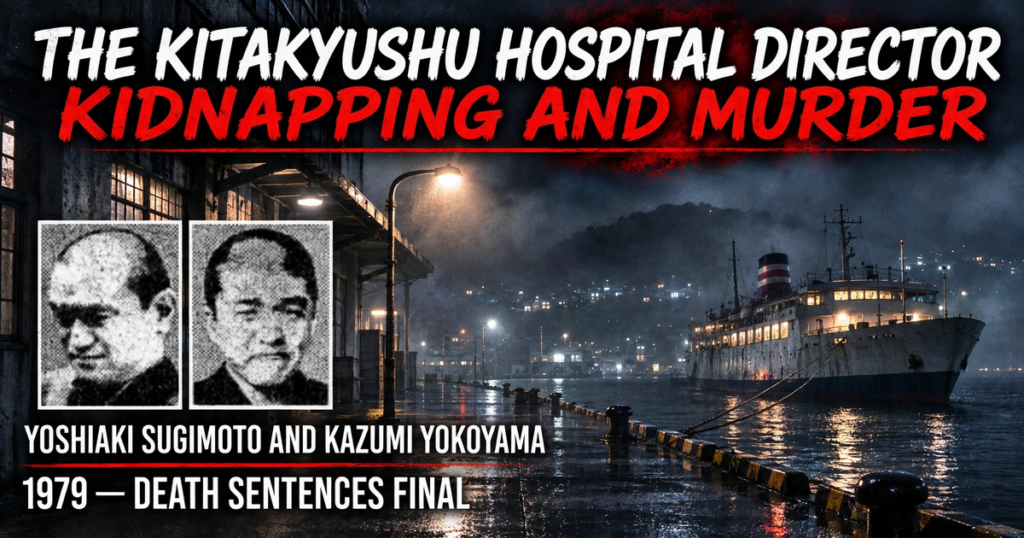
The victim was a hospital director lured through an acquaintance
On November 4, 1979, Kaoru Tsuda, who operated a hospital in Kitakyushu, was lured away by Yoshiaki Sugimoto and Kazumi Yokoyama. The two offenders used a relationship and an invitation to bring him within their control. The case is often called a kidnapping-murder in public accounts, but the formal Supreme Court case title was robbery-murder, abandonment of a body and attempted extortion. That distinction matters when describing the legal charges. The plan was to obtain a large amount of money and to conceal the crime after the victim had been killed.
The offenders used firearms and a knife to take approximately 950,000 yen
Sugimoto and Yokoyama threatened Tsuda with a shotgun and a knife. He was injured with a blade, suffering a wound that reached his lung, and the offenders took approximately 950,000 yen in cash that he carried. Tsuda asked for medical assistance, but the two men did not provide help. Instead, they kept him under their control for an extended period while the injury and loss of blood weakened him. The robbery therefore developed into a prolonged confinement and extortion scheme rather than ending when the cash was taken.
A further 20 million yen was demanded from the victim's family
The offenders made Tsuda telephone his wife and tell her to prepare 20 million yen. The money was to be brought to a designated location. The Supreme Court found that the additional demand was unsuccessful: the offenders did not obtain the 20 million yen. The formal charge included attempted extortion. The distinction between the money actually taken and the money they tried to obtain is important. The approximately 950,000 yen was stolen from Tsuda, while the further 20 million yen was the subject of an unsuccessful demand.
The court found that the murder was part of the original plan
After the attempt to obtain the additional money failed, Tsuda was already seriously weakened by his injury and the prolonged failure to provide medical assistance. The Supreme Court found that the two men killed him in accordance with their original plan. The killing was not treated simply as a sudden decision made because the ransom demand had failed. The court found that the offenders had planned from the outset to take the money, kill Tsuda and dispose of his body in order to reduce the chance that the crime would be discovered.
The body was dismembered and disposed of at sea
After killing Tsuda, Sugimoto and Yokoyama dismembered his body and disposed of it in the sea. The Japanese article explains that the disposal was planned as part of an effort to conceal the offence. Some parts of the body had not been found by the time of the judgment. The offenders' preparation for body disposal was considered an aggravating feature because it showed that concealment had been considered before the killing. The English record does not add details about the precise route or every location where remains were found unless established in the article.
The Supreme Court's formal description was robbery-murder, body disposal and attempted extortion
Although the case is commonly described as an abduction-murder, the Supreme Court's formal case name was “Robbery-Murder, Abandonment of a Body, Attempted Extortion.” The first taking of approximately 950,000 yen was robbery; the demand for a further 20 million yen was attempted extortion; the killing and disposal of the body were separate elements of the criminal conduct. The legal description helps prevent the word “kidnapping” in the popular case name from being mistaken for the exact charge title in the final judgment.
Both defendants received death sentences and the courts found their responsibility comparable
The Fukuoka District Court's Kokura Branch sentenced Sugimoto and Yokoyama to death on March 16, 1982. The Fukuoka High Court dismissed their appeals on March 14, 1984. The Supreme Court's Second Petty Bench dismissed their final appeals on April 15, 1988. The Court found that the two men had acted together and jointly carried out the offence. It did not consider one defendant's responsibility sufficiently lower to justify a different sentence. The fact that there was one homicide victim did not prevent death sentences being imposed on both defendants.
The sentences were carried out on the same day in 1996
Sugimoto and Yokoyama were executed at Fukuoka Detention House on July 11, 1996. Sugimoto was 49 and Yokoyama was 43. The executions took place approximately eight years after the Supreme Court's dismissal of their appeals. The two defendants' sentences had followed the same sequence: death sentences at first instance, dismissal of appeals and finality at the Supreme Court, followed by execution. The date of finality and the date of execution must not be treated as the same event.
The case is a rare example of two death sentences for one homicide victim
The case is notable because a single victim was killed but two defendants received death sentences. The Supreme Court's reasoning focused on the joint plan and the fact that the men acted together throughout the robbery, the attempted extortion, the murder and the body disposal. It also considered the financial motive and the advance preparation for concealment. The final result was two final death sentences, both carried out on July 11, 1996. The translation keeps the formal legal charges, the unsuccessful 20-million-yen demand and the two defendants' separate identities clear.
Original Japanese record: 北九州病院長誘拐殺人事件|津田薫さんから95万円を奪い2000万円を要求、2人に死刑
Last updated:
Related articles
Case record
The Cosmo Research Case: Two Abductions, One Hundred Million Yen and Litigation After the Executions

Case record
The Manila Insurance Murders
Case record
The Fukuoka Family of Four Murders: Three Defendants Tried in Japan and China, and the Evidence Behind Wei Wei's Death Sentence
Case record