
The Yuji-chan Kidnapping-Murder: A Six-Year-Old Lured with an Insect and a Ransom Demand of 20 Million Yen
On May 9, 1986, six-year-old first-grade pupil Yuji Honma was abducted while walking home from a friend's house in Koto Ward, Tokyo. Fusao Suda approached the child using his interest in insects, reportedly showing him a rhinoceros-beetle larva, and took him away by car. Suda killed the child and demanded 20 million yen from his family. Police traced the communications and the attempted ransom handover and arrested Suda. The Tokyo District Court sentenced him to death on December 22, 1986. Suda withdrew his appeal in January 1987, making the first-instance sentence final; he was executed in 1995.
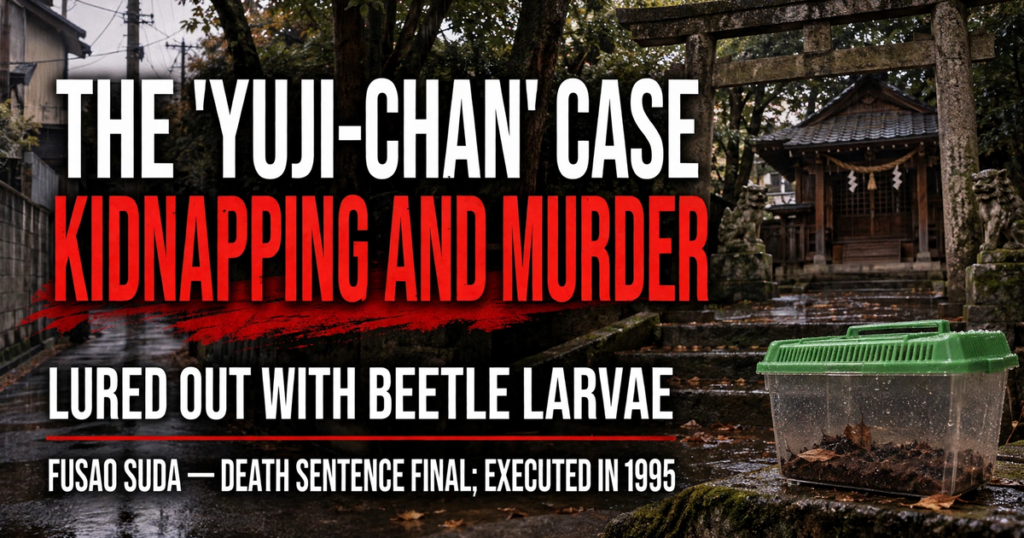
A six-year-old child was approached on the way home
The incident occurred on the afternoon of May 9, 1986, in Koto Ward, Tokyo. Yuji Honma, a six-year-old first-grade pupil, was walking home alone after visiting a friend's house. Fusao Suda approached him during that ordinary journey. Accounts of the case say that Suda used the child's interest in insects to attract his attention and showed him a rhinoceros-beetle larva. He then took the child away by car. The relationship between Suda and the family was not described as a longstanding family acquaintance or a prior dispute; the approach was made to obtain money.
The abduction was planned to obtain ransom
Suda needed money, with reports describing expenses associated with moving house and opening a restaurant. He planned to abduct a child and demand ransom. After taking Yuji, he contacted the family and demanded 20 million yen. The family was placed in the position of responding to the offender's communications while hoping that the child could be returned alive. The Japanese article records that Yuji had already been killed while the ransom demand continued. The demand was therefore not a negotiation intended to secure the child's safe release.
Yuji was killed after being taken away
Historical accounts cited by the Japanese article state that Suda killed Yuji after abducting him. They describe a blow to the head with a stone and strangulation. The English record does not reproduce further physical detail because it is not needed to understand the legal case. The essential fact is that the child was killed before the ransom had been collected. The later proceedings treated the abduction, murder and ransom communications as connected parts of a money-motivated offence.
The police investigation followed the ransom communications and handover
The police worked with Yuji's family to follow the telephone demands and the locations specified for the money. Reports describe the use of public telephones and changes in contact locations. Investigators monitored the attempted handover and followed Suda when he appeared in connection with the ransom. The investigation therefore focused not only on the disappearance but also on the communications and the physical opportunity to identify the person who came to receive money. Suda was arrested after coming into the police investigation through that process.
The case was prosecuted as kidnapping and murder
After Suda's arrest, the investigation addressed both the abduction and the killing. The legal charges included kidnapping for ransom, abduction of a minor and murder. The fact that the child had been killed before the family received the ransom demand was important to the court's assessment. The court was not dealing with a case in which a child was held until the family paid and then released. It was a ransom-motivated kidnapping in which the victim's life had already been taken.
The Tokyo District Court imposed death in December 1986
On December 22, 1986, the Tokyo District Court sentenced Suda to death. The judgment came a little more than seven months after the abduction. The court considered that the victim was only six years old, that he had been taken for financial gain and that his family had been made to respond to a ransom demand after he had already been killed. The fact that there was one homicide victim did not remove the seriousness of the planned kidnapping and murder of a young child.
Suda withdrew his appeal, so there was no appellate judgment
Suda initially appealed the death sentence. In January 1987, however, he personally withdrew the appeal. The Tokyo High Court therefore did not deliver an appellate judgment, and the Supreme Court did not review the case. The death sentence became final because the appeal was withdrawn, not because a higher court dismissed an appeal. This procedural distinction is important: a first-instance death sentence may become final when a valid appeal is withdrawn, and the case does not necessarily proceed to a second or third judicial decision.
The death sentence was carried out in 1995
Suda was executed at Tokyo Detention House on May 26, 1995, approximately eight years after his death sentence became final. The execution ended the criminal process against him. The Japanese article records no later retrial that overturned the conviction or changed the sentence. The final legal sequence is the Tokyo District Court death sentence of December 22, 1986, the appeal withdrawal in January 1987, and the execution on May 26, 1995.
The case remains a record of the ransom investigation as well as the homicide
The case is remembered not only because a six-year-old child was abducted and killed, but also because the police had to follow ransom communications while the family hoped for his return. The attempted handover became a key part of identifying Suda. The legal record must preserve both the human result and the procedural route: a child killed before the ransom was obtained, a demand of 20 million yen, a first-instance death sentence, an appeal withdrawn by the defendant and an execution in 1995. No Supreme Court ruling should be attributed to this case.
Original Japanese record: 裕士ちゃん誘拐殺人事件|本間裕士ちゃんを誘拐・殺害、須田房雄は控訴取下げで死刑確定
Last updated:
Related articles
Case record
The Tokyo–Saitama Child Abduction and Murder Case: Four Victims and a Long Trial Over Criminal Responsibility
Case record
The Yoshinobu-chan Kidnapping and Murder: A Failed Ransom Exchange and a Death Sentence

Case record
The Four-Prefecture Four-Murder Case: Twelve Years for the First Killing and Death for Three Later Murders

Case record